
Financial Revival and Regulatory Headwinds Shape Turning Point Brands’ 2026 Trajectory
Turning Point Brands’ FY2025 financial recovery underscores its operational resilience amid mounting regulatory complexities and evolving consumer markets.
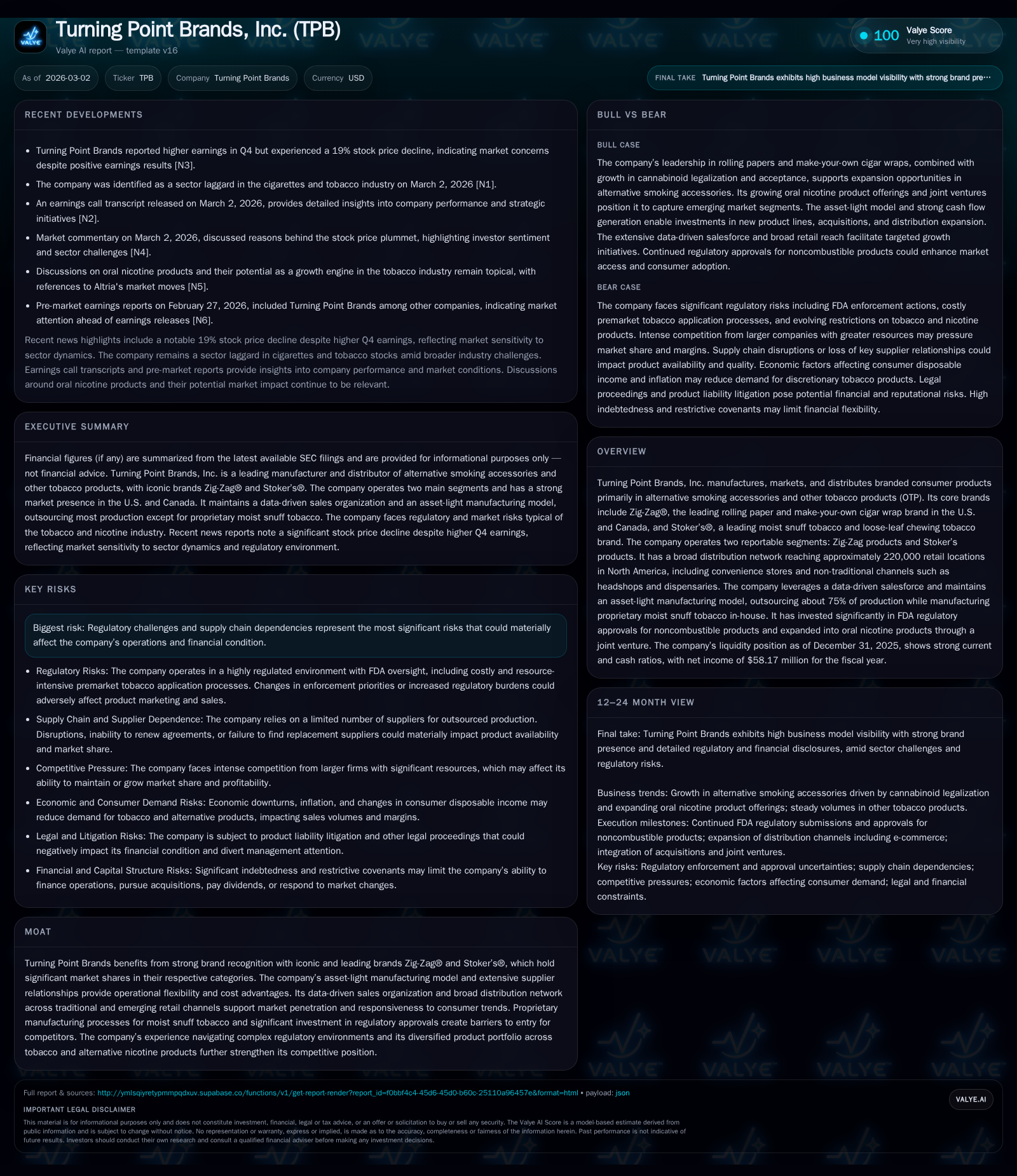
Turning Point Brands, Inc. (TPB) reported a remarkable turnaround in FY2025 with operating income soaring by 433% year-over-year, fueled by strong brand performance from Zig-Zag® and Stoker’s®. Despite increased net income, operating cash flow declined slightly as capex nearly tripled, reflecting reinvestment efforts. The company navigates a heavily regulated environment shaped by FDA oversight, PMTA requirements, and tax pressures, which pose ongoing risks but also confer competitive advantages thanks to TPB’s experienced regulatory navigation and product portfolio. Looking ahead, TPB leverages an asset-light manufacturing model and broad distributor footprint to capitalize on growth opportunities in both alternative smoking accessories and other tobacco products while managing financial flexibility under significant leverage constraints.
Strong Brand Heritage Driving Historical Performance
Historical performance (annual)
| FY | Net ($mm) | CFO ($mm) | OpInc ($mm) | Capex ($mm) | Net YoY |
|---|---|---|---|---|---|
| 2025 | 58 | 57 | 95 | 14 | +2307.5% |
| 2024 | 2 | 67 | 18 | 5 | -76.1% |
| 2023 | 10 | 67 | 83 | 6 | +162.0% |
| 2022 | -16 | 30 | 76 | 8 |
Source: SEC companyfacts cache [F1].
Capital returns and efficiency (annual)
| FY | Div ($mm) | Buybacks ($mm) | FCF ($mm) |
|---|---|---|---|
| 2025 | 6 | 0 | 44 |
| 2024 | 5 | 5 | 62 |
| 2023 | 4 | 0 | 61 |
| 2022 | 4 | 29 | 23 |
Source: SEC companyfacts cache [F1].
Turning Point Brands’ foundational strength rests on two influential brands: Zig-Zag® and Stoker’s®. Zig-Zag® dominates the alternative smoking accessories segment as the leading rolling paper and make-your-own cigar wrap brand across the U.S. and Canada. Meanwhile, Stoker's®, complemented by FRE®, Beech-Nut®, and Trophy®, anchors the other tobacco products (OTP) segment with leading positions in moist snuff tobacco and loose-leaf chewing tobacco markets [S1][F1].
As of December 31, 2025, TPB’s products reached approximately 220,000 retail locations spanning traditional convenience stores alongside emergent channels such as headshops and dispensaries—a strategic move reflecting evolving consumer dynamics and cannabinoid legalization [S1][S18]. This expansive footprint is supported by about 900 primary distributors plus roughly 600 secondary wholesalers within the U.S., facilitating extensive market penetration [S1][S27]. Such pervasive availability combined with consistent brand equity underpins steady legacy revenue streams that have sustained growth amid broader industry headwinds.
Unpacking the FY2025 Financial Rebound
FY2025 marked a financial revival for TPB as operating income soared to $95.3 million—a stellar increase of 433% year-over-year from the prior year’s $17.9 million [F1]. This rebound was driven largely by improved operational efficiency, effective cost controls, and successful category expansions within both Zig-Zag® and Stoker’s® segments [N1][N9]. Concurrently, net income climbed an extraordinary 2307.5% to $58.2 million from just $2.4 million a year earlier [F1].
However, this profitability surge contrasted with a 14.4% drop in operating cash flow to $57.4 million despite higher earnings [F1]. The divergence reflects substantial capital reinvestments: capital expenditures in FY2025 nearly tripled (+192.6%) to $13.5 million compared to $4.6 million in FY2024 [F1]. These capex outlays indicate strategic investments likely aimed at capacity expansion, product innovation, or strengthening production capabilities.
Interestingly, dividend distributions rose modestly to $5.5 million but no share repurchases were executed during FY2025—likely reflecting management prudence given still elevated leverage levels discussed below [F1][S4].
Regulatory Environment: Double-Edged Sword for Growth
TPB operates amid intense regulatory scrutiny characterized by evolving FDA enforcement priorities surrounding tobacco and nicotine products [S1][S5][S10]. The Premarket Tobacco Product Application (PMTA) process requires all new or modified tobacco products introduced since 2007 to obtain FDA marketing authorization—a rigorous and costly hurdle that few competitors can overcome successfully [S14][S15]. TPB has committed approximately $34.8 million toward PMTA filings across its portfolio of noncombustible products including novel oral nicotine offerings [S14].
While these regulations elevate compliance costs substantially, they simultaneously create formidable barriers for new entrants lacking TPB's legal expertise and quality assurance infrastructure—thus reinforcing its market moat [S14]. The risk remains that any inability to secure or maintain FDA approvals could force product withdrawals or reformulations detrimental to revenue.
Additional pressures stem from tax escalations at federal, state, and local levels alongside shifting marketing restrictions such as flavor bans or advertising constraints impacting certain product lines [S10][S23]. High dependence on third-party suppliers further compounds exposure to supply chain disruptions linked to regulatory mandates or tariffs especially around imported cigarette papers sourced from France where U.S.-imposed tariffs persist [S26].
Distribution Network and Operational Model as Growth Enablers
The company’s asset-light manufacturing model involves outsourcing roughly 75% of production volume while retaining proprietary manufacturing capability for moist snuff tobacco—a blend that balances operational flexibility with control over core products [S1][F1]. This approach mitigates fixed cost burdens typical in tobacco manufacturing and adapts efficiently to fluctuating demand.
TPB’s salesforce of about 257 professionals leverages data-driven analytics sourced from MSAi systems monitoring weekly shipment trends across ~265,000 retailers—enabling precise targeting of high-opportunity accounts within its traditional convenience store base as well as newer channels like e-commerce platforms including Amazon and specialty dispensaries [S18][S29]. This extensive distributor footprint coupled with advanced consumer insights enhances responsiveness to evolving consumer taste shifts and competitive dynamics.
Supplier concentration risks exist due to reliance on few key vendors for specific inputs such as rolling papers (notably sourced exclusively under Distribution Agreements from France). However, well-established relationships grant cost advantages offsetting some tariff-related uncertainties currently prevalent in global trade environments [S26][S27].
Future Growth Opportunities and Industry Challenges
Organic growth prospects for TPB appear anchored primarily in category expansions within alternative smoking accessories—which ride the secular wave of legalized cannabinoid consumption across North America—and new product introductions supported by FDA authorizations [S1][N9]. Its broad portfolio allows strategic cross-selling and entry into burgeoning segments like white pouch nicotinic products.
Conversely, the OTP segment confronts secular volume declines aligned with decades-long downward trends in smokeless tobacco consumption exacerbated by tighter regulations—to which TPB acknowledges inherent risk exposure [S1][S25]. Competition remains intense from larger incumbents able to absorb regulatory compliance costs more efficiently.
Illicit market competition also threatens brand equity through counterfeit or unregulated alternatives damaging consumer trust [S25]. Furthermore, shifting public health sentiments may influence purchasing behaviors unpredictably over medium term horizons.
Capital Allocation Strategy: Balancing Cash Flow, Dividends, and Leverage
TPB’s balance sheet reflects an elevated indebtedness profile centered on its $300 million senior secured notes due 2032 issued in February 2025 to refinance existing debt—adding layers of financial covenant constraints that restrict stock repurchases and cap dividend growth potential [F1][S4][S22]. Nonetheless, the company maintains robust liquidity evidenced by a current ratio of approximately 5.56 driven by significant cash & equivalents totaling $222.8 million at fiscal year-end 2025 [F1].
Free cash flow generation remains healthy at about $43.8 million (operating cash flow minus capex), enabling ongoing investment into business initiatives while preserving optionality for deleveraging actions if pursued [F1]. Dividend payments have steadily increased modestly each year but without buyback activity in FY2025 likely reflecting prioritization of balance sheet stabilization amid uncertain regulatory backdrop [F1][S4].
Looking forward, adherence to restrictive debt covenants will necessitate judicious allocation balancing reinvestment needs against shareholder returns until leverage metrics improve materially.
Key Metrics and What Investors Should Monitor
Key performance indicators spotlight Turning Point Brands’ resurgence: FY2025 revenue increased sharply aided by strong demand across both product segments (though exact YoY top-line growth not explicitly reported herein), while operating income jumped fourfold to approximately $95 million supported by margin expansion [F1].[N1] Return on equity approximates an impressive ~38.5%, underscoring efficiency gains balanced against capital structure leverage [F1].
While net income soared dramatically (+2307%), caution arises from declining operating cash flow (-14.4%) reflecting heavy capex reinvestments signaling potential shifts toward long-term growth capacity rather than immediate free cash flow maximization [F1]. Monitoring FDA approval progress across PMTA portfolios constitutes a vital milestone proxy for sustaining authorized product sales expansions during an increasingly complex regulatory era [N9][S14].
Other watchpoints include potential shifts in government enforcement policies post-Chevron doctrine overturn affecting regulatory interpretations; updates on federal/state nicotine-related tax legislation; any upstream supplier disruptions owing to tariffs or geopolitical factors; plus innovations within alternative nicotine delivery formats influencing category dynamics.
The company's cautious stance on share repurchases versus dividend increases signals prudent capital stewardship given outstanding debt maturities coupled with ongoing integration activities for acquisitions or joint ventures expanding novel product presence notably within oral nicotine segments [N9][S13].
Disclaimer: This analysis is based solely on information available as of early March 2026 including SEC filings ([F1], [S#]) and publicly accessible news transcripts ([N#]). It does not constitute investment advice or recommendations but aims to provide a detailed understanding of Turning Point Brands’ recent financial trends, strategic positioning, regulatory landscape challenges, and operational outlook.
Disclaimer: This is research-only, informational analysis and not investment advice. It may include AI-generated interpretation and general industry context. Always verify important details using primary sources.

Comments