
Tungray Technologies Strengthens Customized Manufacturing Amid Margin Pressure and Inflation Risks
2025 revenue growth driven by expanded standardized product sales offsets margin and net losses challenges.
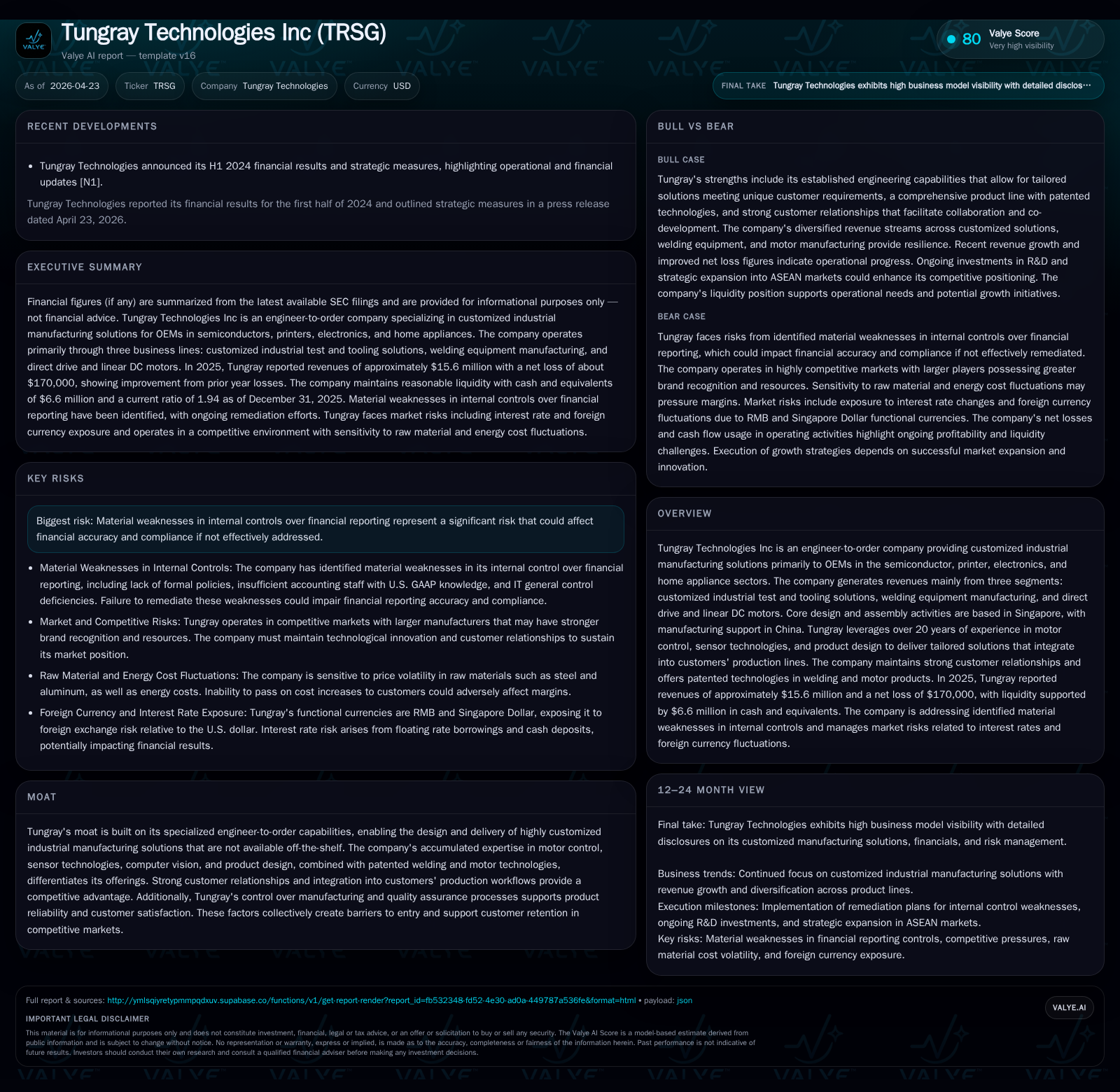
Tungray Technologies Inc reported a 22% revenue increase in 2025 to $15.6 million, fueled chiefly by growth in welding equipment and motor segments, despite ongoing net losses and operating income pressure. The company’s engineer-to-order model, focused on customized industrial solutions for OEMs in semiconductor and home appliance sectors, is supported by patented technologies and a dual manufacturing base in Singapore and China. Pricing pressures and inflation elevated costs compressed gross margins particularly in its customized product line. Tungray’s strategic growth hinges on expanding ASEAN sales, enhancing R&D efforts, and pursuing acquisitions amid a competitive landscape featuring diverse global players.
Recent Operating Update
The latest quarterly filing dated September 30, 2025 [S2] alongside the comprehensive annual report filed April 23, 2026 [S1] reveals Tungray Technologies executing a recovery in top-line performance following subdued results in the preceding year. The company posted revenues totaling $15.6 million for the full year ended December 31, 2025—a robust 22% increase over $12.8 million in 2024 [F1]. This rebound was primarily driven by stronger sales within the standardized product lines: welding equipment manufacturing and direct drive/linear DC motors.
Despite revenue growth, Tungray remains unprofitable at the operating level with a loss that narrowed from $656,000 in fiscal year 2024 to $242,000 in fiscal year 2025 [F1]. Net losses similarly improved but persisted at $170,000 [F1]. These results reflect inflation-related cost pressures outpacing the company’s ability to fully offset via price increases during high customer resistance [S1]. The firm acknowledges sensitive exposure to steel, aluminum, oil-based components as main raw materials whose price volatility injects risks into margins.
Business Model
Tungray operates an engineer-to-order (ETO) business model targeting OEM customers in semiconductors, printers, electronics, and home appliances [S1]. It leverages over two decades of domain expertise spanning motor control technologies, sensor technology integration, computer vision applications, and overall precision product design [S1]. The company's revenue streams are generated through three main business lines: customized industrial test/tooling solutions (67% of revenue), welding equipment manufacturing (15%), and direct drive/linear DC motors (18%) [S1].
The ETO model forces close engineering collaboration with customers who require highly specific manufacturing solutions that cannot be sourced off-the-shelf. Tungray’s Singapore subsidiaries spearhead the core design and assembly functions while Chinese subsidiaries handle volume manufacturing support [S1]. This bi-national footprint allows balance between tight customization control and cost-effective production.
Patent-protected technologies—such as machine vision-enhanced automated induction welding equipment—and proprietary motor designs underpin differentiation especially for products serving high-precision manufacturing activities like wafer fabrication and solar panel assembly lines [S10][S19]. The company also provides compatible control modules enhancing motor system precision.
Customers are mainly industry-leading OEMs with demanding quality standards seeking reliable integration with existing production workflows [S18]. Direct sales via an entrenched salesforce maintain tight customer feedback loops later reinforced by responsive technical service teams offering post-sale troubleshooting within stringent timeframes.
Industry Structure & Competitive Positioning
The sectors Tungray targets—customized industrial testing tooling; induction welding; direct drive/linear motor markets—are fragmented yet increasingly competitive globally [S22]. Key competitors include:
- Sigma Design & Engineering Pte Ltd: Focused on ETO customized solutions competing largely on capability parity but with Tungray claiming advantages in lead-time compression and cost efficiency.
- Regional motor manufacturers such as Qingdao Zhihe Precision Technology Co., Ltd. and Yokokawa Robotics (Shenzhen), which tend to have narrower product portfolios relative to Tungray’s diversified offering but compete on price points.
- Xiamen Inker Induction Co., Ltd., a Chinese producer servicing manual induction welding lines with imported technology comparable to Tungray’s manual units but lacking the latter’s advanced automation features using robotic arms and machine vision algorithms.
Tungray attempts differentiation through patented technology layers embedded into their machines' automation capabilities aligned with Industry 4.0 trends promoting interconnectivity and smart manufacturing platforms [S11][S22]. Strong customer relationships afford decision-level access aiding retention amidst this competition [S18]. Moreover, full control over design/manufacturing cycles boosts quality assurance—a key purchasing consideration for OEM customers under stringent reliability regimes.
Growth Drivers & Constraints
Tungray identifies several growth catalysts:
- Expansion into ASEAN markets beyond Singapore by establishing dedicated business units tailored to country-specific manufacturing clusters (e.g., automotive assembly in Thailand; electronics manufacturing in Vietnam) leveraging Singapore HQ expertise for technical support [S21].
- Increased investments in R&D totaling approximately $1 million per annum—up from $800k three years prior—to innovate next-generation motors, welding technologies, and smart manufacturing solutions underpinning longer-term competitive positioning [S3][S6].
- Talent development initiatives focusing on both recruitment of new engineers skilled in customization processes as well as ongoing internal training aiming to preserve their technical edge [S21].
- Potential strategic acquisitions targeting complementary intelligent manufacturing tech or scale advantages that can accelerate technological leadership or expand addressable markets [S6][S21].
Constraints limiting growth include:
- Persistent inflationary headwinds affecting labor costs and commodity prices (steel/aluminum/oil derivatives), constraining gross margins especially within the sensitive customized solutions segment where customer price resistance limits immediate cost pass-throughs [S1][S15].
- Market pricing pressure indicated by declining average revenue per customer—from $88k in 2023 down toward $64k at end of 2025—suggesting either competitive pricing tension or changing customer project scope impacting ASPs negatively [S10].
- Financial control weaknesses flagged as material risks may affect reporting reliability or compliance if not remediated promptly .
- Currency volatility risk given RMB is not freely convertible creating foreign exchange translation challenges; operational presence spans RMB- and SGD-functional currency zones exposing company results to FX fluctuations versus USD reporting currency [S11][S14].
- High dependence on repeat business from existing customers—246 customers served in FY25 compared to fewer previously—meaning both retention efforts and diversification are crucial but pose ongoing execution risks [S10].
What to Watch Next
Key milestones that could significantly influence Tungray's trajectory include:
- Execution of ASEAN expansion plans particularly setting up operations or localized sales teams targeting Vietnam and Thailand manufacturing hubs will test scalability of Tungray's direct sales model outside current geographies [S21].
- New product launches emerging from intensified R&D programs focusing on higher automation levels or precision improvements could reinforce pricing power if successfully commercialized.
- Management's ability to reverse decline in average revenue per customer by increasing value-added solution offerings or moving upmarket within existing client accounts would be critical for sustainable revenue quality improvement.
- Progress made addressing financial control shortcomings highlighted as material internal weakness will be key from governance perspective affecting investor confidence.
- Market reception toward recently introduced standardized product offerings such as medical component manufacturing technologies or contract repair services will indicate efficacy of diversification strategy beyond core ETO customized products where margins have slipped.
- Monitoring operational leverage effects: given increasing SG&A expenses partly driven by higher selling costs (+61%) alongside general/admin expense jump (+19%), efficiency gains or scale benefits must eventually materialize.
Financial Profile
Based on the most recent financial data through fiscal year-end December 31, 2025 [F1]:
Historical performance (annual)
| FY | Rev ($mm) | Net ($) | CFO ($mm) | OpInc ($) | Rev YoY | Net YoY |
|---|---|---|---|---|---|---|
| 2025 | 16 | -170277 | -3 | -241808 | +22.0% | +64.5% |
| 2024 | 13 | -480019 | -1 | -656100 | -10.8% | -156.0% |
| 2023 | 14 | 856536 | 0 | 1099675 |
Source: SEC companyfacts cache [F1].
Capital returns and efficiency (annual)
| FY | Div ($) | FCF ($mm) | ROE% |
|---|---|---|---|
| 2025 | 517140 | -4 | -0.9 |
| 2024 | 517140 | -1 | -2.8 |
| 2023 | 1275902 | 0 | 5.4 |
Source: SEC companyfacts cache [F1]. *Approximate ROE calculated for context; actual ROE not disclosed explicitly.
Tungray’s revenue growth resumed strongly after a decline in prior year; however profitability remains elusive with operating losses continuing albeit narrowed by more than half versus last year. The dramatic increase in operating cash outflow (-$3 million FY25 versus -$0.8 million FY24) combined with elevated capital expenditures (~$0.8 million up nearly +77%) suggests aggressive reinvestment possibly associated with capacity enhancements or R&D asset purchases.[F1]
Balance sheet liquidity appears adequate with a current ratio near two times (current assets around $18.7 million versus current liabilities approx $9.6 million) supporting short-term operational needs comfortably.[F1] Cash reserves exceeded $6.6 million at FY-end providing runway despite free cash flow deficits.
Continued net losses indicate it may take additional operational scaling or margin recovery initiatives before significant profitability re-emerges given rising SG&A expense burdens reflective of expansion efforts.[F1][S5][S7] Investors should scrutinize how soon new product introductions coupled with geographic expansion translate into improved operating leverage to reverse negative cash flow trends.
Summary Analysis
Tungray Technologies represents a niche player positioned strategically at the intersection of precision engineer-to-order industrial manufacturing solutions tailored for high-tech OEM customers primarily within Asia Pacific regions including Singapore and China. The company leverages proprietary intellectual property blended with decades of specialized engineering enabling differentiated products not easily replicated off-the-shelf—forming a moat based on customization expertise supported by patented welding technologies and custom motion platforms.
Revenue growth acceleration observed during fiscal year ended December 31, 2025 illustrates successful penetration beyond traditional core offerings into standardized product domains such as medical device components and aviation repair services which offer higher margins compared to historically dominant ETO segments experiencing pricing pressures.[S15][F1]
However, persistent net losses underscore that managing inflation-driven input cost escalation while contending with customer pushback on pricing raises remain critical challenges dampening profitability restoration prospects thus far.[S1][F1] Operating expense increases accompanying expansion efforts create further short-term burdens requiring effective scalability measures going forward.[S7]
Moreover, governance concerns linked to internal controls over financial reporting pose potential risk should remediation lag.
Tungray’s ambition leveraging Singapore as a technological innovation hub combined with extended outreach into ASEAN markets may unlock broader demand if execution rigor holds under competitive intensity posed by larger incumbents with established distribution channels.[S21][S22]
The company’s strong balance-sheet liquidity buffers near-term funding requirements but sustained free cash flow negatives signal need for vigilant working capital management amidst ongoing capex commitments.[F1]
Overall, Tungray embodies a sophisticated small-cap manufacturer evolving through transition stages marked by expanding market footprints aided by continuous innovation investment yet battling margin erosion linked primarily to macro cost factors alongside fierce competition requiring additional scale efficiencies for durable profitability creation.
Disclaimer: This analysis is intended for informational purposes only based on publicly available filings and does not constitute investment advice or recommendations.
Disclaimer: This is research-only, informational analysis and not investment advice. It may include AI-generated interpretation and general industry context. Always verify important details using primary sources.

Comments