
Tesla Inc.: Navigating Scale, Innovation, and Emerging Risks in Electric Mobility and Energy
Tesla remains a dominant force in electric vehicles and energy solutions, balancing operational scale with innovation amid industry and geopolitical challenges.
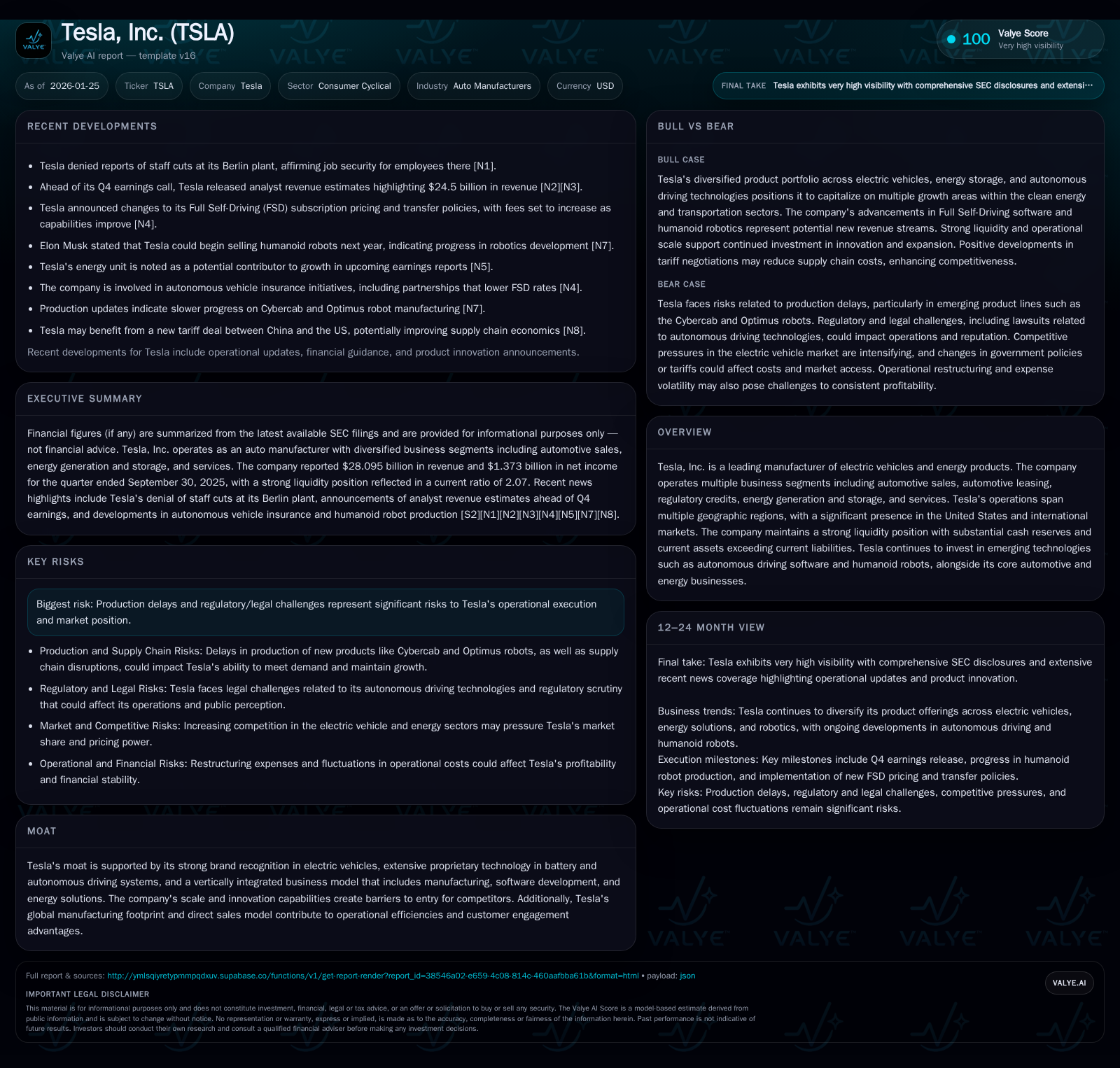
Tesla continues to leverage its vertically integrated model, proprietary technology, and global reach to sustain leadership in electric vehicles and energy products. Recent developments include robust revenue estimates ahead of Q4 2025 earnings and ongoing expansion in energy storage and autonomous capabilities. However, the company faces operational risks including production dynamics at key plants and evolving regulatory landscapes. The interplay of scale economies, supply chain constraints, and market competition will shape Tesla's near-term financial and strategic trajectory.
What Changed Recently
Tesla has publicized analyst estimates ahead of its Q4 2025 earnings call, highlighting an expected $24.5 billion in revenue, signaling continued robust demand across its automotive and energy segments [N1][N2]. This optimism contrasts with some market skepticism reflected in put options activity ahead of earnings, indicating hedging or cautious positioning by certain investors [N3]. Media scrutiny around Tesla's Berlin Gigafactory intensified when reports suggested job cuts; Tesla swiftly denied these claims, asserting workforce stability at that site [N11]. Concurrently, Tesla's energy generation and storage business is attracting increased attention as a growth vector, potentially diversifying revenue sources beyond vehicles [N4]. Additional supply chain developments include Syrah Resources securing extended graphite supply deals, critical for Tesla’s battery production scale-up [N10].
Business Model as a System
Tesla operates a vertically integrated business model spanning automotive manufacturing, energy generation and storage, software development, and services [S1][S2]. The automotive segment, the largest revenue contributor, encompasses vehicle design, manufacturing, and direct sales. Tesla bypasses traditional dealership networks, enabling tighter control over pricing, customer experience, and data collection. This direct-to-consumer sales model integrates with Tesla's software ecosystem, including over-the-air updates and Autopilot/Full Self-Driving (FSD) capabilities, creating recurring software revenue potential and customer lock-in.
The energy segment offers solar energy systems, energy storage products (Powerwall, Powerpack, Megapack), and energy services. Tesla bundles hardware with software for energy management, enabling residential and commercial customers to optimize consumption, storage, and grid interaction. Leasing and regulatory credits provide additional revenue streams. Tesla’s research and development investments focus heavily on battery chemistry, autonomous driving software, and longer-term ventures like humanoid robots, reflecting a strategic push into AI and robotics [S14].
Geographically, Tesla operates manufacturing facilities in the U.S. (Fremont, Texas), Germany (Berlin), and China (Shanghai), allowing it to serve key markets with localized production advantages and tariff mitigation [S7][N9]. The company’s balance sheet shows substantial liquidity, with cash and equivalents around $18 billion and a current ratio above 2.0, supporting ongoing capex and R&D [S3][S11].
Industry Map & Competitive Battlefield
Tesla occupies a leadership position in the global electric vehicle (EV) market, distinguished by its scale, brand, and integrated technology stack. The competitive landscape includes established automakers (Toyota, Volkswagen, GM) aggressively expanding EV portfolios, Chinese EV startups with local market advantages, and emerging players focusing on specific niches such as luxury EVs or commercial electric trucks.
Beyond vehicles, Tesla competes in renewable energy solutions against companies like SunPower, LG Energy Solution, and Fluence in energy storage and solar markets. The autonomous driving frontier is contested by tech giants (Alphabet/Waymo, Apple), traditional OEMs, and startups developing software-only approaches. Tesla’s integrated approach—combining hardware, software, and energy products—creates a multifaceted competitive moat but also exposes it to diverse regulatory regimes and technological risks.
Tariff developments, such as new China-U.S. trade agreements, could influence Tesla’s cost structure and competitive positioning, especially given its significant manufacturing base in Shanghai [N9]. Supply chain bottlenecks, particularly in battery raw materials like graphite and lithium, remain critical constraints industry-wide, with Tesla’s supplier relationships (e.g., Syrah Resources) being strategically important [N10].
Where the Economics Become Real
Tesla’s unit economics are shaped by capital-intensive manufacturing balanced against scale efficiencies and premium pricing power. Cost of goods sold includes raw materials (notably battery components), manufacturing overhead, and logistics. The company’s ability to optimize battery chemistry and production throughput at Gigafactories directly impacts margins [S8][S9].
Regulatory credits have historically boosted profitability by monetizing emission allowances but face potential future headwinds as other OEMs increase EV sales [S8]. Tesla’s operating leverage is influenced by ongoing R&D spending (~$3 billion annually) that supports software innovation and next-generation product development [S14].
Tesla’s direct sales model reduces dealer margins but requires significant investment in sales infrastructure and customer support. Leasing operations add complexity but provide recurring revenue streams and vehicle lifecycle control [S1]. Cash reserves and liquidity ratios enable Tesla to fund expansion and buffer supply chain disruptions, though capital expenditures remain substantial.
In the energy segment, product gross margins are still evolving as Tesla scales installations and services. The integration of software for energy management enhances value capture but depends on customer adoption and regulatory environments.
Diligence Questions / Disconfirming Signals
- How sustainable is Tesla’s current revenue growth across automotive and energy segments given intensifying competition and regulatory changes?
- What are the operational realities behind the reported workforce adjustments at Berlin Gigafactory, and could these signal broader production challenges?
- To what extent could supply chain constraints, particularly in battery materials, impede Tesla’s production ramp or margin profile?
- How resilient is Tesla’s software and autonomous driving roadmap in the face of regulatory scrutiny and competitive advances?
- What is the outlook for regulatory credits as an earnings driver given global emission policies?
- How effectively can Tesla scale its energy generation and storage business to meaningfully diversify revenue and improve margins?
- What are the implications of Tesla’s capital intensity and R&D spending on free cash flow generation in the medium term?
- How does Tesla’s direct sales model perform in new markets with different regulatory frameworks and consumer behaviors?
- Are there mounting legal or regulatory risks related to autonomous driving features and workplace practices that could affect Tesla’s operations?
This analysis synthesizes publicly available information and recent news to outline Tesla’s current operational, financial, and competitive context. It does not constitute investment advice or recommendations. Readers should consider additional sources and perform their own due diligence.
Disclaimer: This is research-only, informational analysis and not investment advice. It may include AI-generated interpretation and general industry context. Always verify important details using primary sources.

Comments