
Tesla Inc. in 2025: Scaling Electric, AI, and Robotics amid Macro Challenges
Tesla produced 1.66 million vehicles and expanded AI and robotics ambitions while navigating trade and competitive pressures in 2025.
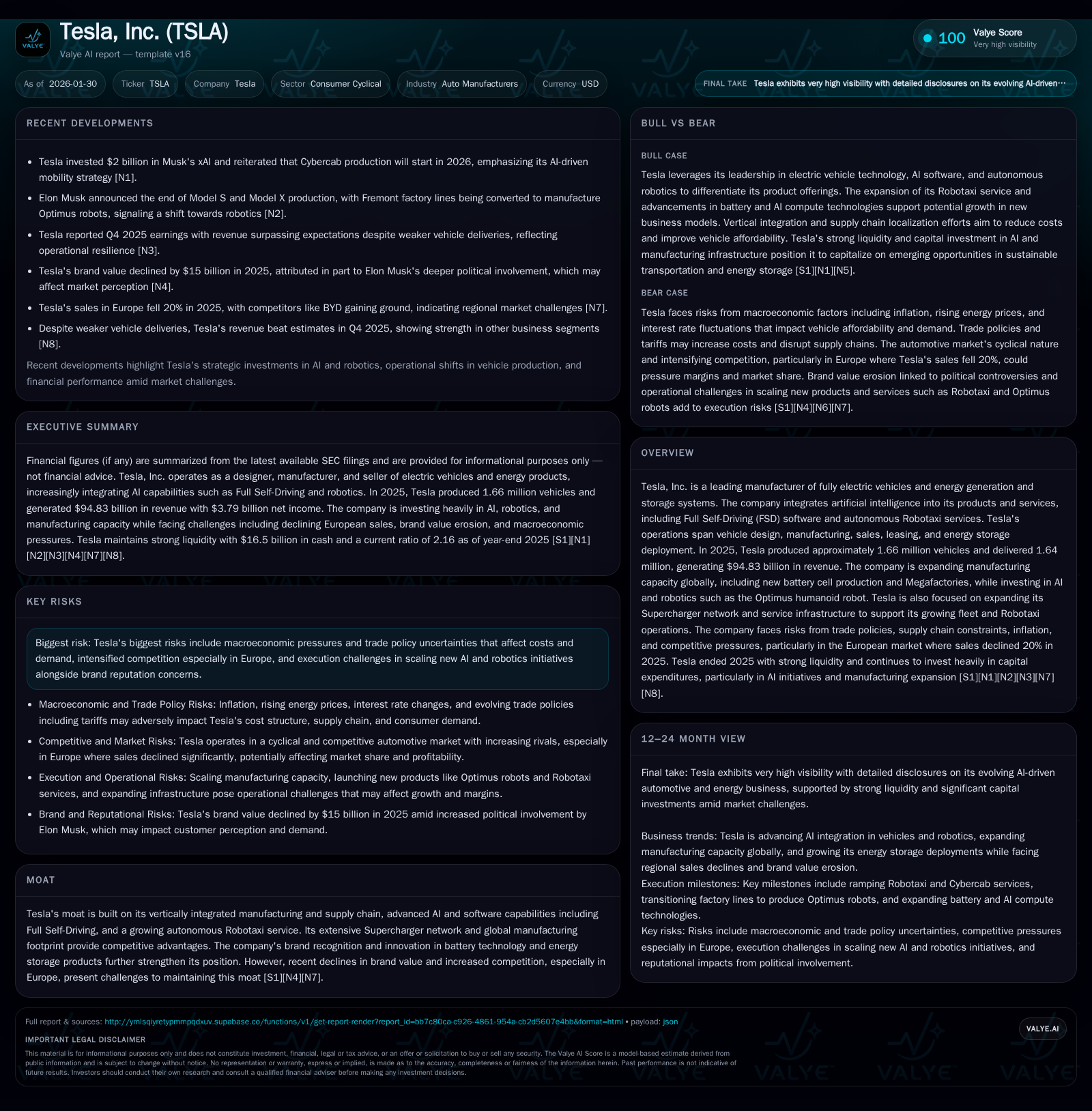
In 2025, Tesla delivered nearly 1.64 million electric vehicles generating $94.8 billion in revenue but saw declines in net income compared to the prior year. The company continued advancing its Full Self-Driving technology and embarked on commercializing its autonomous Robotaxi service with the Cybercab model. Tesla also aggressively invested in expanding manufacturing capacity, battery production, and energy storage deployments while pioneering AI innovations like the Optimus humanoid robot. However, the business faced headwinds from trade policy-induced cost pressures, supply chain constraints, and emerging competition, particularly in Europe.
Overview and Recent Performance
Tesla Inc., a leading auto manufacturer focused on fully electric vehicles (EVs), artificial intelligence (AI) software integration, and advanced robotics, completed a pivotal year in 2025 marked by robust vehicle production yet notable profitability declines. The company produced approximately 1.66 million cars and delivered about 1.64 million units globally generating revenues of roughly $94.8 billion—down slightly year-over-year by about $2.9 billion—and net income decreased by over $3 billion to $3.79 billion by year-end [F1][S1].
These financial outcomes reflect a complex operating environment with increased costs driven by global trade policy shifts including tariffs predominantly affecting Tesla's energy generation and storage businesses more than automotive operations [S1]. Nonetheless, Tesla’s operational cash flow remained strong at nearly $14.75 billion, supporting substantial capital expenditures of $8.53 billion focused on scaling manufacturing capacity while netting an increase in liquidity to over $44 billion [S1].
Vertical Integration and Manufacturing Scale
A cornerstone of Tesla’s strategy remains its vertically integrated supply chain and expansive global factory footprint. In 2025, the company extended its investments in Gigafactories incorporating proprietary battery cell production to alleviate reliance on external suppliers amid ongoing component shortages that plague the industry broadly [S1]. These expansions enable Tesla to better control costs, improve margins over time, and enhance vehicle output reliability.
Ramp-ups involved addressing historic production bottlenecks through process improvements and workforce training initiatives aimed at achieving tighter design tolerances coupled with high-quality standards essential for scaling mass-market EVs as well as automating deliveries [S1]. Moreover, Tesla's product mix has evolved to emphasize models embedded with its latest Full-Self Driving (FSD) software suites alongside work toward the soon-to-be-launched Cybercab—a purpose-built Robotaxi designed to propel fleet-based autonomous mobility services.
AI and Autonomous Vehicle Technology
The integration of AI into Tesla’s product ecosystem underpins differentiation within a rapidly commoditizing EV market. Full Self-Driving remains both a technological challenge and a long-term growth vector as comprehensive driver assistance evolves toward true autonomy [S1]. Since launching its Robotaxi service in June 2025 leveraging FSD capabilities across an interoperable fleet infrastructure, Tesla has sought to pioneer scalable ride-hailing revenue streams driven by AI-powered software rather than hardware sales alone.
Concurrently, Tesla is advancing development of the Optimus humanoid robot—positioned as a marquee robotics project intending commercialization beyond automotive use cases—further aligning the company’s identity with cutting-edge AI innovation [N4][N3][S1]. These areas present technical execution risks given nascent product maturity stages but also offer transformative upside if successful.
Energy Storage & Infrastructure Growth
Tesla’s energy generation and storage segment complements vehicle sales by addressing grid sustainability and consumer power needs through deployments totaling nearly 47 gigawatt-hours of storage capacity in 2025 alone [S1]. This business line is subject to heightened tariff impacts influencing cost structures but remains strategically important for diversifying revenue sources.
Expansion of Tesla’s proprietary Supercharger fast-charging network continues at scale to support an increasing EV fleet world-wide, enhancing customer convenience and indirectly reinforcing brand loyalty essential for sustaining premium valuations amidst intensifying competition [S1]. Service infrastructure build-out further facilitates maintenance efficiencies critical for fleet uptime especially as Robotaxi utilization increases.
Competitive Landscape & Market Risks
Tesla operates amid mounting industry headwinds from macroeconomic volatility including inflationary cost pressures aggravated by evolving U.S. trade policies notably impacting supply chains for key raw materials and components [S1]. Supply disruptions risk delivery delays that could undermine customer satisfaction or lead to costly manufacturing inefficiencies.
Competition has intensified with traditional automakers aggressively entering the electrification race enhanced by supportive European policies favoring established brands—this dynamic narrows Tesla’s moat predicated on early mover advantages [N7][S1]. Additionally, recent fluctuations in brand value highlight reputational sensitivity tied to both product quality perceptions and public scrutiny of CEO Elon Musk’s leadership style.
Elon Musk's Vision & Strategic Initiatives
Recent market speculation around potential mergers involving SpaceX signals broader ambitions to integrate space-based technologies with terrestrial AI applications underpinning Tesla’s future trajectory [N2][N12]. Although some investors express skepticism about such consolidation benefits for shareholders citing unrelated business synergies [N10], Musk’s approach emphasizes cross-domain innovation synergistic effects especially related to data center infrastructure supporting AI workloads potentially relocating partially off Earth orbit [N13].
Tesla’s recasting as a robotics and AI platform beyond just an automobile manufacturer reflects deliberate strategic repositioning consistent with emerging trends where software-driven services may ultimately eclipse hardware sales margins [N3]. This pivot entails execution risks but aligns with long-term aspirations to build an industrial-scale AI ecosystem encompassing vehicles, robots, energy systems, and data platforms.
Financial Health & Liquidity Position
Despite margin pressures evidenced in net income decline (to $3.79 billion), Tesla maintained strong liquidity characterized by cash & equivalents exceeding $16 billion at fiscal year-end along with a current ratio above 2.0 indicating solid short-term asset coverage against liabilities [F1]. Operating cash flows remain robust enabling reinvestment into R&D ($8+ billion capital expenditure) critical for maintaining technological leadership.
This financial profile supports Tesla’s ability to endure near-term challenges while funding ambitious production expansions globally including battery factories designed for next-generation chemistries aimed at improving vehicle range, reducing costs, and lowering environmental impact over time.
Summary Perspective
Tesla stands at a pivotal inflection point where traditional automotive manufacturing expertise intersects with frontier advancements in AI-driven autonomy and robotics technologies. The interplay between booming production volumes of EVs paired with nascent software-driven business lines like Robotaxi shapes a novel growth architecture still subject to external policy shocks and intensifying marketplace competition.
The company’s extensive vertical integration remains a competitive advantage helping offset supply chain vulnerability yet mandates disciplined execution on scaling new factories efficiently without quality compromises. Meanwhile mechanical innovation meshes with software sophistication yielding promising prospects albeit accompanied by substantial risk around timelines for broad consumer acceptance of autonomous fleets or robotic workers.
Leadership under Elon Musk continues to push boundaries imagining converged futures where terrestrial transportation seamlessly integrates data-rich AI ecosystems supported even by space infrastructure—an unconventional vision only feasible through scale-enabled experimentation across multiple sectors simultaneously.
This analysis is based on publicly available information including Tesla’s SEC filings through January 2026 combined with recent news coverage up to early February 2026. It reflects historical facts and forward-looking initiatives disclosed by the company without offering investment recommendations.
Disclaimer: This is research-only, informational analysis and not investment advice. It may include AI-generated interpretation and general industry context. Always verify important details using primary sources.

Comments