
Tile Shop Holdings Navigates Profitability Challenges and Strategic Transition
Tile Shop maintains a diversified tile product portfolio amid declining profitability and a strategic shift toward reduced public reporting.
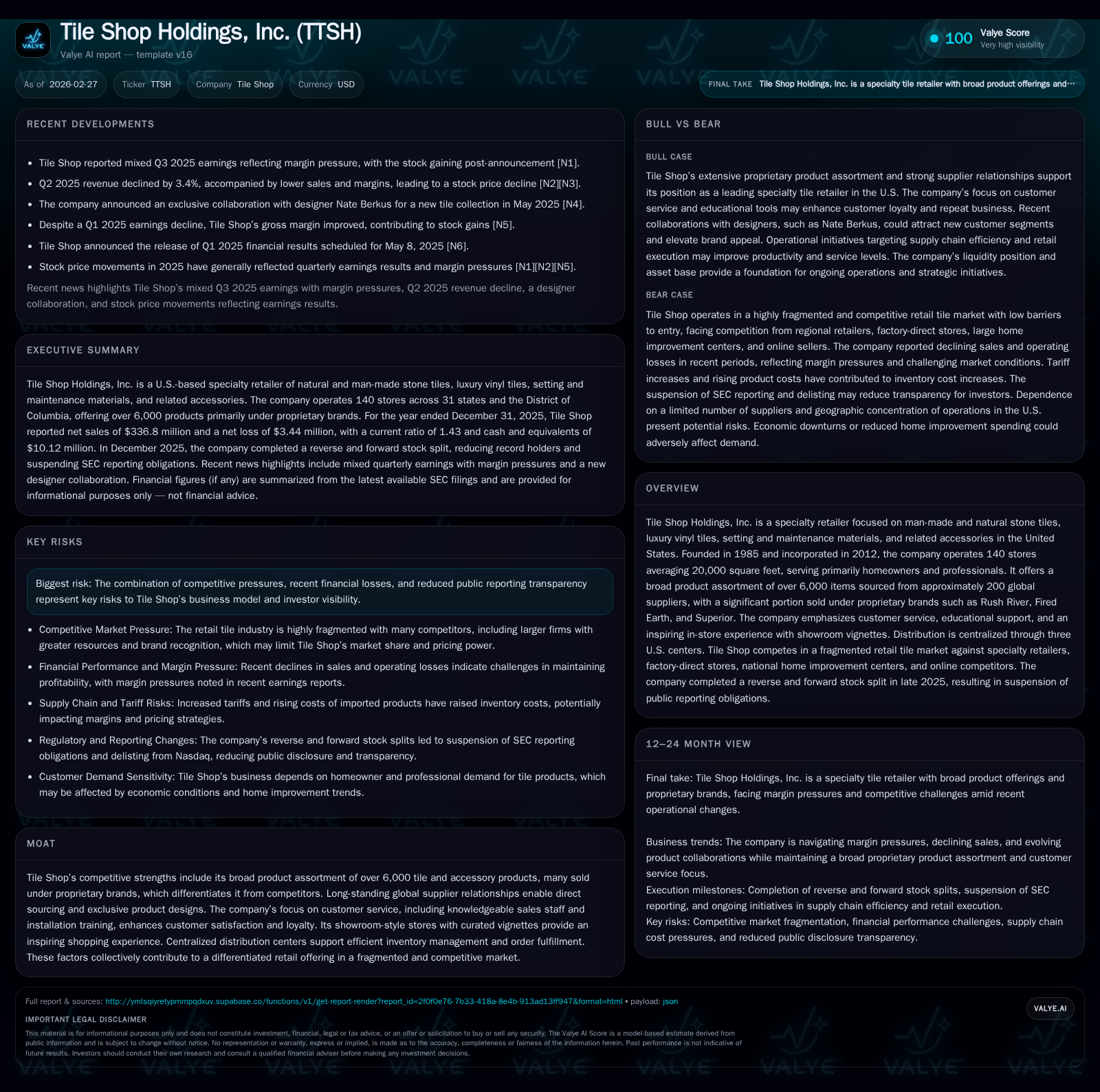
Tile Shop Holdings, a specialty retailer with over 6,000 tile SKUs and proprietary brands, reported top-line resilience through 2025 despite a revenue decline from $377 million in 2023 to $337 million in 2025. Profitability deteriorated sharply, with operating losses reaching $4.47 million and net losses of $3.44 million in 2025. The company executed a reverse-forward stock split and delisted from Nasdaq, substantially reducing its public shareholder base and SEC reporting obligations. Operating cash flow contracted significantly alongside ongoing capex investments, resulting in negative free cash flow in 2025. Tile Shop’s competitive strengths include broad product assortment, proprietary branding, showroom retailing, and centralized distribution. Future focus centers on supply chain efficiency and managing tariff-driven cost pressures amid a fragmented competitive landscape.
Diversified Product Assortment and Retail Experience
Tile Shop Holdings specializes in man-made and natural stone tiles alongside luxury vinyl tiles and related setting materials. Its portfolio comprises over 6,000 SKUs sourced from approximately 200 global suppliers spanning North America (44%), Europe (31%), Asia (17%), South America (7%), and Africa (1%) [S4][S21]. The majority of products are sold under proprietary brands including Rush River and Fired Earth for tiles, as well as Superior for setting compounds such as thinset, grout, and sealers [S1][S21].
The company operates around 140 stores averaging approximately 20,000 square feet each. Stores feature showroom vignettes replicating various living spaces like bathrooms and kitchens to inspire customers and facilitate product selection [S6][S9]. This experiential retail approach is supported by three strategically located distribution centers in Michigan, Oklahoma, and Virginia that centralize inventory management and internal manufacturing of setting materials [S4][S5].
Competition is intense within the fragmented retail tile market that includes regional specialty retailers, factory-direct stores, large home improvement chains, and online platforms [S9]. Tile Shop’s competitive edge derives from its broad product range, proprietary branding, high-touch customer service including installation training, and efficient distribution.
Historical Financial Performance Highlights
Historical performance (annual)
| FY | Net ($mm) | CFO ($mm) | OpInc ($mm) | Capex ($mm) | Net YoY |
|---|---|---|---|---|---|
| 2025 | -3 | 6 | -4 | 10 | -448.4% |
| 2024 | -1 | 27 | -1 | 15 | -198.7% |
| 2023 | 1 | 62 | 1 | 15 | -56.2% |
| 2022 | 1 | 3 | 3 | 14 |
Source: SEC companyfacts cache [F1].
Capital returns and efficiency (annual)
| FY | Buybacks ($mm) | FCF ($mm) |
|---|---|---|
| 2025 | 32 | -4 |
| 2024 | 30 | 13 |
| 2023 | 30 | 47 |
| 2022 | 30 | -11 |
Source: SEC companyfacts cache [F1].
Revenue declined modestly from $377 million in FY2023 to $337 million in FY2025 [F1][S1]. Operating income reversed from positive territory into losses exceeding $4 million by FY2025; net income followed this trend with losses widening to $3.44 million [F1].
Cash Flow Trends and Capital Expenditures
Operating cash flow contracted significantly from approximately $27 million in FY2024 to $5.79 million in FY2025—a decline of nearly 79%—while capital expenditures decreased by about one-third to roughly $9.56 million during the same period [F1][S18]. This dynamic led to negative free cash flow near $3.77 million in FY2025 after accounting for investment needs.
The company's liquidity position remains sufficient with current assets at roughly $113 million against current liabilities near $79 million at year-end FY2025 yielding a current ratio of approximately 1.43 [F1]. However, inventory increased slightly due to tariff-related cost inflation on imports as well as new product line expansions [S4].
Strategic Transition: Reverse Stock Split and Delisting
In late 2025, Tile Shop executed a reverse stock split at a ratio of one-for-3,000 shares immediately followed by an inverse forward split at the same ratio [S7][S8][S17]. This action reduced the number of shareholders below the SEC reporting threshold of three hundred holders enabling the company to deregister its common stock from Nasdaq and suspend SEC reporting obligations [S7][S8][S14].
Minority shareholders holding fewer than the minimum block size were cashed out at $6.60 per share totaling approximately $32 million aggregate payments [S7][S17][S25]. This transaction consolidated ownership among continuing shareholders including insiders who held significant stakes pre-transaction.
This strategic move reduces compliance costs associated with public company status but limits external transparency going forward.
Outlook: Addressing Cost Pressures Amid Competitive Fragmentation
While explicit guidance is unavailable due to deregistration status post-transaction, Tile Shop’s disclosed strategy emphasizes continued investment in human capital focused on customer service excellence; leveraging technology for operational productivity gains; enhancing supply chain transparency; maintaining an industry-leading curated product assortment across value tiers; and managing tariff-induced cost inflation pressures [S5][S6].
The company faces ongoing competition from both specialized tile retailers and large home improvement chains offering broader flooring options along with online competitors exerting pricing pressure [S9]. Sustained differentiation through proprietary branding coupled with superior customer engagement remains critical.
Capital Allocation: Share Repurchases Without Dividends
Tile Shop has consistently favored share repurchases over dividend payments since before its public listing era [F1]. In FY2025 alone, it repurchased shares valued around $32 million despite operating losses and negative free cash flow [F1], likely supported by cash reserves near $10 million year-end FY2025 combined with available credit facilities [F1].
No dividends have been paid recently reflecting capital allocation priorities centered on ownership consolidation rather than cash returns.
Human Capital as a Strategic Asset
The company employs approximately 1,196 people as of December 31, 2025—primarily store employees (924), distribution/manufacturing staff (187), plus corporate personnel (85) [S20]. Training extends beyond sales into installation techniques enhancing customer satisfaction while reducing returns or complaints.
Store managers oversee operations aligned with delivering inspirational showroom experiences designed to both engage customers emotionally and facilitate purchasing decisions [S6][S9][S20].
Monitoring Key Milestones Going Forward
Investors should watch for any reinstatement of public reporting if shareholder counts rise above regulatory thresholds; indications of margin recovery amid inflationary headwinds; enhancements in supply chain efficiency; digital commerce channel development; and shifts in merchandise mix responding to evolving consumer preferences.
Disclaimer: This report is based solely on publicly available information without offering investment advice or recommendations.
Disclaimer: This is research-only, informational analysis and not investment advice. It may include AI-generated interpretation and general industry context. Always verify important details using primary sources.

Comments