Take-Two Interactive: Earnings Miss Meets Elevated Fiscal 2026 Sales Forecast Amid Digital Evolution
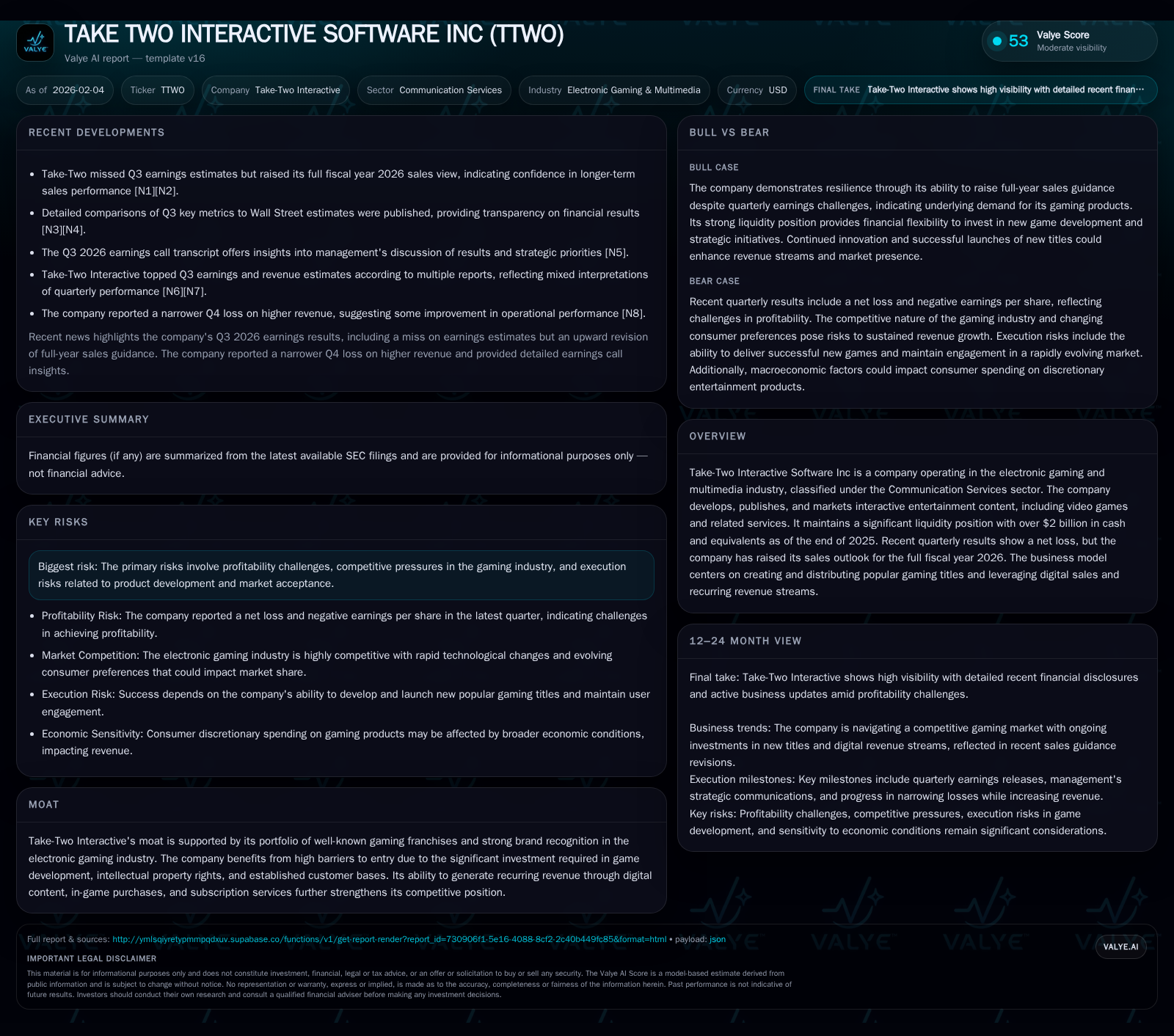
TTWO reported a Q3 earnings shortfall yet raised its full-year 2026 sales outlook, reflecting an evolving digital revenue mix and resilient franchise moat.
Take-Two Interactive’s recent Q3 results revealed a net loss contrasting with an uplifted FY26 sales guidance, underscoring complex near-term profitability challenges against a backdrop of expanding digital streams and strong liquidity. The company leverages its deep franchise portfolio and recurring revenue from digital content to navigate intense industry competition. Operationally, solid cash reserves and a current ratio of 1.14 provide strategic flexibility for development investments and potential acquisition opportunities, while product pipeline risks and execution hurdles persist as notable uncertainties.
A Tale of Two Results: Q3 Earnings Miss Versus FY26 Sales Outlook Upgrade
Take-Two Interactive’s latest quarterly report embodies a striking paradox: the company posted a $92.9 million net loss in its third quarter while simultaneously raising its sales guidance for the entire fiscal year 2026 [N1][N2][N3][S2][F1]. Revenues fell short of Wall Street expectations, attributed largely to elevated operating costs during the period. The adjusted earnings per share also trailed analysts’ estimates, highlighting short-term challenges with cost management and profitability. However, management’s upbeat tone on the earnings call reveals optimism anchored in growth prospects fueled by digital content expansion and franchise vitality [N5][S2]. This dual outcome underlines Take-Two’s transitional phase as it continues pivoting toward a higher-margin, recurring revenue model amid persistent industry headwinds.
Strong Cash Position as a Strategic Buffer and Growth Enabler
Financially, Take-Two remains robust with over $2.16 billion in cash and cash equivalents at quarter-end [F1][S2]. This liquidity cushion represents a vital asset in today’s capital-intensive gaming landscape where extended development cycles and innovation require substantial upfront investment. It provides the company flexibility to fund new game development, bolster live service offerings, or pursue acquisitions that complement its portfolio without immediate dilution concerns. Compared to current liabilities of approximately $3.24 billion, the company's current assets deliver a current ratio of 1.14—a reasonable buffer signaling that Take-Two retains operational health necessary to address near-term obligations while executing its strategic roadmap.
Franchise Strengths and Recurring Revenue: The Pillars of Take-Two's Moat
At the core of Take-Two’s competitive edge lies an established suite of gaming franchises that enjoy strong brand recognition in the crowded electronic gaming sector [valye_report_excerpt.moat][S1][S2]. These IP assets create high entry barriers due to the significant creative investment required to build new worlds and narratives that resonate globally. Such franchises underpin recurring revenue streams—principally through digital expansions like downloadable content (DLC), in-game purchases, and subscription services—which not only stabilize cash flow but also enhance customer engagement beyond initial game sales. This strategy aligns with broader industry trends favoring live service games that continuously monetize user bases rather than relying solely on discrete transactions.
Navigating Profitability Challenges Amidst Industry Competition
Despite its strengths, Take-Two faces material profitability challenges as indicated by recent negative net income and operating losses [valye_report_excerpt.risks][N1][F1]. Development costs have soared with technological advances demanding greater resource commitments for cutting-edge graphics, expansive gameplay mechanics, and multiplayer infrastructure. Additionally, intensifying competition from rivals vying for gamer attention imposes pricing pressures and necessitates elevated marketing spend. Execution risks loom large as delayed or underwhelming launches could erode market share gains. The company's acknowledgment of these hurdles underscores an intricate balancing act between investing for future growth and managing short-term financial metrics.
Analyzing Take-Two’s Product Pipeline and Market Reception Risks
Looking ahead, Take-Two’s product pipeline remains both a key opportunity catalyst and risk factor [valye_report_excerpt.risks][N5][S2]. While detailed forward-looking disclosures remain limited, management commentary suggests planned releases aiming to capitalize on franchise loyalty while experimenting with new concepts designed to attract diverse demographics. Yet, timing uncertainties—shifts in consumer tastes or unexpected developmental delays—pose threats to revenue rhythm. Market reception will be critical; consumer enthusiasm dictates monetization viability given the shift toward continuous engagement models rather than one-off purchases.
Balancing Current Assets and Liabilities: Liquidity and Operational Health
With current assets standing at approximately $3.68 billion relative to just over $3.23 billion in current liabilities [F1][S2], Take-Two’s liquidity position is sound but demands vigilance amidst sizeable working capital requirements inherent in content production cycles. Maintaining this equilibrium is essential for covering short-term debts while investing strategically in R&D, digital infrastructure, or brand-building initiatives—all crucial for sustaining competitive moats over time.
Investor Takeaways: What the Numbers Mean for TTWO's Valuation
For buy-side audiences dissecting these mixed signals, Take-Two represents a nuanced story shaped by an enduring moat but punctuated by near-term operational headwinds [N1][N3][valye_report_excerpt][F1]. The raised fiscal 2026 sales forecast signals belief in demand robustness largely driven by digital transformation efforts despite the Q3 earnings setback. Liquidity strength offers optionality for weathering volatility or opportunistic expansion, yet execution risk around product launches tempers enthusiasm. Ultimately, TTWO’s story illustrates how legacy content combined with forward-leaning digital monetization continues shaping industry incumbents’ paths amidst fast-evolving gaming landscapes.
This analysis is based on publicly available information including recent SEC filings, quarterly results, earnings call transcripts, and reported industry context as of early February 2026. It does not constitute investment advice or recommendations.
Disclaimer: This is research-only, informational analysis and not investment advice. It may include AI-generated interpretation and general industry context. Always verify important details using primary sources.

Comments