
Tevogen Bio Advances AI-Driven Immunotherapies Amid Nasdaq Compliance Challenges
Recent quarterly disclosures highlight Tevogen Bio’s clinical progress and AI platform maturation against financial and regulatory headwinds.
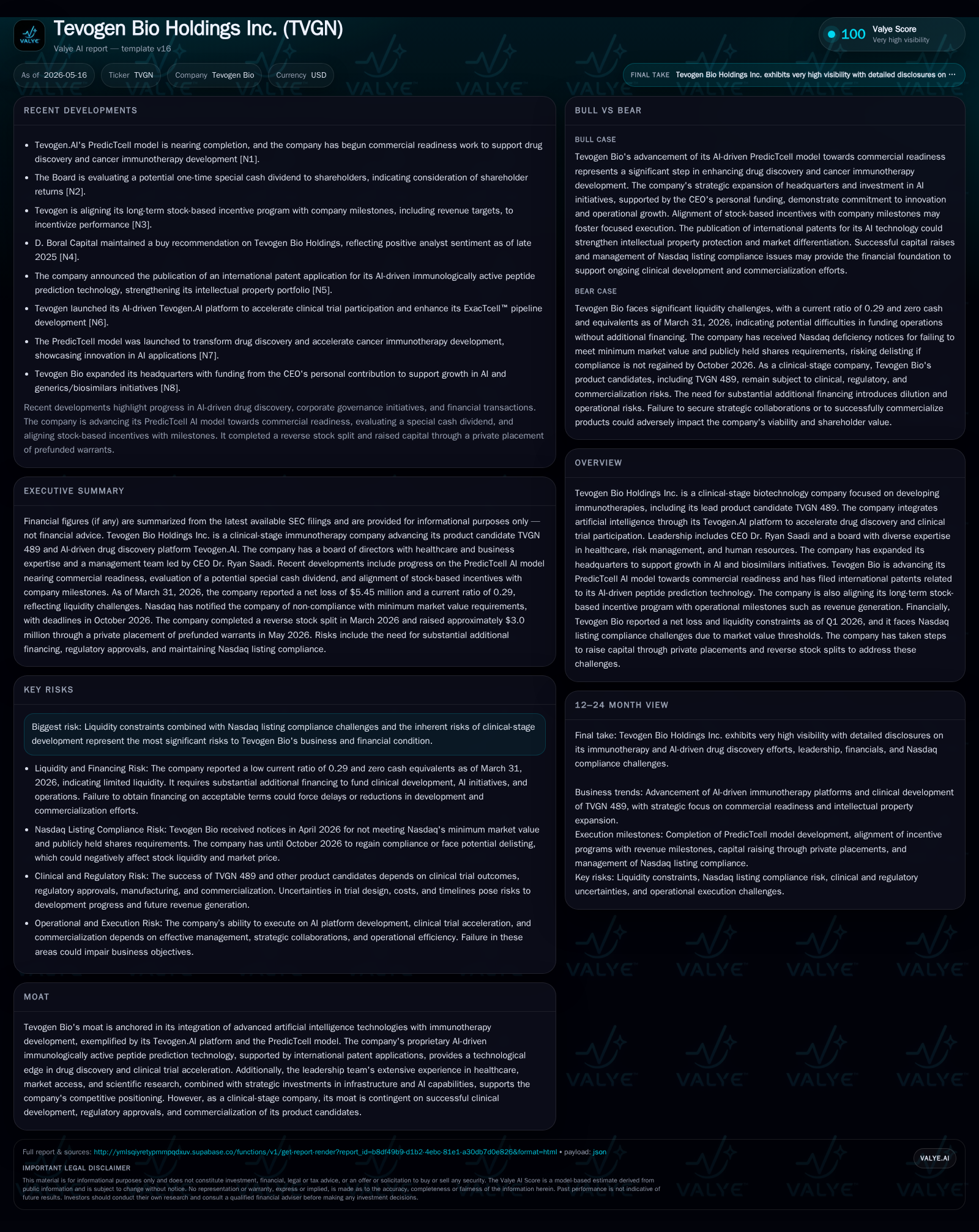
Tevogen Bio Holdings Inc. is progressing its lead immunotherapy candidate TVGN 489 alongside its innovative AI-powered drug discovery platform, PredicTcell. The company faces significant liquidity constraints and Nasdaq compliance challenges due to a low market capitalization and bid price, posing risks to its listing status. Tevogen's business model relies on clinical-stage advancement and eventual commercialization of immunotherapies enhanced by proprietary AI capabilities, though execution risks remain high. Near-term growth drivers include completion of clinical trials, regulatory submissions, AI platform commercialization, and strategic capital raises.
Recent Operating Update
Tevogen Bio Holdings’ latest quarterly filing dated May 15, 2026 ([S2]) underscores continued efforts advancing its lead immunotherapy candidate TVGN 489 amidst challenging funding dynamics. The company is simultaneously progressing its PredicTcell AI-driven immunologically active peptide prediction model toward commercial readiness ([N1]), signaling maturation of their integrated AI platform dubbed Tevogen.AI. This progress is structural for accelerating both drug discovery cycles and optimizing patient recruitment for clinical trials.
However, material regulatory pressure has emerged as Tevogen received notifications from Nasdaq indicating non-compliance with multiple listing standards: a market capitalization below $50 million and a closing bid price under the required $1.00 minimum ([S2][S12]). The company faces deadlines in October 2026 to restore compliance or risk delisting that could severely restrict future fundraising options.
The balance sheet at March 31, 2026 ([F1]) reveals ongoing liquidity constraints. The financial snapshot elucidates the precarious nature of Tevogen’s near-term liquidity situation. The absence of cash reserves coupled with large short-term liabilities underscores the imperative need to secure additional funding swiftly to sustain clinical programs and organizational operations.
Business Model
Tevogen Bio operates as a clinical-stage biotechnology company focused on discovering and developing novel immunotherapies using cellular therapeutics enhanced by proprietary artificial intelligence technologies. Its business model generates value primarily from advancing product candidates through costly preclinical and clinical stages towards regulatory approvals and eventual commercialization.
The flagship asset TVGN 489 exemplifies this approach—a cell therapy designed leveraging Tevogen’s ExacTcell technology aimed at treating certain cancers or immunological conditions [S1]. Parallelly, the company leverages the Tevogen.AI platform which incorporates machine learning algorithms—specifically the PredicTcell system—to predict immunologically active peptides. This technology supports both internal pipeline acceleration and potential out-licensing applications by identifying targets more efficiently than traditional methods.
Revenue streams remain contingent on milestone payments tied to successful clinical progression or licensing deals in addition to anticipated product sales post-approval. Given the nascent stage, Tevogen currently consumes capital primarily via R&D investment. The firm also invests in patent coverage globally for its AI-driven discoveries to protect competitive edges worldwide [S1].
Industry Structure and Competitive Position
Tevogen operates within the highly specialized cell therapy ecosystem intersecting precision oncology/immunology with AI-enabled drug discovery—a rapidly evolving segment with intense innovation but also significant hurdles. Competitors range from well-capitalized biotech firms developing CAR-T therapies to emerging startups integrating computational biology in immune modulation.
Tevogen’s moat roots itself in combining advanced artificial intelligence methods with proprietary cellular immunotherapy approaches—factors reflected in its international patent filings protecting peptide prediction capabilities ([S1]). Leadership expertise spanning scientific research, market access strategy (with CEO Dr. Ryan Saadi's background), and operational execution lends it credibility in managing complex translational pathways.
Nonetheless, the company's limited scale relative to industry giants presents challenges around speed-to-market, manufacturing scalability, reimbursement negotiations, and broad patient adoption dynamics.
Growth Drivers
- Clinical Pipeline Advancement: Progression of TVGN 489 through Phase I/II trials remains critical to proving safety/efficacy necessary for FDA or equivalent approvals essential for commercial viability ([S1]).
- AI Platform Commercialization: Near-term finalization of PredicTcell model's commercial readiness ([N1]) opens possibilities for partnering with pharmaceutical companies or direct application in accelerating pipeline assets—creating new revenue channels beyond product sales.
- Strategic Capital Raises: Given liquidity pressures supplemented by awareness around Nasdaq compliance risks ([S2]), successful equity offerings or collaborations will resolve funding gaps needed for continued R&D scaling.
- Intellectual Property Expansion: Ongoing patent filings protecting technical innovations cement barriers against competing entrants focusing on similar target identification algorithms ([S1]).
- Operational Milestones Aligned Incentives: Revisions in stock-based compensation tied explicitly to revenue milestones reflect management’s increased focus on transitioning from research stage toward generating sustainable income streams ([S1]).
Risks / Watchpoints / Growth Constraints
- Nasdaq Listing Threats: Failure to regain compliance may result in delisting which often reduces liquidity drastically while complicating access to capital markets essential for biotech development burn rates ([S2][S12]).
- Liquidity Constraints: The absence of cash reserves coupled with large short-term liabilities underscores vulnerability requiring urgent capital infusion or restructuring ([F1]).
- Clinical Development Risks: Biotech clinical programs face high failure rates; setbacks in trials may delay timelines or extinguish expected product revenues altogether ([S6]).
- Competitive Pressure: Larger rivals possess broader pipelines and financially stronger positions enabling faster commercialization cycles or aggressive IP challenges.
- Market Acceptance & Pricing: Even if products gain approval pricing power depends on reimbursement landscapes which can be unpredictable especially for pioneering cell therapies.
- Execution Complexity: Coordinating AI integration within biologics development demands substantial cross-disciplinary expertise which must scale alongside regulatory expectations.
What to Watch Next
Key milestones over the next several quarters include:
- Updates on clinical trial data readouts for TVGN 489 indicating efficacy/safety profiles that underpin potential NDA submissions [S1].
- Progress reports following end-Q2/Q3 regarding PredicTcell’s full commercial deployment capabilities including third-party collaboration announcements ([N1]).
- Monitoring initiatives taken by management to address Nasdaq deficiencies including possible share price support measures or market-making arrangements [S2][S12].
- Additional financing events such as PIPE transactions illustrated by recent Securities Purchase Agreements signed (e.g., May 2026 transaction with Patel Family LLP) which inject fresh capital essential for operations continuity ([S25]).
- Patent grants or challenges impacting exclusivity horizons around core AI-driven technologies [S1].
Financial Profile (Latest Snapshot)
Latest financial snapshot
| Metric | Value | Period |
|---|---|---|
| Cash & equivalents | 0 USD | |
| 2025-12-31 | ||
| Current assets | $2mm | |
| 2026-03-31 | ||
| Current liabilities | $7mm | |
| 2026-03-31 | ||
| Current ratio | 0.29x | |
| 2026-03-31 |
Source: SEC companyfacts cache [F1].
| Metric | Value | Period End |
|---|---|---|
| Current Assets | $2.14 million | |
| 2026-03-31 | ||
| Current Liabilities | $7.27 million | |
| 2026-03-31 | ||
| Current Ratio | 0.29 | |
| 2026-03-31 | ||
| Cash & Equivalents | $0 | |
| 2025-12-31 |
The financial snapshot elucidates the precarious nature of Tevogen’s near-term liquidity situation. The absence of cash reserves coupled with large short-term liabilities underscores the imperative need to secure additional funding swiftly to sustain clinical programs and organizational operations.
Disclaimer
This analysis is intended solely for informational purposes based on publicly available SEC documents and news as of May 16, 2026. It does not constitute investment advice or recommendations regarding any securities discussed herein.
Disclaimer: This is research-only, informational analysis and not investment advice. It may include AI-generated interpretation and general industry context. Always verify important details using primary sources.

Comments