
Two Hands Corp Faces Acute Liquidity Pressure While Reinvigorating Wholesale Food Distribution
Recent filings reveal zero revenue alongside a significant working capital deficit as the company seeks new capital to sustain its legacy and fintech ventures.
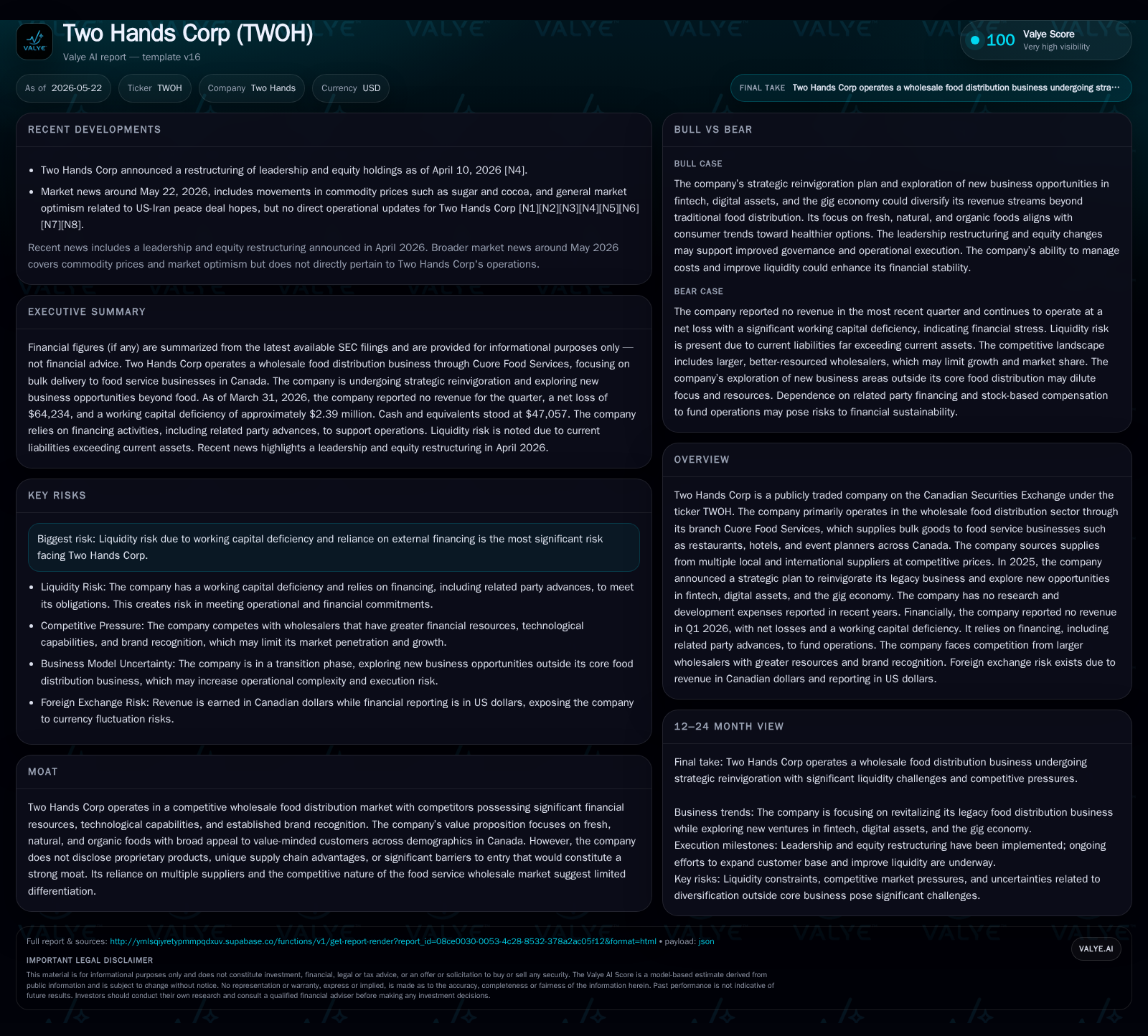
Two Hands Corp's latest quarterly 10-Q shows no revenue in Q1 2026 and a severe working capital deficiency of approximately $2.4 million driven by current liabilities dwarfing current assets. The firm’s core wholesale food distribution business, operated under Cuore Food Services, is being revitalized following a strategic shift announced in mid-2025. Simultaneously, management is exploring diversification into fintech, digital assets, and gig economy fields. Despite operational stagnation and intense competition, the company relies heavily on CEO advances and investor discussions for financing to maintain operations amid negative cash flows.
Recent Operating Update
The latest 10-Q filing dated May 22, 2026 ([S2]) underscores Two Hands Corp’s precarious financial and operating condition as it reported zero revenue for Q1 2026. Net loss stood at $70,284 compounded by a non-cash charge associated with changes in fair value of derivative liabilities amounting to $250,102. Cash reserves were modest at roughly $47,000 with a catastrophic working capital deficiency near $2.4 million — driven by current liabilities over $2.46 million vastly outweighing current assets of about $80,000 [F1].
Management notes reliance on CEO advances to fund organizational costs such as filing fees and professional services. Despite ongoing negotiations with investors regarding private loans and an equity line of credit, no binding commitments exist. The filing cautions that failure to obtain additional financing may jeopardize continued operations [S2][S6].
This report builds on the annual filing from April 10, 2026 ([S1]), where the company reaffirmed its path to rejuvenate its Cuore Food Services wholesale distribution branch after evaluating the legacy business thoroughly in June 2025. Parallel plans involve assessing growth opportunities beyond food service into fintech-related and gig economy spaces.
Business Model
Two Hands primarily operates through Cuore Food Services, focusing on wholesale distribution of bulk food goods—particularly fresh, natural, and organic products—to commercial customers including restaurants, hotels, and event planners across Canada ([S1],[S2]). Revenue emerges from bulk product sales; customers pay per volume ordered typically via purchase orders or contractual arrangements supporting recurring deliveries.
Products are sourced opportunistically using inventory present in the company warehouse combined with additional ad hoc acquisitions from multiple suppliers both domestic and international [S1]. This procurement approach enables competitive pricing but lacks exclusive supplier contracts or proprietary formulations that might protect margin or competitive positioning.
Revenue generation is constrained by operating expenses that outpace sales currently; operating losses have persisted with no reported R&D investment indicating a lack of pipeline innovation or product development to differentiate offerings further ([S1]). Pricing power appears limited given intense competition.
The company also accounts for derivative liabilities related to convertible notes impacting reported income via fair value adjustments each period ([S2]). Compensation often includes stock-based awards to conserve cash usage given ongoing liquidity shortages.
Industry Structure and Competitive Position
Wholesale food distribution in Canada is fragmented yet highly competitive with numerous players possessing extensive financial muscle, sophisticated logistics infrastructure, and strong supplier relationships. Two Hands operates at a small scale compared with these larger wholesalers who benefit from economies of scale driving lower unit costs and broader geographic reach.
Competitive forces are intensified by commoditized goods where switching costs for customers are low and value orientation dominates buyer behavior. The company’s emphasis on organic and fresh foods appeals broadly yet does not clearly create sustainable differentiation especially without proprietary supply chain advantages or technological capabilities mentioned in disclosures [S1].
Regulation plays a moderate role largely around food safety compliance but does not appear particularly restrictive nor a moat factor.
Growth Drivers
Two Hands aims to expand Cuore Food Services’ footprint across additional geographies within Canada while broadening its product offering focused on fresh and organic categories. Management believes that continuous delivery of "ever-changing value deals" can foster customer loyalty across income segments [S1], though tangible signs of improved sales traction remain unreported in filings.
Parallel strategic initiatives target explorations of opportunities outside traditional food wholesaling: digital asset ventures, fintech services, and potential participation in the gig economy ecosystem. These sectors suggest ambitions to diversify revenue sources beyond cyclical wholesale revenues; however, firm details remain scant about concrete projects or timelines ([S1],[S2]).
Operationally, efforts include improving cash flow through tighter accounts receivable management, diversified supplier purchases to reduce costs or availability risks, minimizing customer incentives that dilute margins, outsourcing delivery logistics for flexibility, and compensating personnel partially with stock awards instead of cash ([S24],[S25]).
Risks / Watchpoints / Growth Constraints
Liquidity is paramount risk facing Two Hands as it operates with a current ratio near 0.03 — an acute imbalance indicating inability to cover short-term obligations with existing liquid assets [F1][S2]. This underscores dependency on continuous funding from related parties (notably CEO advances) or external investors for operational continuity ([S2],[S6],[S15]). Failure or delay in raising capital could force operational cuts or cessation.
No reports indicate meaningful revenue generation recently despite business revitalization efforts per management commentary suggesting stagnant or declining volume/mix trends. High operating expenses relative to sales exacerbate negative cash flow alongside derivative expense volatility impacting earnings volatility.
Competitive pressures restrain pricing leverage; commoditized product lines lack defensible intellectual property or branding advantage possibly accelerating customer churn risks when faced with better-capitalized rivals.
The attempted diversification into fintech/digital assets introduces execution complexity outside core competencies which could dilute managerial focus without guaranteed returns.
Risks related to accounting estimates include valuation uncertainties for convertible debt derivatives influencing income statement swings making profit/loss analysis challenging ([S1],[S2]).
What To Watch Next
Monitoring Two Hands’ ability to secure new financing lines will be critical over the next few quarters; successful closure of private loans or equity issuance would offer vital breathing room for executing its operational plans ([S2],[S6]).
Key demand markers include any reported increase in revenue traction within Cuore Food Services—such as contract wins extending regional coverage—or expansion into adjacent food categories with higher margin potential as indicated by management’s intent.
Further clarity around fintech/gig economy ventures will be important; disclosures may evolve regarding partnerships, pilot programs or regulatory approvals enabling those business lines.
Operational execution milestones encompass improved working capital management reflected by shrinking receivables cycles or lower accrued payables alongside continued use of non-cash compensation mechanisms sustaining cash burn rates below historical peaks ([S24],[S25]).
Financial reporting updates on derivative liabilities' fair value impact will also influence perceived volatility risk for stakeholders.
Financial Profile (Latest Quarter Context)
The most recent quarter ending March 31, 2026 shows no revenue generation but net loss approximating $70,284 compounded by adverse changes in derivative liability valuations totaling over $250K further pressuring earnings ([F1],[S2],[S20]).
Liquidity metrics remain weak: cash balances near $47K are dwarfed by substantial current liabilities above $2.46M resulting in critical working capital shortages ([F1],[S2]). Total debt reported at prior dates appears nominal but related party advances accumulate as notes payable earning interest at 8%, underscoring funding dependence ([S13],[S20]).
Cash flow remains negative driven by operational outflows partially offset through financing activities centered on CEO loan advances ([S20]). The company's capacity to reduce operational losses sustainably is unproven given recent trends.
Overall, the financial profile reflects a distressed company attempting business model stabilization while addressing existential liquidity challenges.
This analysis assimilates information solely from publicly filed SEC documents up to May 22, 2026. It refrains from speculative forward-looking statements or investment advice and instead provides descriptive insight based on verifiable disclosures and industry context.
Disclaimer: This is research-only, informational analysis and not investment advice. It may include AI-generated interpretation and general industry context. Always verify important details using primary sources.

Comments