
Udemy’s AI-Led Transformation Boosts Skill Development for a Changing Workforce
Udemy leverages advanced AI technologies and an enterprise subscription model to drive profitable growth in workforce upskilling.
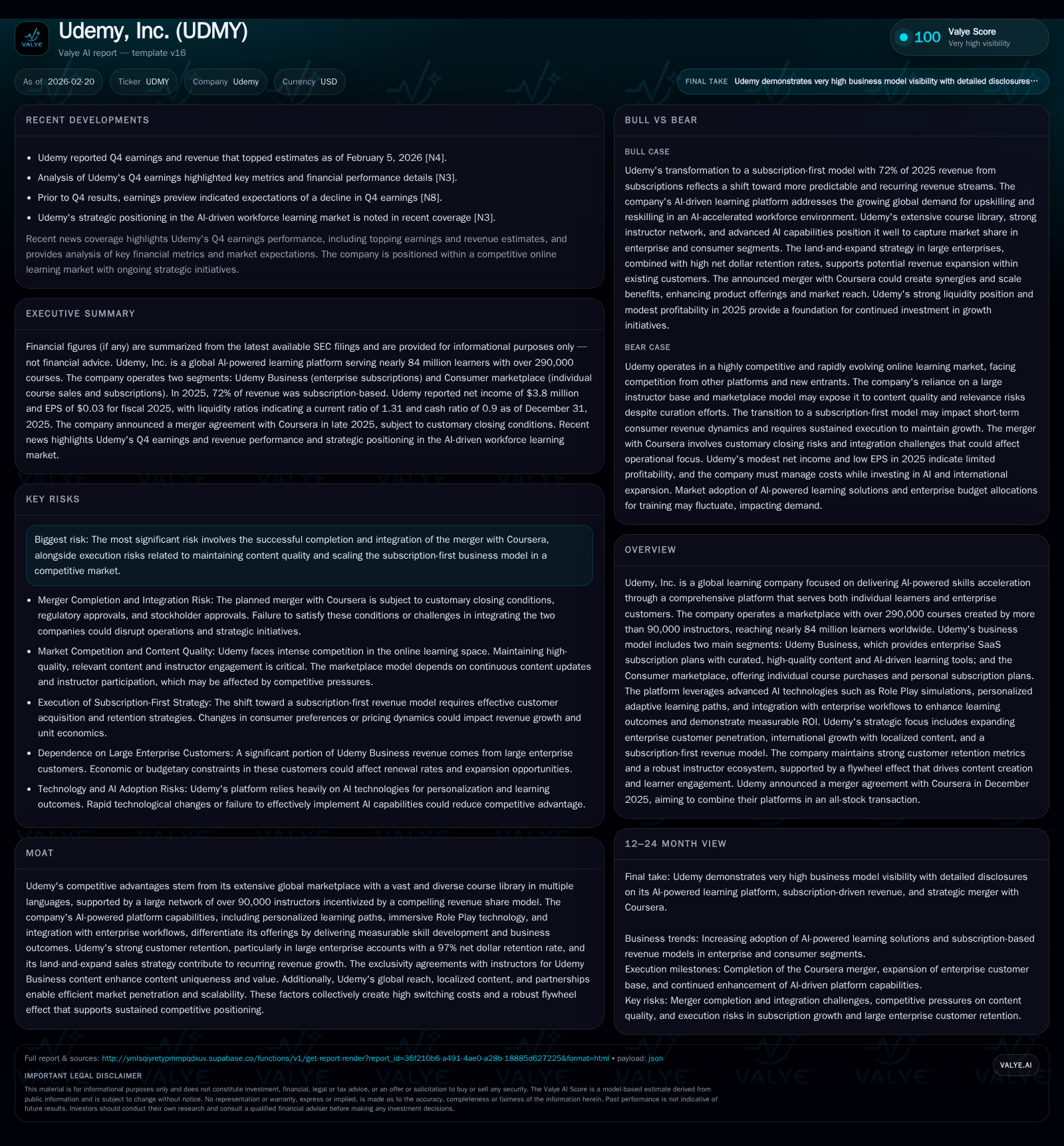
Udemy, Inc. has executed a strategic transformation in 2025 centered on its AI-powered skills acceleration platform, shifting towards a subscription-first model and expanding its enterprise business. The company achieved a notable operating income loss reduction of 95% year-over-year in FY2025 and reported positive net income for the first time since at least FY2022, while significantly improving operating cash flow. Its Udemy Business segment, featuring AI-driven personalized learning paths, Role Play simulations, and integration with enterprise workflows, fuels growth by addressing skill needs amid workforce digitization. The pending Coursera merger introduces execution risks but also potential market scale benefits. Capital allocation demonstrates increased capex investment to support R&D alongside substantial buybacks. Key risks include the successful merger integration and maintaining differentiated content quality.
Historical Growth Trajectory: Revenue Drivers and Profitability Progress
Udemy’s financial trajectory through fiscal year 2025 marked a decisive inflection point following its strategic reset towards an AI-driven skills platform combined with a subscription-first enterprise SaaS model [S1]. The company’s operating income improved dramatically; from a loss of $89.3 million in FY2024 to just $4.2 million negative in FY2025 — representing a remarkable 95.3% improvement year-over-year [F1]. This shift reflected enhanced operational efficiency alongside robust growth in recurring subscription revenues.
Moreover, Udemy swung to positive net income of approximately $3.8 million in FY2025 compared to losses exceeding $85 million one year earlier — reinforcing the turnaround narrative [F1]. Accompanying earnings progress was a substantial uplift in operating cash flow which climbed by over 65% YoY from $53 million to nearly $87.7 million [F1]. Capital expenditures rose sharply by about 152% YoY to $5.8 million as the company invested aggressively in technology infrastructure and platform enhancements aligned with AI capabilities [F1]. These stabilized cash flows underpin ongoing R&D investments critical to maintaining platform leadership.
Historical performance (annual)
| FY | Net ($mm) | CFO ($mm) | OpInc ($mm) | Capex ($mm) | Net YoY |
|---|---|---|---|---|---|
| 2025 | 4 | 88 | -4 | 6 | +104.5% |
| 2024 | -85 | 53 | -89 | 2 | +20.5% |
| 2023 | -107 | -2 | -122 | 1 | +30.3% |
| 2022 | -154 | -61 | -151 | 2 |
Note: Omitted columns lack sufficient annual XBRL coverage in the provided tags (need ≥2 annual points): Rev, Div. Source: SEC companyfacts cache [F1].
Capital returns and efficiency (annual)
| FY | Buybacks ($mm) | FCF ($mm) | ROE% |
|---|---|---|---|
| 2025 | 51 | 82 | 1.8 |
| 2024 | 150 | 51 | -43.2 |
| 2023 | -3 | -30.1 | |
| 2022 | -63 | -45.3 |
Source: SEC companyfacts cache [F1].
Note: Revenue data unavailable from provided tags.
These results stemmed from deliberate shifts away from transactional course purchases toward subscription models emphasizing predictability and engagement [S6]. Udemy’s growing focus on enterprises via its Udemy Business plan with seat-based subscriptions helped smooth revenue recognition profiles despite seasonal consumer segment fluctuations around holidays [S5]. Cash flow strength has also enabled the company to maintain disciplined capital deployment amid competition.
AI-Powered Platform and Enterprise Segments: Key Growth Engines
The beating heart of Udemy’s transformation lies in its integration of AI-enabled learning tools within both individual consumer offerings and notably its enterprise Udemy Business suite [S1], [S6], [S26]. The product suite now includes proprietary Role Play technology that simulates real-world scenarios — sales pitch exercises or leadership decision-making games — allowing learners dynamic practice opportunities rarely found outside bespoke training programs.
Further differentiation arises from personalized adaptive learning paths incorporating real-time adjustment algorithms based on learner progress metrics powered by machine learning models [S26], enabling tailored upskilling journeys across tech specialties as well as soft skills.
AI Transformation Packages launched in 2025 specifically target organizational AI fluency readiness and advanced technical growth tracks for engineering leadership — key areas given accelerating automation trends across financial services and manufacturing sectors adopting generative AI applications [S6], [S26]. These packages align with strategic vertical focuses where client digital transformations demand rapid workforce reskilling.
Udemy Business pricing is tiered by volume seats (Team Plan vs Enterprise Plan), feature functionality including cohort-based leadership development platforms enhancing engagement through instructor-led hybrid sessions described as “cohort-based learning,” empowering companies’ talent development strategies [S7], [S16]. Subscription seats expanded through land-and-expand selling strategies as seat penetration remains under 10% even within existing large clients despite retention rates above 93%, suggesting material upsell runway [S6], [S14].
Integration depth further strengthens marketplace stickiness: The Model Context Protocol server enables embedding Udemy’s learning modules directly into client-specific internal large language models (LLMs) like ChatGPT or Claude for contextualized querying inside familiar workflows—signifying advanced interoperability uncommon among competitors [S15].
Sector analysis reveals escalating demand for skill-based talent management solutions leveraging subscription seat expansions tied closely with measurable business outcomes — retention improvements tied directly to role-specific skill acquisitions validated via assessments and certifications provided by Udemy’s platform [S14], [S21].
Implications of the Coursera Merger: Integration Challenges and Opportunities
On December 17th, 2025 Udemy entered into an all-stock merger agreement with Coursera designed to create competitive scale amid burgeoning competition from traditional e-learning incumbents aggressively integrating AI as well as large tech firms entering workforce upskilling services [S3]. The transaction awaits regulatory clearance under the Hart-Scott-Rodino Act conditions reflecting typical scrutiny towards consolidation affecting customer choice and market power [S3].
The merger brings considerable opportunity given complementary course portfolios and geographic reach expansion yet also poses classical integration execution risks articulated explicitly in filings—specifically preserving distinct content quality standards across very large instructor bases while avoiding attrition or cannibalization amid merging subscriber bases [S19], [N5]. Furthermore,the challenge lies in harmonizing separate AI platform architectures without disruption.
It is prudent not to speculate on deal closure outcomes or synergies quantitatively but companies consolidating multi-vendor edtech ecosystems often face complex cultural & technical rationalization hurdles along with customer retention volatility during transition phases .
Outlook on Business Expansion and Market Penetration Prospects
Despite nearly reaching nearly 5,800 large enterprise customers worldwide—which represent rapidly accelerating cohorts—Udemy estimates underpenetration within these organizations at below single-digit percentages of total available seats highlighting potential for significant organic expansion through intensified account-based marketing operations focused on sector-specific learning needs plus multi-language localizations aligned with global transnational clients' footprints [S6], [S8], [N9].
Internationally the firm strengthened locale-specific adaptations introducing Arabic language content collections targeting Middle East & North Africa markets during 2025 that combine local payment methods plus currency adjusted pricing grounded on purchasing power parity—a vital approach given localized economic heterogeneity affecting online education uptake rates globally [S6], [S8]. These expansions broaden pipeline generation for both direct-to-consumer flows that feed Udemy Business leads plus direct sales teams empowered by refined customer success efforts segmented by organizational complexity tiers (Self-serve to High Touch Managed Services) ensuring customized onboarding & ongoing adoption reinforcement methodologies driving retention gains above industry averages at scale [S10], [S14].
Upside growth catalysts comprise extension of new AI fluency offerings tapping surging workforce digital transformation demands—as evidenced by accelerating uptake within financial services & manufacturing verticals that are aggressively deploying generative AI capabilities requiring holistic re-skilling initiatives across multiple functional roles simultaneously [N9], [S6], confirming alignment with macro labor market retooling trends projecting ~40-60% skill set evolution over next five years globally per World Economic Forum studies referenced by Udemy management narratives [S1].
Seasonality considerations continue influencing booking patterns favoring Q4 peaks especially within Consumer segments; however subscription revenue stability counters quarterly volatility over time supporting structured forecasting analyses albeit explicit forward guidance remains undisclosed prompting attention on deferred revenue movements versus bookings reported each period typical for SaaS transitions moving from transactional models toward annual seat commitments driving revenue deferrals but enhancing long-term ARR visibility alike core enterprise software deployments.
Capital Allocation Review: Evaluating Udemy’s ROE, Cash Flow Improvements, and Share Repurchases
Financial stewardship reflects a nuanced balance between aggressive buyback initiatives totaling approximately $51 million repurchased common stock during FY2025 alongside judicious reinvestment via capital expenditures swelling more than twofold year-over-year demonstrating commitment to enhancing core platform capabilities essential for sustaining competitive differentiation supported by proprietary AI tooling investments plus expanding immersive learning formats such as Role Play laboratories detailed elsewhere in filings (capex up from $2.3M to $5.8M) [F1].
Operating cash flow improvements covering cash conversion surged substantially yielding positive free cash flow approximating $81.9 million—calculated as CFO minus Capex—helping improve liquidity buffers given volatile industry dynamics while enabling flexible capital deployment strategies moving forward even amidst uncertain macroeconomic backdrop faced over recent years before this turnaround phase was reached.
Return on equity posted low but positive near ~1.8%, a significant swing versus previous negative double-digit levels consistent with recent profitability attainment though still moderate for growth-stage technology firms aiming eventually for double-digit returns commensurate with innovation cycles typical in edtech sector evolution ([F1] approximated calculation based on net income / equity).
Buybacks warrant careful contextual framing: sizable repurchases amounting almost equally split relative to capital expenditures but possibly constraining war chests should merger-related costs or unexpected integration investments arise indicating prioritization of shareholder value capture balanced against conservative liquidity preservation outlooks.
Risks Impacting Long-Term Strategy Execution
Principal risk factors revolve around successful consummation and operational integration of the Coursera merger which simultaneously offers scale benefits but carries high execution complexity common in tech consolidation environments including cultural alignment challenges alongside technology platform harmonization uncertainty potentially impacting service continuity or slowing innovation pace post-combination[S19],[S28],[N5].
Market positioning risks include maintaining rigorous content exclusivity enforcement pivotal for Udemy Business uniqueness given contractual clauses requiring instructors’ exclusivity while embedded content curation mandates high ratings thresholds necessitate continuous monitoring lest quality drop-offs provide openings for competitors especially generative AI entrants offering novel content creation channels competing for learner attention[S25].
Balancing evolving consumer business segment transformations shifting towards subscriptions also introduces near-term recognition timing variances alongside incremental unit economics pressures compounded by increasing competition fueled by both traditional e-learning providers advancing their AI capabilities plus general purpose AI offerings presenting free or low-cost alternatives[S11].
Macro environment risks such as shifts in global corporate training budgets or adverse regulatory developments related to privacy or antitrust scrutiny around mergers remain relevant uncertainties necessitating vigilant strategic adjustments moving forward.
This analysis relies exclusively on cited public disclosures including SEC filings dated through early calendar year 2026 and reputable news sources contemporaneous with this report's publication date without speculative extrapolations beyond disclosed data points.
Disclaimer: This is research-only, informational analysis and not investment advice. It may include AI-generated interpretation and general industry context. Always verify important details using primary sources.

Comments