
Ulta Beauty, Inc. (ULTA) — Strategic Growth Amid Competitive and Operational Challenges
Ulta Beauty’s extensive footprint and loyalty-driven multi-channel model support steady revenue generation, but lease obligations, evolving consumer preferences, and international expansion risks require nuanced execution to sustain growth and operational leverage.
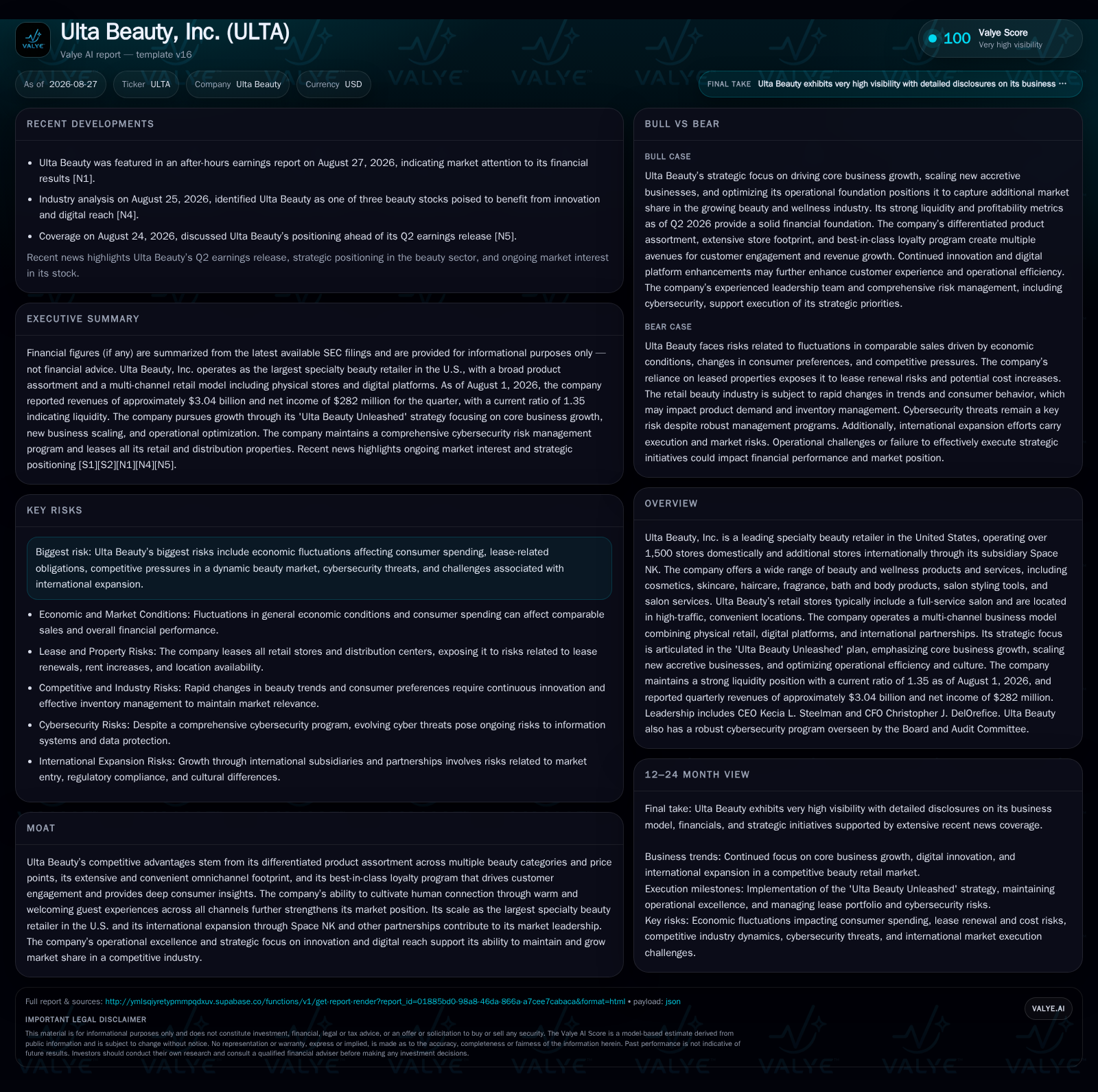
Ulta Beauty operates the largest U.S. specialty beauty retail chain, combining physical stores, digital platforms, and international partnerships. Its broad product assortment and strong loyalty program underpin customer engagement. The company’s ‘Ulta Beauty Unleashed’ strategy aims to accelerate core growth, scale new ventures, and optimize operations. While its financial footing is solid, with $3.04 billion quarterly revenue and $282 million net income, risks include lease cost exposure, rapid shifts in beauty trends, cybersecurity threats, and international market execution. Key value drivers will be customer retention, digital innovation, and efficient cost management amid intensifying competition.
Ulta Beauty, Inc. stands as the largest specialty beauty retailer in the United States, operating a broad multi-channel business with over 1,500 domestic stores and international presence through Space NK and partnerships. Its expansive product range and integrated salon services drive diverse revenue streams. The company’s strategic focus, captured in its 'Ulta Beauty Unleashed' plan, seeks to bolster core business growth, scale new ventures, and optimize operations amid a rapidly evolving beauty landscape. Solid financial results in Q2 2026, coupled with a robust loyalty program and digital engagement, position Ulta well — but significant risks from lease commitments, consumer trends, international expansion, and cybersecurity require careful navigation to maintain competitive advantage and profitability.
Latest Operating Snapshot
As of August 2026, Ulta Beauty operates approximately 1,505 stores across the U.S. and 86 international stores through its Space NK subsidiary in the U.K. and Ireland, complemented by joint ventures and franchises in Mexico and the Middle East [S1]. The stores average around 10,000 square feet domestically, featuring integrated salons occupying roughly 950 square feet, which diversifies revenue beyond product sales into service income. This wide footprint highlights Ulta’s scale but also implies substantial fixed operating commitments.
Financially, Ulta reported quarterly revenues of about $3.04 billion and net income of $282 million, reflecting ongoing profitability and strong top-line scale [S2]. The company’s liquidity position shows a current ratio of 1.35 with $158 million in cash and $55 million in short-term investments, indicating adequate near-term potential financial flexibility though a modest cash ratio of 0.09 suggests working capital is largely tied up in receivables and inventory [S2]. Operationally, Ulta leases all its retail and distribution properties, with typical 10-year store lease terms exposing it to potential cost escalation and renewal uncertainties [S1].
Business Model and Unit Economics
Ulta Beauty generates revenue primarily through retail sales of a broad assortment of beauty products and complementary salon services. The company’s unit economics hinge on a multi-channel retail model combining physical stores, digital platforms, and international partnerships. Its store model, with integrated salons, enhances average revenue per square foot and customer lifetime value by bundling product and service consumption. Pricing is influenced by product mix, with offerings spanning mass-market to prestige brands, enabling some margin diversification but also complexity in inventory management and supplier negotiations.
Ulta’s fixed costs are significant due to leased retail spaces and distribution centers, limiting operational leverage if sales decline. However, variable costs such as product procurement and salon labor scale with volume. Digital channels allow some scalability, with lower incremental cost per additional customer engagement, providing potential operating leverage if online sales grow faster than physical store costs. Capital expenditure is moderate given asset-light leasing strategy, but requires investment in digital infrastructure and customer experience. The loyalty program adds value by reducing customer acquisition costs and fostering repeat purchases, potentially improving unit economics over time.
Moat, Competition and Counterforces
Ulta’s moat derives largely from its extensive store footprint combined with a differentiated product assortment that covers cosmetics, skincare, haircare, fragrance, and salon services, which few competitors match comprehensively. Its best-in-class loyalty program creates switching frictions by offering personalized promotions and insights that deepen customer engagement. The company’s integrated salon services add experiential differentiation versus pure-play online or specialty retailers, strengthening customer retention and basket size.
Competitive pressure arises from both specialty beauty retailers and generalist mass retailers with beauty segments, as well as online pure plays like Sephora’s digital platforms and direct-to-consumer beauty brands. Ulta’s lease obligations create cost rigidity, putting it at risk if traffic declines or if ecommerce substitutions accelerate. Rapid shifts in beauty trends require agile merchandising and inventory management to avoid markdowns and obsolescence. International expansion introduces execution risks given differing consumer preferences and market dynamics. Cybersecurity threats also pose operational risks potentially affecting customer trust and data privacy.
Bull Case
In a bullish scenario, Ulta Beauty leverages its strong balance sheet and liquidity to aggressively expand its core store base and upscale digital channels, benefiting from rising consumer demand for beauty and wellness products post-pandemic. The loyalty program continues to deepen customer engagement and data-driven personalization, driving higher spend per visit and improving retention. Ulta successfully scales new accretive businesses under its 'Ulta Beauty Unleashed' strategy, including wellness and premium services, which diversify revenue and improve margins.
Operational optimizations reduce lease cost impacts via renegotiations or store footprint rationalization, while investment in digital technologies improves inventory management and supply chain responsiveness. International ventures mature, contributing incremental revenue and brand presence. Confirming evidence would include sustained comparable store sales growth, expansion of loyalty program membership and engagement metrics, margin expansion driven by higher service revenue mix, and successful new business launches. Failure to see these trends or persistent margin pressure would falsify the bull case.
Base Case
The base case envisions steady growth driven by Ulta’s entrenched U.S. market leadership and stable loyalty program performance, offset by moderate competitive pressure and margin compression from lease costs and promotional intensity. Core retail sales continue to grow in line with beauty industry averages, supported by incremental digital channel gains and ongoing but cautious international expansion. New business initiatives contribute marginally but do not materially shift the revenue or margin profile in the near term.
Operational efficiency improvements partially offset lease inflation and labor cost increases, maintaining steady net income levels. The company's balance sheet remains solid with disciplined capital allocation, including measured share repurchases under the existing $3 billion program. This scenario assumes no major disruptions in consumer spending patterns or cybersecurity breaches. Key confirming signs include stable comparable store sales, consistent loyalty program usage, and controlled SG&A expense growth. Significant deviation in any of these could shift outlook either positively or negatively.
Bear Case
In a downside scenario, Ulta faces pronounced headwinds from an economic downturn that curtails discretionary consumer spending on beauty products and salon services, leading to declining comparable store sales and traffic. Lease obligations become burdensome amid lower revenues, forcing margin compression and potential store closures. Aggressive competition from digital-first beauty retailers and direct-to-consumer brands erodes market share, especially if Ulta fails to innovate or adapt merchandising quickly to shifting trends.
International expansion efforts falter due to regulatory challenges, cultural mismatches, or operational missteps, resulting in write-downs or impaired goodwill. Despite a robust cybersecurity program, a material breach could damage customer trust and invite regulatory penalties. Confirming evidence would include sustained negative comps, deteriorating margins, rising lease-related costs, and failed new ventures. Conversely, stabilization or improvement in these metrics would challenge the bear thesis.
What Matters Next
Key performance indicators to monitor include comparable store sales growth, which signals underlying consumer demand and Ulta’s ability to maintain relevance amid shifting beauty trends. Loyalty program metrics such as active membership growth, average spend per member, and redemption rates will reveal customer engagement depth and pricing power potential. Digital and e-commerce sales growth rates matter for assessing operating leverage and channel mix shifts.
Lease expense trends and renewal outcomes will impact cost structure and margin sustainability, especially as leases mature. International expansion progress, measured by revenue contribution and profitability of Space NK and other ventures, will indicate success in diversifying geographic risk. Operational efficiency metrics, including inventory turnover and SG&A as a percentage of sales, reflect the effectiveness of the company’s optimization efforts. Lastly, cybersecurity incident reports and risk mitigation updates will be crucial to assess operational resilience.
Disclaimer: This is research-only, informational analysis and not investment advice. It may include AI-generated interpretation and general industry context. Always verify important details using primary sources.

Comments