
Uniti Group’s Fiber Ambition: Growth Opportunities and the Realities of Competitive Broadband Economics
Uniti Group’s broad fiber network and multi-segment platform offer exposure to rising U.S. demand for broadband and managed enterprise connectivity. Yet persistent net losses, intense competition, and the capital intensity of fiber expansion frame a business model where operational leverage, pricing discipline, and customer retention are under constant pressure.
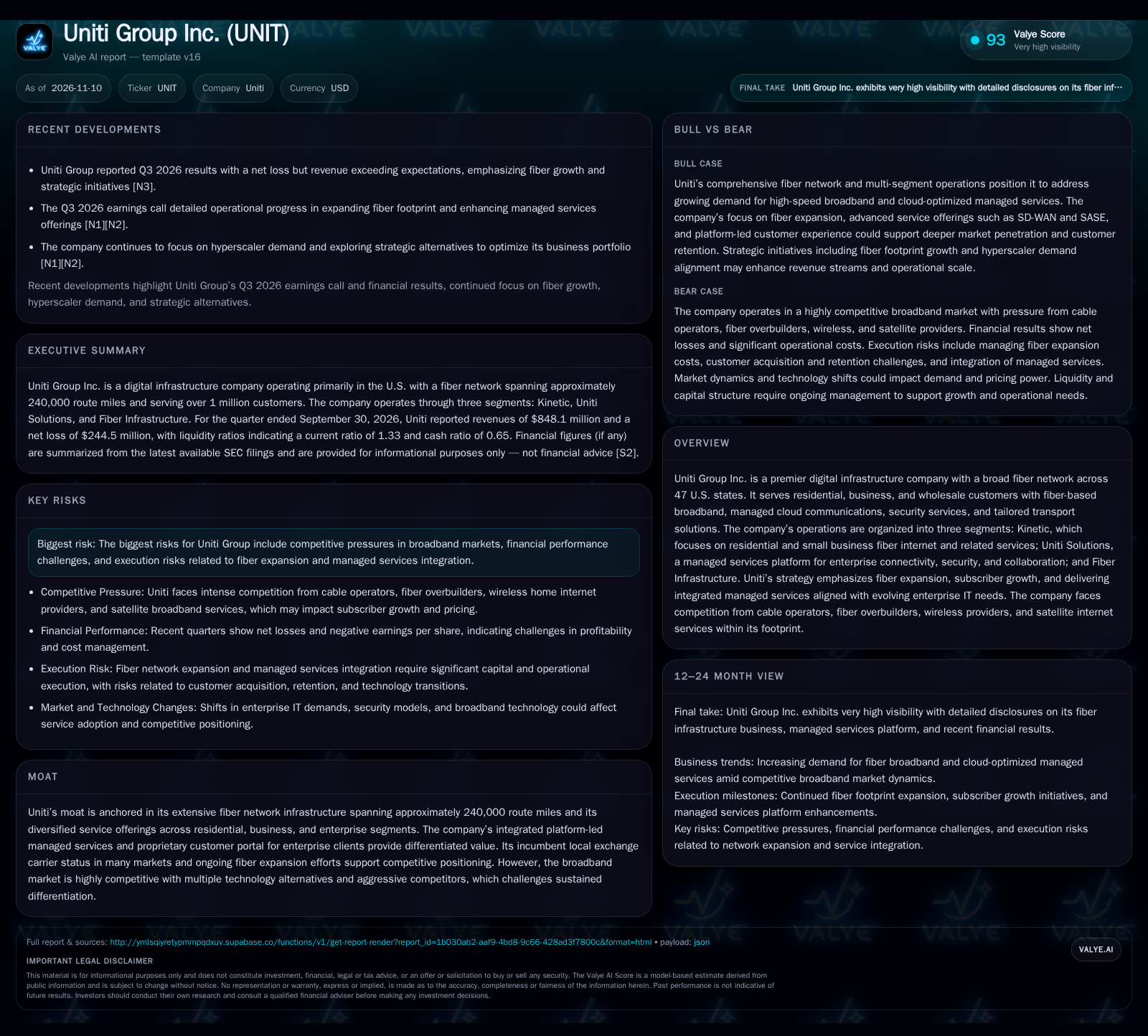
Uniti Group operates a 240,000-mile fiber network across 47 states, serving over 1 million customers and targeting both residential and enterprise markets. Despite strong top-line performance—with Q3 2026 revenue reaching $848.1 million—the company reported a net loss of $244.5 million and faces stiff competition from cable, wireless, and satellite providers. The merger with Windstream has integrated assets and scale, but Uniti’s ability to translate network expansion and managed service offerings into sustainable profitability remains an open question. Execution on fiber buildout, cost discipline, and churn management will likely define future outcomes. [S1] [S2] [N1] [N2] [N3]
Uniti Group Inc. stands as one of the largest digital infrastructure providers in the U.S., operating an extensive fiber network that spans nearly every region and aims to serve both households and enterprises with high-speed connectivity and managed services. The company’s recent merger with Windstream has given it scale and a broader service portfolio, but the realities of the U.S. broadband market—where cable, wireless, and satellite alternatives are ever-present—mean that growth ambitions must be weighed against persistent net losses and the heavy capital demands of network expansion. The next phase for Uniti hinges on its ability to drive profitable subscriber growth, manage churn, and execute on strategic initiatives in a fiercely contested landscape.
Recent Results Highlight Scale—And Ongoing Losses
Uniti reported Q3 2026 revenue of $848.1 million but a net loss of $244.5 million, with basic and diluted EPS at -$1.03. As of September 30, 2026, the company held $861.5 million in cash and cash equivalents, balancing $1.33 billion in current liabilities—a current ratio of 1.33 and cash ratio of 0.65. The company’s fiber network now spans approximately 240,000 route miles, serving over 1 million customers, including more than 500,000 residential fiber subscribers and 1.9 million fiber-equipped households, mostly in the Midwest and Southeast. Segment disclosures for 2025 show Kinetic with $928.4 million in revenue and $407.6 million contribution margin, and Uniti Solutions generating $332.3 million revenue and $164.1 million margin. The August 2025 merger with Windstream consolidated fiber assets and expanded Uniti’s managed services platform, but integration and cost pressures remain central challenges. [S1] [S2] [N1] [N2] [N3]
How Uniti’s Segmented Model Drives Revenue—and Where Margins Get Squeezed
Uniti’s business model is anchored in three segments: Kinetic (residential and small business fiber internet and bundles), Uniti Solutions (enterprise managed services), and Fiber Infrastructure (underlying network assets). Revenue is generated through a combination of monthly subscriptions for broadband, value-added services (such as internet security or whole-home Wi-Fi), and managed enterprise solutions (SD-WAN, SASE, UCaaS/CCaaS). The Kinetic segment emphasizes subscriber growth, ARPU expansion, and churn reduction, while Uniti Solutions targets recurring revenue from enterprise contracts, leveraging both on-net fiber and partner access.
The capital intensity of fiber buildout is high, with significant upfront investment required to pass new households and businesses. Margins benefit from operating leverage as networks scale, but are pressured by customer acquisition costs, retention expenses, and the need to continually upgrade service offerings to match competitor features and speeds. Fixed costs related to network maintenance and infrastructure are substantial, and the timing of returns on new builds is uncertain—especially in competitive or overbuilt markets where price competition can be acute.
Uniti’s managed services arm offers higher-margin opportunities, as enterprises increasingly outsource connectivity, security, and collaboration infrastructure. However, these solutions are also subject to rapid technology cycles, requiring ongoing investment in platform updates and integration capabilities. Sustained profitability depends on balancing fiber expansion with disciplined capital allocation, growing the customer base faster than churn, and shifting the mix toward higher-value managed services.
Competitive Dynamics: Fiber’s Reach Meets U.S. Broadband Realities
Uniti’s extensive fiber footprint is a strategic asset, but the U.S. broadband market is characterized by aggressive competition from cable operators, regional fiber overbuilders, fixed wireless providers, and increasingly, low-Earth-orbit satellite services. The company itself acknowledges that very few locations in its footprint lack meaningful competition. Cable incumbents often retain pricing power and customer loyalty through bundled services and legacy relationships, while wireless and satellite providers are rapidly improving their speed and reliability—shrinking the performance gap with fiber.
Switching costs for residential broadband are typically low, with promotional pricing and installation incentives driving customer churn across the sector. In enterprise and carrier markets, longer contract terms and integration complexity can provide stickier revenue, but these customers are highly price- and performance-sensitive, often leveraging multiple connectivity options for redundancy.
Uniti’s ability to differentiate rests on delivering superior service quality, reliability, and integrated managed services for enterprises. However, the company’s scale alone does not guarantee pricing power or long-term retention unless paired with continual investment in network upgrades, customer service, and platform innovation. The integrated platform approach may help defend share in certain markets, but the risk of commoditization remains ever-present.
If Fiber Expansion and Managed Services Outpace Churn and Competition
A favorable scenario for Uniti would see its aggressive fiber buildout and managed services platform translating into rapid subscriber growth, ARPU expansion, and improving operating leverage. If the company can capitalize on hyperscaler and enterprise demand—particularly in underserved or fast-growing regions—it could accelerate revenue growth while spreading fixed costs over a larger base. Successful integration of the Windstream merger could unlock synergies in back-office functions, network utilization, and cross-selling of managed services.
Evidence that would confirm this scenario includes sustained double-digit growth in fiber subscribers, rising ARPU in both residential and enterprise segments, expanding contribution margins, and a clear inflection toward positive net income. Announcements of multi-year enterprise contracts, new hyperscaler partnerships, or material reductions in churn would further validate the upside case. Conversely, if subscriber growth stalls, ARPU remains flat, or margin gains are offset by rising costs, the scenario would be challenged.
Fiber Growth Offsets Churn, but Profitability Lags as Competitive Pressures Persist
The most plausible near-term outcome is that Uniti continues to grow its fiber footprint and managed services revenue, but competitive dynamics and capital intensity keep net margins under pressure. In this scenario, the company posts steady revenue growth—driven by both residential fiber additions and enterprise managed services—but net losses persist as customer acquisition costs, network maintenance, and integration expenses remain high. Pricing power is limited by cable and wireless alternatives, and while ARPU may edge higher in certain segments, promotional churn and retention costs offset much of the gain.
This view would be confirmed by ongoing top-line growth paired with continued net losses or only modest improvement in profitability metrics. If reported churn rates remain elevated, integration synergies from the Windstream merger are slow to materialize, or capital expenditures stay high relative to revenue, the base case is reinforced. Key falsifiers would include a sudden, sustained improvement in net income, or evidence that Uniti is achieving operating leverage and cost discipline faster than sector peers.
Escalating Competition, High Churn, and Capital Strain Erode Value
The adverse scenario for Uniti is that competitive intensity from cable, wireless, and satellite providers accelerates, driving up churn and forcing further price concessions. If fiber expansion fails to deliver sufficient subscriber or enterprise contract wins, the company could face a situation where incremental capital investment yields diminishing returns. Integration challenges post-merger could exacerbate cost overruns or distract from operational execution.
Financially, this would manifest as stagnant or declining revenue, persistent or widening net losses, and potential pressure on liquidity if cash burn outpaces available resources. Should external market conditions—such as interest rate spikes or a downturn in enterprise IT spending—compound these pressures, Uniti’s ability to invest for growth could be severely constrained.
What Will Clarify Whether Uniti’s Fiber and Managed Services Strategy Can Deliver Profitable Growth?
The pace of residential and enterprise fiber subscriber additions, as disclosed quarterly, will be a direct test of demand and competitive positioning.
Reported churn rates in both Kinetic and Uniti Solutions segments—if disclosed—would help assess the effectiveness of retention initiatives and the impact of competitive pressure.
Average revenue per user (ARPU) trends in residential and enterprise segments will reveal whether Uniti can capture pricing gains and up-sell higher-value services.
Progress on integration synergies and cost savings from the Windstream merger, including updates on back-office consolidation and network utilization, will be telling.
Contribution margin evolution by segment, particularly in Uniti Solutions, will indicate whether managed services are driving higher-margin growth.
The ratio of capital expenditures to revenue over time will show whether the company is achieving greater operating leverage as the network scales.
Any material announcements of new hyperscaler, enterprise, or wholesale carrier contracts would offer evidence of commercial momentum and platform relevance.
Trends in current and cash ratios, while not determinative alone, will contextualize liquidity management as Uniti pursues continued network expansion.
Disclaimer: This is research-only, informational analysis and not investment advice. It may include AI-generated interpretation and general industry context. Always verify important details using primary sources.

Comments