
Union Pacific Corp: Navigating Scale, Strategy, and Sector Shifts in America's Rail Backbone
A deep dive into Union Pacific’s expansive rail operations, financial challenges, strategic initiatives, and evolving risks shaping its future trajectory.
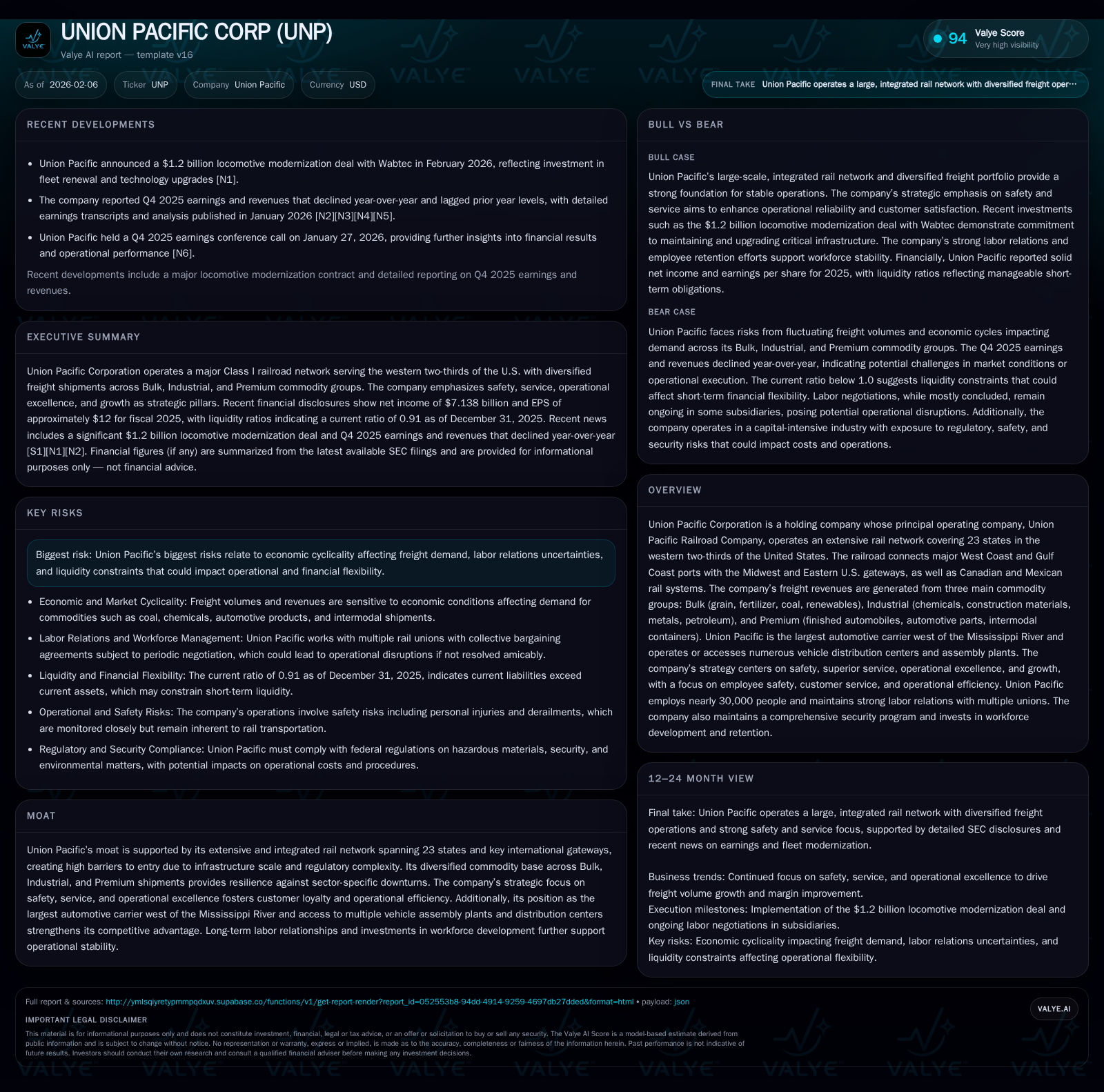
Union Pacific stands as a titan of the North American rail industry, operating an expansive network that undergirds much of the western U.S. freight movement. However, recent earnings reveal underlying revenue pressures linked to economic cyclicality and sector dynamics. Despite these headwinds, UP’s entrenched moat—anchored in its vast integrated rail network and commodity diversification—affords resilience. Strategic emphasis on safety culture and a landmark $1.2 billion locomotive modernization deal signal ongoing efforts to reinforce operational excellence. Labor dynamics and liquidity constraints present tangible challenges, while careful capital allocation underscores a nuanced financial footing. Looking forward, cyclical risks and regulatory complexities remain key considerations for this critical transportation juggernaut.
America’s Rail Giant at a Glance: Scale, Scope, and Strategic Foundations
Union Pacific Corporation embodies an essential artery in the U.S. supply chain ecosystem. Its principal operating entity, Union Pacific Railroad Company, commands an extensive rail network covering more than two-thirds of the country west of the Mississippi — spanning 23 states and bridging vital corridors between West Coast and Gulf Coast ports to the populous Midwest and Eastern U.S. gateways [S1]. This sprawling infrastructure not only facilitates domestic freight flows but also interlinks with Canadian rail systems and uniquely serves all six major Mexico gateways.
Union Pacific’s diversified commodity base divides into three principal groups: Bulk (such as grain, fertilizer, coal, renewables), Industrial (chemicals, construction materials, metals, petroleum), and Premium (finished automobiles, automotive parts, intermodal containers) [S1]. Each commodity group interacts with distinct market dynamics yet collectively fortifies revenue stability through diversification.
Strategically, UP prioritizes safety as a non-negotiable foundation — emphasizing personal commitment across its workforce to achieve industry-leading safety records [S1]. Service excellence follows as a deliberate promise to customers: understanding their market needs in detail to deliver reliable performance consistently. Underpinning these is operational excellence aimed at maximizing efficiency without excessive strain on resources — maintaining buffers to handle inevitable surges due to weather or fluctuating volumes [S1]. These pillars jointly target sustainable growth driven by improved margins and returning shareholder value.
Navigating Economic Headwinds: Analyzing the Latest Earnings Miss and Revenue Pressures
In Q4 2025, Union Pacific’s financial results revealed cracks amid broader macroeconomic uncertainties. Revenues trailed estimates with noted year-over-year declines — a reflection of softer demand patterns observed across several freight segments [N1][N3][N4][F1][S1]. The earnings miss underscores underlying cyclicality impacting key commodity flows such as coal and certain industrial products during periods of subdued economic activity.
The company’s results illustrate the sensitivity of railroad operations to shifting market demands — where overcapacity or underutilization triggers elevated unit costs via storage of idle assets or workforce inefficiencies [S1]. Furthermore, operational disruptions caused by weather events magnify cost pressures when network velocity slows against capacity demands.
Despite these temporary setbacks, management commentary during earnings calls repeatedly stressed proactive measures such as enhanced transportation planning and flexibility initiatives designed to mitigate service shortfalls when volumes exceed planned thresholds [N2][S1]. The interplay between volatile demand drivers and UP’s ability to optimize resource deployment remains critical for restoring top-line momentum.
The Moat in Motion: Network Scale, Diversification, and Competitive Advantages
Union Pacific’s competitive moat derives primarily from its scale—combining physical infrastructure prowess with strategic geographic positioning—which creates significant entry barriers amidst regulatory complexity and capital intensity [valye_report_excerpt][S1]. Operating an integrated rail network reduces reliance on third-party interconnections that competitors might require; this integration translates into reliability advantages vital for customer retention.
The diversified commodity profile shields UP from concentrated downturns affecting single sectors. Bulk shipments like grain may offset softness in industrial chemicals or vice versa. Moreover, UP's unique role as the largest automotive carrier west of the Mississippi River leveraging access to numerous vehicle assembly plants bolsters its premium segment strengths [valye_report_excerpt][S1]. Such cross-commodity resiliency smooths revenue volatility over business cycles.
Together these elements reinforce UP’s positioning not just as a transportation provider but as a logistic partner embedded deeply within North American supply chains.
Safety as Strategy: Embedding Culture to Fortify Long-term Growth
The company’s safety-first ethos transcends compliance — it functions as a core cultural pillar girding every operational aspect [S1]. Management articulates this focus not simply as risk mitigation but as foundational for superior service delivery; fewer incidents mean more predictable schedules which customers depend upon.
Embedding safety within workforce behaviors strengthens employee engagement while safeguarding enterprise value by minimizing costly accidents or regulatory penalties. This resilience fosters customer trust essential for growth ambitions tied closely to sustained margin improvements [S1]. As UP transforms its railroad capabilities going forward, safety remains both cause and effect behind operational excellence claims.
Modernization Moves: The $1.2 Billion Deal and Technology Upgrades
A recent landmark agreement with Wabtec valued at approximately $1.2 billion highlights Union Pacific’s commitment to capital investment focused on technology-led modernization [N12][S1]. This deal aims at upgrading locomotive fleets—critical assets governing overall system reliability and fuel efficiency.
Upgrading technological platforms including Positive Train Control (PTC) systems exemplifies necessary expenditures countering risks associated with older infrastructure potentially impairing competitive positioning [S1]. Beyond locomotives themselves, broader IT enhancements like advanced transportation control systems promise better network visibility and responsiveness.
This sizeable capital outlay underscores both the vital need—to maintain parity or advantage within complex logistics networks—and the challenge posed by such investments given simultaneous liquidity pressures described later.
Labor Dynamics and Operational Efficiencies: Managing Workforce and Capacity Challenges
Labor relations have historically been pivotal within railroads’ operational matrices due to the sector's labor-intensive nature. Union Pacific’s disclosures highlight inherent risks stemming from fluctuations in workforce demand triggered by volume variability [valye_report_excerpt][S1]. Adjusting staffing levels involves significant lead times complicated further by collective bargaining agreements.
Operationally, managing capacity buffers remains critical for sustaining committed service levels amidst unpredictability caused by weather or market shifts [S1]. However swift resizing without jeopardizing morale or incurring excessive costs represents a balancing act.
Given UP’s prominence in vehicle distribution—a segment necessitating precise timing aligned to assembly plant schedules—workforce efficiency directly affects customer satisfaction metrics. Overall labor dynamics continue presenting both a cost leeway challenge and an execution risk influencing broader operational performance.[valye_report_excerpt]
Commodity Streams Under the Microscope: Bulk, Industrial, and Premium Freight Insights
Each commodity group traversing Union Pacific’s rails demonstrates distinct characteristics influencing revenue stability:
- Bulk commodities—including grain where agricultural cycles dominate alongside coal that faces structural headwinds due to environmental regulation shifts—have shown mixed demand traction [valye_report_excerpt][F1]. The inclusion of renewables introduces new growth vectors but also exposes UP to evolving policy climates.
- Industrial shipments like chemicals or metals reflect industrial production health; fluctuations here tend strongly correlated with manufacturing trends.
- Premium freight containing finished automobiles or intermodal containers stands out for relatively steady volume owing partly to UP’s integrated vehicle distribution presence west of the Mississippi River [valye_report_excerpt][F1]. This segment typically commands higher service expectations translating into margin premiums.
Analyzing these streams together reveals a nuanced picture where strength in one category may offset softness elsewhere but requires vigilant management focus given differing lifecycle exposures.
Financial Footing under Pressure: Liquidity, Capital Allocation, and Dividend Appeal
On the balance sheet front, Union Pacific shows signs of tightening liquidity conditions—a current ratio of approximately 0.91 illustrates current liabilities slightly exceeding current assets as of end-2025 [F1]. Cash reserves stand around $1.26 billion signaling available firepower yet reflecting ongoing capital deployment demands.
Dividend attractiveness remains highlighted in market commentary underscoring solid free cash flow profiles historically supporting payout commitments even amid earnings volatility [N14][F1]. Nonetheless maintaining this balance amid heavy modernization investments plus potential labor cost inflation requires prudence.
Capital allocation strategies are increasingly complex—balancing returns through dividends against imperative reinvestments for safety compliance upgrades or fleet modernization mandates thoughtful stewardship given constrained near-term operating cash flow scenarios documented in latest SEC filings [S1].
Looking Ahead: Risks on the Horizon and Growth Outlook
Union Pacific faces several salient risks underscoring its operating environment:
- Economic cyclicality: Variability in freight demand linked to macroeconomic health introduces revenue forecasting uncertainty impacting costs related to asset idling or surge-service adjustments [S1][N11].
- Labor uncertainties: Contract negotiations pose execution risks that could disrupt service continuity or increase labor expenses materially [S1].
- Hazardous material transport: Regulatory burdens coupled with accident liability concerns especially involving toxic inhalation hazards represent potential reputational and financial hazards requiring continuous vigilance [S1].
- Technological obsolescence: Failure to timely upgrade systems risks downgrading competitive position relative to other transport modes or more agile carriers [S1].
Management guidance delivered during recent earnings highlights cautious optimism grounded on improving volume trends tempered by acknowledgement of persistent market volatility factors [N2][N11]. Continued emphasis on operational discipline alongside targeted growth initiatives shape outlook though sizable external uncertainties persist.
Union Pacific Corporation remains an indelible force anchoring American freight logistics west of the Mississippi River. Its sprawling rail network coupled with diversified product flows compose a resilient footprint amidst an increasingly complex landscape of economic shifts, operational demands, labor challenges, technological imperatives, and regulatory scrutiny. Recent financial results reveal strains typical of cyclical industries navigating transition — yet underscore strategic efforts embedding safety culture and modernization investment as pillars for future durability. Stakeholders should watch carefully how well these balancing acts maintain service integrity while executing large-scale technological upgrades amid tightening liquidity parameters. Across this narrative unfolds a company central not just to moving goods but enabling regional economies' vitality through uncertain times.
This analysis is informational only; it does not constitute investment advice or recommendations.
Disclaimer: This is research-only, informational analysis and not investment advice. It may include AI-generated interpretation and general industry context. Always verify important details using primary sources.

Comments