USCB Financial Holdings Inc: Navigating Regional Banking with Niche Lending and Risk Discipline
USCB Financial Holdings operates as a Florida-focused regional bank emphasizing diversified lending and prudent credit management.
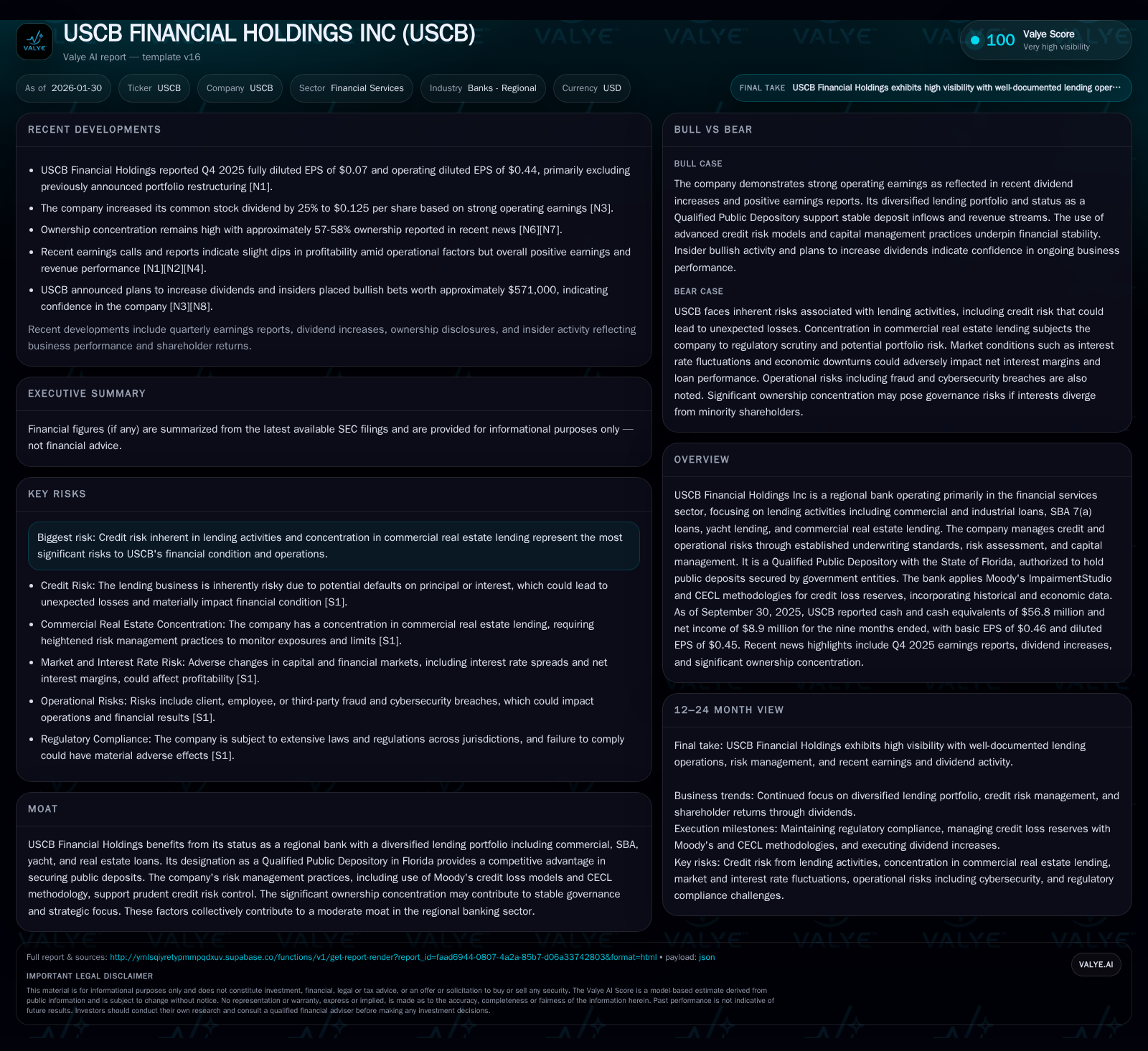
USCB Financial Holdings Inc leverages a diversified loan portfolio spanning commercial, SBA, yacht, and real estate lending to serve regional clients primarily in Florida. The firm’s status as a Qualified Public Depository and its adoption of Moody’s impairment models and CECL methodology underpin its credit risk management framework. Recent earnings showed solid operating performance alongside a 25% dividend increase, reflecting management confidence amid moderate profitability pressures. Key risks remain concentrated in credit exposure, notably commercial real estate, while concentrated ownership supports stable governance and strategic alignment.
What Changed Recently
In early 2026, USCB Financial Holdings released earnings for Q4 2025 and the first quarter of fiscal 2026, which revealed a nuanced performance picture. Operating diluted EPS for Q4 stood at $0.44 excluding previously announced portfolio restructuring charges, while fully diluted EPS was much lower at $0.07, reflecting non-operating adjustments [N12]. Despite a slight dip in profitability noted in recent quarters, the company increased its quarterly dividend by 25% to $0.125 per share, indicating management's confidence in underlying earnings and cash flow generation [N6, N8, N9]. Insider buying activity totaling approximately $571,000 in bullish bets on the common stock was reported around the earnings period, suggestive of positive insider sentiment [N10]. Ownership concentration remained high, with insiders controlling around 57%-58% of shares, underscoring a governance structure with limited external influence but potentially stable strategic focus [N7, N11].
Business Model as a System
USCB Financial Holdings operates as a regional bank with a primary focus on lending activities within Florida and adjacent markets. Its loan portfolio is diversified across commercial and industrial loans, SBA 7(a) guaranteed loans, yacht financing, and commercial real estate lending [S1]. The bank’s designation as a Qualified Public Depository (QPD) with the State of Florida authorizes it to hold public deposits secured by governmental entities such as municipalities and state agencies, providing a relatively stable and low-cost funding source [S10].
Credit risk management is central to the business model. USCB employs Moody’s ImpairmentStudio tool to estimate expected credit losses, leveraging probability of default (PD) and loss given default (LGD) metrics derived from historical default rates adjusted for current economic conditions. This is complemented by the Current Expected Credit Loss (CECL) methodology, mandated under U.S. GAAP, which requires forward-looking loss reserves incorporating historical loss data and macroeconomic forecasts including national unemployment rates, GDP growth, and housing price indices [S4, S5]. The bank’s underwriting standards and risk assessment procedures are designed to maintain loan portfolio quality and support capital adequacy.
Operationally, the bank generates net interest income by funding loans through deposits (including public deposits) and other borrowings, with non-interest income contributions primarily from SBA loan fees and ancillary services. Funding cost advantages arise from the QPD status, while loan yields reflect the niche nature of yacht loans and SBA guarantees, which typically carry risk premiums relative to standard commercial loans.
Industry Map & Competitive Battlefield
USCB operates within the regional banking sector, specializing in middle-market and niche lending segments. The Florida banking market is competitive, populated by larger regional banks, community banks, and specialty lenders. Competitors often overlap in commercial real estate and SBA lending, but USCB’s yacht lending niche is relatively uncommon, potentially attracting affluent clientele and providing a differentiated revenue stream.
The designation as a Qualified Public Depository places USCB in a favorable position to capture public sector deposits, a competitive moat of sorts given that not all regional banks qualify or cultivate such relationships. This stable deposit base can lower funding costs and improve net interest margin (NIM).
However, competition is intense on loan pricing and underwriting standards, especially in commercial real estate where loan-to-value ratios and borrower creditworthiness have tightened post-pandemic. Regional banks must balance growth ambitions against escalating credit risk, regulatory scrutiny, and digitization pressures.
USCB's concentrated ownership might limit agility or openness to strategic partnerships but provides a stable governance structure that aligns management incentives with shareholder interests. This can be advantageous in navigating economic cycles but may also limit external oversight.
Where the Economics Become Real
At the unit economics level, USCB’s profitability hinges on net interest margin generated from loan yields minus funding costs and loan loss provisions. The diversified loan portfolio mitigates concentration risk but also requires calibrated risk pricing. For example, SBA 7(a) loans typically have government guarantees reducing expected losses, but yacht loans might carry higher risk premiums due to collateral liquidity risk.
USCB’s capital deployment strategy involves balancing growth in performing loans against maintaining adequate credit loss reserves, calculated under Moody’s impairment models and CECL standards. The integration of economic forecasts (e.g., unemployment rates, GDP trends, housing price indices) into loss provisioning is critical given the cyclical nature of credit risk. Loan loss reserves can materially affect net income volatility.
Liquidity management leverages the QPD status, providing access to public deposits that are secured and may be less sensitive to interest rate swings than retail deposits. This provides a potential cost advantage and funding stability. Cash and cash equivalents stood at $56.8 million as of September 30, 2025, supporting operational flexibility [S1].
Profitability metrics such as EPS and dividend payouts signal operational health, but recent earnings showed some pressure on bottom-line performance due to portfolio restructuring and credit cost adjustments [N12, N5]. The dividend increase implies sustainable cash flow, but investors and management alike must monitor credit quality trends closely.
Diligence Questions / Disconfirming Signals
- How resilient is USCB’s commercial real estate loan portfolio in the face of potential regional economic slowdowns or sector-specific downturns?
- What are the detailed underwriting criteria and historical loss experience for yacht loans, and how liquid is the collateral under stress scenarios?
- How sensitive are USCB’s credit loss reserves to varying macroeconomic assumptions, particularly shifts in unemployment and housing prices?
- To what extent does the concentrated insider ownership impact strategic decision-making and risk tolerance? Could it limit responsiveness to changing competitive or regulatory environments?
- What is the composition and duration profile of public deposits, and how stable are these funding sources in stress periods?
- How does USCB differentiate itself technologically and operationally from other Florida regional banks to maintain or grow market share?
- Are there regulatory or compliance cost pressures anticipated that could materially impact operating margins?
- What is the pipeline for new SBA and yacht loans, and how does management balance growth with credit quality in these segments?
USCB Financial Holdings operates a focused regional banking business leveraging niche lending lines and public sector deposit relationships to generate sustainable earnings. Its prudent credit risk management and stable ownership structure provide a foundation for disciplined growth, though concentrated commercial real estate exposure and market competition remain key challenges. Recent dividend enhancements and insider buying reflect confidence, but ongoing diligence on credit trends and funding stability is critical in the evolving economic landscape.
This report is for informational purposes and does not constitute investment advice or recommendations.
Disclaimer: This is research-only, informational analysis and not investment advice. It may include AI-generated interpretation and general industry context. Always verify important details using primary sources.

Comments