
Shifts in Futures-Based Currency Exposure Drive UUP’s Recent Performance Patterns
Invesco DB US Dollar Index Bullish Fund’s financials reveal the influence of currency futures volatility on operating metrics and capital flows.
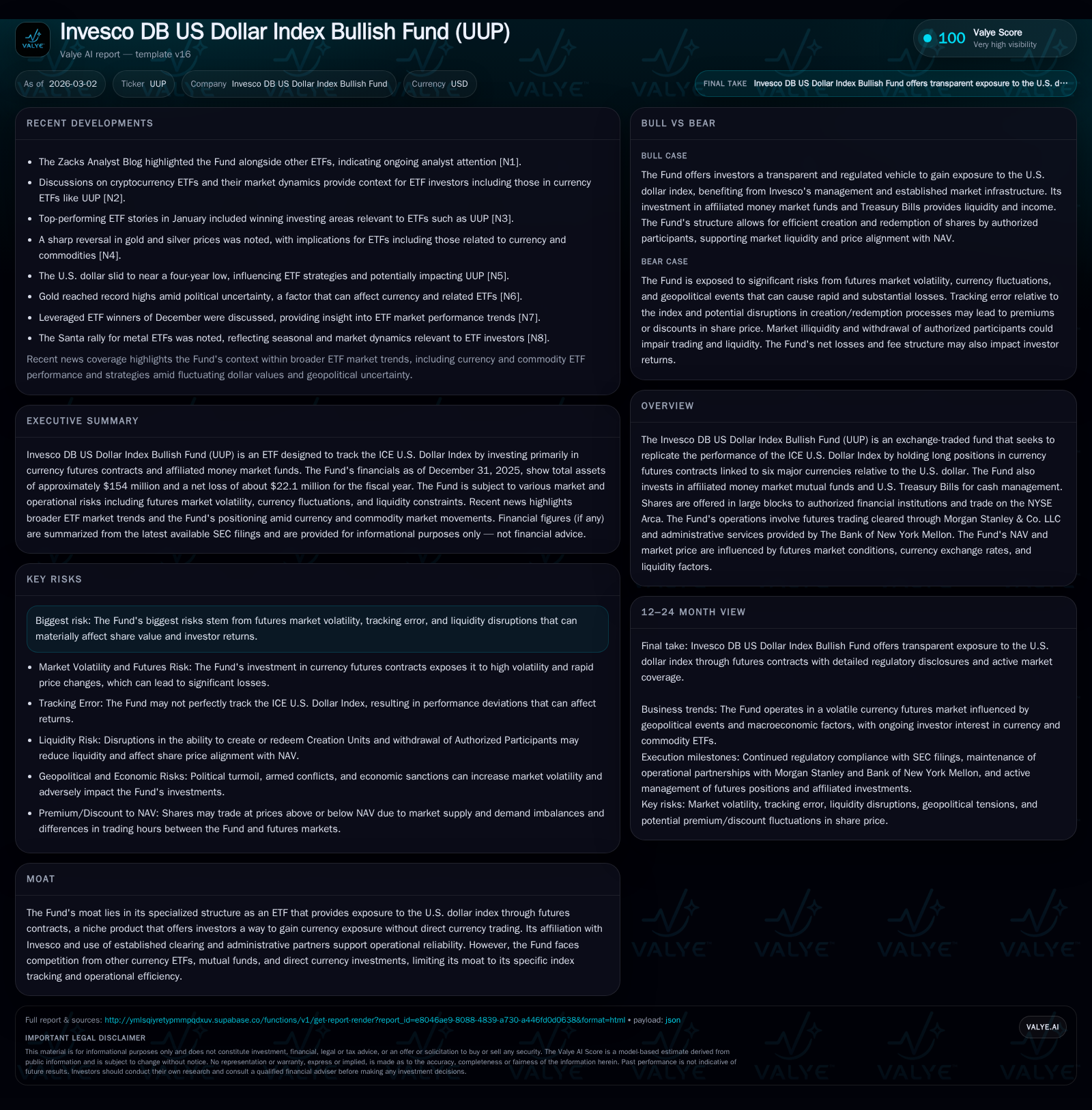
The Invesco DB US Dollar Index Bullish Fund (UUP) operates by holding long positions in currency futures mirroring the ICE U.S. Dollar Index, backed by cash management assets such as money market funds and Treasury Bills. Over recent years, UUP’s operating income has declined sharply amid increased futures market volatility, while net income swung negative in the latest fiscal year despite a substantial rise in operating cash flow. The fund’s returns are pressured by tracking errors and fee drag, compounded by regulatory risks around position limits and liquidity fluctuations. Capital allocation remains active with sizeable buybacks offsetting redemptions; dividends have contracted but continue. Forward growth hinges on dollar index dynamics against a backdrop of macroeconomic and regulatory shifts that could amplify volatility or constrain futures-based strategies.
Structural Overview: The ETF’s Role in Currency Exposure via Futures
The Invesco DB US Dollar Index Bullish Fund (ticker UUP) is a specialized exchange-traded fund designed to grant investors exposure to the performance of the ICE U.S. Dollar Index through holding long positions exclusively in currency futures contracts tied to six major foreign currencies relative to the U.S. dollar. These DX Contracts are cleared through Morgan Stanley & Co. LLC, functioning as Commodity Broker, with The Bank of New York Mellon providing administrative services including custody. For cash management and meeting variation margin obligations associated with futures trading, the Fund maintains investments in affiliated money market mutual funds as well as U.S. Treasury Bills.
This structure leverages not spot FX trading but rather futures derivative contracts to mirror USD index movements while offering operational efficiencies through partnerships with established clearinghouses and custodians that ensure seamless transaction processing and custody reliability [F1][N5]. The creation and redemption mechanism revolves around "creation units" — blocks of 50,000 shares issued or redeemed by authorized participants daily at NAV prices calculated after market close times of relevant exchanges [S5]. This approach facilitates liquidity provision but is subject to typical ETF risks including premium/discount spreads relative to underlying asset value.
Historical Growth Trajectory: Financial Trends and Their Drivers
Examining recent historical financial outcomes reveals significant volatility consistent with the underlying currency futures market dynamics. Operating income declined substantially from $34.18 million in FY2023 to $16.56 million in FY2024, further sliding down 41.7% year-over-year to just under $9.65 million by FY2025 [F1]. This persistent decrease stems from less favorable returns on the DX Contract holdings amid fluctuating exchange rate volatility.
More starkly, net income swung from positive territory ($44.54 million in 2024) into a net loss recorded at approximately -$22.11 million by year-end 2025, reflecting sharp mark-to-market unrealized losses over the period [F1]. Against this backdrop however, operating cash flow grew dramatically — surging over 698% YoY from about $22 million in FY2024 to nearly $177 million for the latest full fiscal year [F1]. This divergence highlights substantial cash inflows related to settlement of margin calls and closing out derivative positions even while earnings suffered on accrual accounting measures.
The Fund bears an annual fee totaling around 0.76%, which relates to overall management costs inclusive of licensing fees for index sponsorship and administrative overheads [S1]. These fees effectively reduce gross gains derived from futures trading activity, dragging realized investor returns during periods of market turmoil or sideways price action.
Historical performance (annual)
| FY | Net ($mm) | CFO ($mm) | OpInc ($mm) | Net YoY |
|---|---|---|---|---|
| 2025 | -22 | 177 | 10 | -149.6% |
| 2024 | 45 | 22 | 17 | +111.2% |
| 2023 | 21 | 1261 | 34 | -74.1% |
| 2022 | 81 | -848 | 18 |
Source: SEC companyfacts cache [F1].
Capital returns and efficiency (annual)
| FY | Div ($mm) | Buybacks ($bn) | ROE% |
|---|---|---|---|
| 2025 | 8 | 0.9 | -9.6 |
| 2024 | 19 | 0.9 | 10.4 |
| 2023 | 29 | 2.3 | 5.4 |
| 2022 | 16 | 1.8 | 4.9 |
Source: SEC companyfacts cache [F1].
Table Note: Operating cash flow spikes correspond largely with variations in margin settlements linked to currency futures position adjustments.
Market Volatility and Index Tracking: Key Challenges to Growth
As outlined extensively in regulatory filings [S1] and risk disclosures [S3], UUP confronts intrinsic challenges pertinent to its reliance on volatile currency futures markets for replication of the USD Index performance.
Currency exposures are influenced by multifaceted forces including sovereign debt levels and trade deficits; inflationary expectations both domestically and abroad; shifts in global interest rates; government interventions like exchange controls or monetary policy impacts; geopolitical disruptions; plus speculative activity from hedge funds and other large currency pools [S1]. These drivers contribute not only to marked price fluctuations but also impact variation margin requirements which force frequent cash adjustments within brokerage accounts maintained at Morgan Stanley as Commodity Broker.
Tracking error—the divergence between Fund returns and those of the underlying index—plays a central role here given the nature of holding DX Contracts rather than spot FX baskets directly [S3]. Furthermore:
- Futures contracts are currently exempt from Commodity Futures Trading Commission (CFTC)-imposed position limits but future regulatory action could introduce caps that materially restrict maximum holdings available for replication purposes.
- Such constraints would hamper ability to scale random large creations/redemptions,
- And may generate premium/discount disparities between market share prices versus NAV,[S1] complicating arbitrage dynamics essential for ETF functioning properly.
- Liquidity disruptions either stemming from counterparties or sudden political/economic shocks can sharply widen bid/ask spreads exacerbating redemption pressures [N5].
These factors combine unpredictably undermining smooth growth trajectories or return stability despite otherwise disciplined management methods.
Capital Allocation Strategy: Returns, Dividends, and Buybacks
Capital deployment at UUP demonstrates active management focused on shareholder value amidst turbulent performance outcomes:
Despite the losses manifested in net income figures above,[F1] operating cash resources have remained robust owing primarily to efficient settlement mechanisms inherent within derivatives markets supported by outstanding brokerage agreements permitting netting arrangements [S4]. The Managing Owner exercises discretion over dividend policies although distributions have been reduced markedly recently—from $18.8MM paid out in FY2024 down roughly two-thirds to under $7.7MM delivered across FY2025[F1].
Share repurchase programs form a critical tool balancing issuance/redemption pressure inherent to ETF structure through 'creation units.' Buybacks remained elevated at over $860MM executed during FY2025 albeit slightly lower than prior years when volumes exceeded multiple billions reflecting swings in investor sentiment toward USD-based exposure [F1][S5].
Fee waivers play a supplementary role where Managing Owner has contractually agreed indefinite waivers offsetting indirect fees incurred via affiliated money market mutual funds holdings used for collateral/emergency liquidity purposes—mitigating some drag on total expense ratio which stands near ~0.76% annually[S8].
Overall tangible return metrics such as ROE appear negative given last fiscal year's reported losses (~-9.6%), illustrating pressures forced by market environments far removed from steady state scenarios [F1].
Future Prospects Based on Dollar Index Dynamics and Regulatory Risks
Looking ahead for UUP requires weighing fundamental macroeconomic vectors shaping USD valuation—a critical driver for DX Contract mark-to-market valuations—and recognizing evolving regulatory landscapes defining permissible trading parameters.
Macroeconomic factors such as relative inflation differentials between the United States versus major currency counterparts (Eurozone EUR/USD pair being dominant), prospective shifts in Federal Reserve interest rate policies vis-à-vis other central banks' stances potentially steer demand for USD assets translating into currency appreciation/depreciation trends impacting Fund’s core derivatives portfolio [N2][N5][S1].
Geopolitical events—ranging from trade tensions to political instability abroad—may trigger abrupt swings heightening volatility beyond historic ranges thereby either presenting opportunity or risk.
Simultaneously regulators including CFTC weigh possible implementation of position limits aiming at mitigating concentration risks within commodities/futures markets though currently DX Contracts enjoy exemption [S10][S1]. Any eventual limitation imposed could curtail flexibility constraining new share creations or enforcing aggregation rules complicating index-tracking fidelity ultimately influencing investor perception favorably slanted toward alternatives or direct FX exposure.
All these underscore a landscape where UUP's operating model navigates structural complexities amplified by externalities outside fund management control.
Critical Milestones to Watch for Monitoring Fund Performance
Absent explicit forward guidance from filings or company commentary,[N5][S5] stakeholders should carefully track several proxy indicators as barometers for prospective performance trajectory:
- Quarterly NAV versus market price correlations measuring premiums or discounts influenced by creation/redemption dynamics affecting share liquidity;
- Open interest levels across DX Contract maturities signaling scale of gross exposure;
- Fluctuations in margin balances held at Commodity Broker reflecting short-term funding pressures or rebalancing activity;
- Announcements or rulemaking regarding position limit status impacting permissible contract volumes;
- Fee waiver statuses declared by Managing Owner modifying net expense profile crucial during thin-margin periods.
Close monitoring of such metrics alongside macroeconomic event developments will aid assessing UUP's capacity to maintain effective proxy exposure within rising complexity realms inherently tied to currency futures-based investment vehicles.
Disclaimer: This analysis is provided solely for informational purposes based on publicly available documents without any recommendation regarding buying or selling securities related to Invesco DB US Dollar Index Bullish Fund (UUP). It does not constitute investment advice or solicit transactions.
Disclaimer: This is research-only, informational analysis and not investment advice. It may include AI-generated interpretation and general industry context. Always verify important details using primary sources.

Comments