
Energy Fuels Inc Expands Rare Earths Capacity While Managing Uranium Market and Debt Pressures
The company leverages its White Mesa Mill monopoly to grow rare earths processing amid continued uranium losses and increasing leverage.
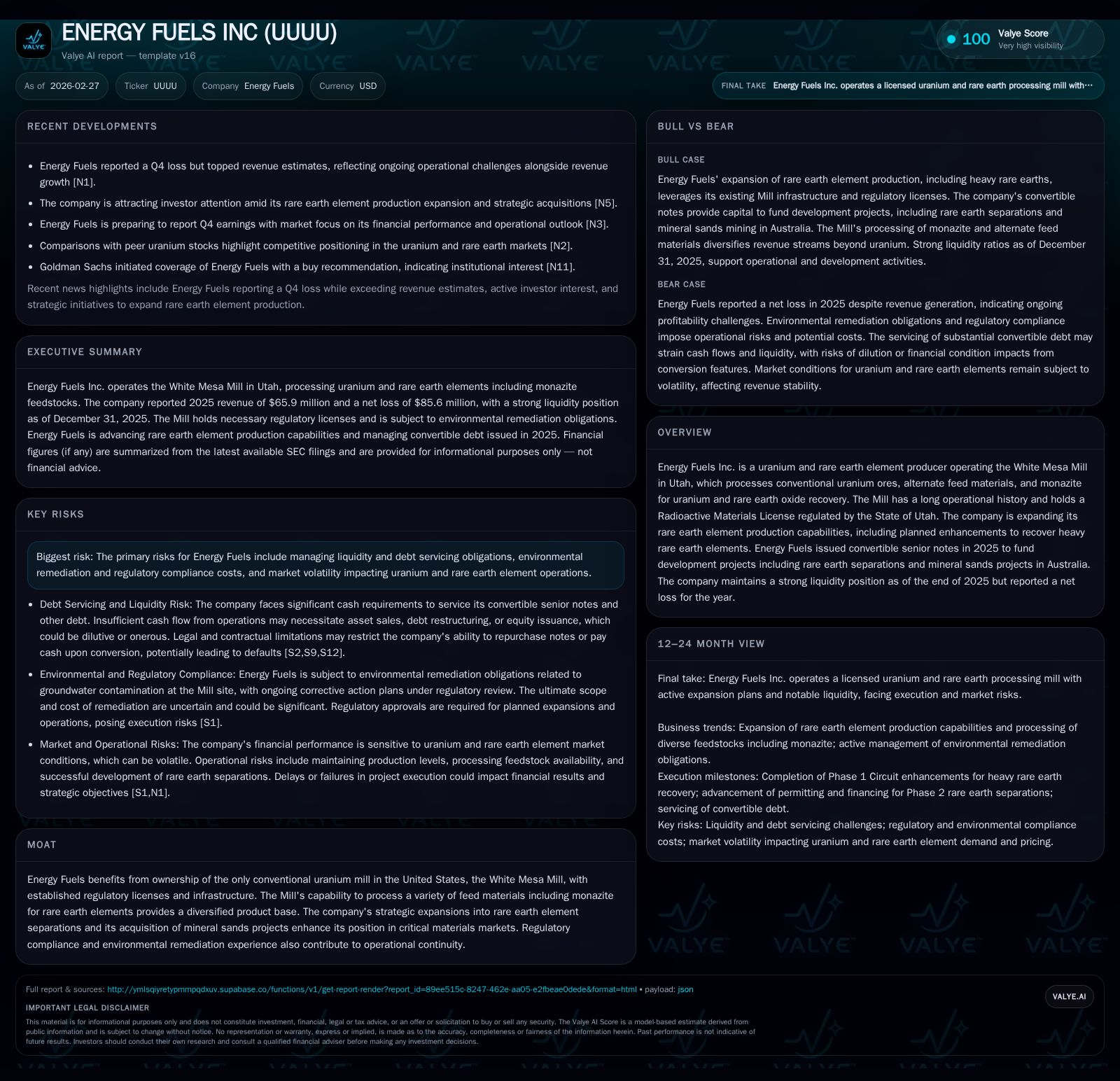
Energy Fuels Inc. operates the only conventional uranium mill in the U.S., the White Mesa Mill, which also processes rare earth elements and vanadium. Despite reporting a net loss of $85.6 million in 2025 on $65.9 million revenue, the company is strategically expanding its rare earths capabilities through acquisitions and new projects, funded by a $700 million convertible notes issuance. Challenges persist from market volatility, environmental remediation costs, and servicing its growing debt load. Key milestones include advancing multiple uranium mines, scaling rare earth separations, and progressing mineral sands projects in Australia and Madagascar.
Overview
Energy Fuels Inc. operates primarily through its White Mesa Mill in Utah — the sole conventional uranium mill licensed to process up to 2,000 tons of ore daily in the United States, yielding over 8 million pounds of U3O8 annually under favorable conditions ([S1]). The mill’s unique capability extends beyond uranium processing to vanadium and rare earth elements (REEs), including monazite feedstock processing aimed at both light and heavy REE recovery.
The company's vertical integration extends across multiple uranium mining projects spread over the Western U.S., including Pinyon Plain, La Sal Complex, Whirlwind, Bullfrog, Roca Honda, and Sheep Mountain among others ([S1]). These assets underpin Energy Fuels as a leading domestic supplier amid shifting geopolitical landscapes impacting uranium supply chains.
Historical Performance
Over the past four years leading up to fiscal year ending December 2025, Energy Fuels showed top-line revenue growth until hitting headwinds in 2024-25:
Historical performance (annual)
| FY | Rev ($mm) | Net ($mm) | CFO ($mm) | OpInc ($mm) | Rev YoY | Net YoY |
|---|---|---|---|---|---|---|
| 2025 | 66 | -86 | -89 | -101 | -15.6% | -79.3% |
| 2024 | 78 | -48 | -44 | -48 | +106.0% | -147.9% |
| 2023 | 38 | 100 | -15 | -32 | +203.1% | +266.4% |
| 2022 | 13 | -60 | -50 | -45 |
Source: SEC companyfacts cache [F1].
Capital returns and efficiency (annual)
| FY | FCF ($mm) | ROE% |
|---|---|---|
| 2025 | -109 | -12.6 |
| 2024 | -66 | -9.0 |
| 2023 | -31 | 26.6 |
| 2022 | -52 | -24.9 |
Source: SEC companyfacts cache [F1].
*Net income included a large nonrecurring item in FY23.
Revenues peaked in 2024 at $78 million before declining sharply due to lower uranium prices and reduced contract volumes ([F1]). Operating losses deepened from $47 million in 2024 to over $101 million in the most recent year as operating expenses outpaced shrinking top line.
Operating cash flows have been negative throughout this period but worsened markedly to nearly $90 million negative last year as capital investments increased.
Despite losses and cash burn, equity almost tripled from $240 million to nearly $680 million over four years reflecting capital raises including a significant convertible note issuance reported in October 2025 ([F1], [S15]). This infusion supports the strategic pivot towards expanding REE capabilities while sustaining uranium production growth.
Production Profile & Operations
In calendar year 2025, the White Mesa Mill processed sufficient feedstock to produce approximately one million pounds of U3O8, maintaining Energy Fuels' status as the largest producer of uranium within the U.S ([S1]). Production is primarily sourced from three mines: Pinyon Plain, La Sal Complex, Pandora—all located across Arizona and Utah—aiming for combined output between two to two-and-a-half million pounds of contained U3O8 for calendar year 2026.
Beyond these active mines are several development-stage projects with significant potential:
- Whirlwind Mine in Colorado is anticipated to enter production within one year after a go decision.
- Projects such as Roca Honda (NM), Bullfrog (UT), and Sheep Mountain (WY) are being advanced to potentially expand production by more than five million pounds annually when market conditions support.
- Additionally, acquisition or toll milling arrangements for third-party ore stand ready as flexible avenues for supplementing supply.
On rare earths front, Energy Fuels is accelerating efforts:
- The White Mesa Mill is upgrading Phase II separation circuits focused on recovering heavy REEs such as dysprosium and terbium critical for high-tech applications ([S3]).
- The Donald Project joint venture with Astron Limited controls a heavy mineral sands deposit containing monazite enriched with valuable heavy REEs; it has all major permits approved to begin construction targeting production start second half of calendar year 2027 with expected outputs upwards of 7,200 tonnes per annum of rare earth oxide concentrate ([S1], [S3]).
- Complementing this is the Toliara Project in Madagascar—an acquisition via Base Resources—with an updated feasibility study projecting robust economics: ~$1.8 billion post-tax NPV @10%, IRR near 25%, ~38-year mine life producing zircon, ilmenite, rutile plus monazite feedstocks pivotal for downstream REE processing ([S12], [S21]). This project awaits final investment decision pending regulatory clearances.
Capital Structure & Liquidity Position
In October 2025 Energy Fuels completed issuance of $700 million aggregate principal of unsecured convertible senior notes due November 2031 at an annual coupon rate of just 0.75%. Proceeds netted approximately $675 million after fees ([S15],[S18]). Purpose of funds includes financing rare earth phase II circuitry expansion at White Mesa Mill as well as funding the Donald Project earn-in contributions alongside general corporate purposes.
As of end-2025:
- Cash plus equivalents stood at $64.7 million.
- Current assets sat around $958 million while current liabilities were modest at approximately $31 million yielding an extraordinarily healthy current ratio (~30x), indicating strong near-term liquidity albeit driven by note issuance accounting positions ([F1]).
- Despite cash buildup management continues to generate significant negative operating cash flow (-$89M) reflecting operational challenges compounded by ongoing investments.
Debt covenants permit further additional borrowing subject to no caps on incurring secured or unsecured indebtedness outside indenture limitations for notes ([S4]-[S9]). Risks from substantial debt include mandatory repurchases or cash settlements upon note conversions or fundamental changes that could pressure liquidity further if market valuations fluctuate adversely ([S4],[S6],[S7]).
Future Growth Prospects & Key Milestones
Energy Fuels’ near-term growth hinges predominantly on ramping uranium mine outputs combined with expanding REE capacity:
Uranium Mining Expansion:
- Executing "go" decisions for developmentally advanced mines like Whirlwind could boost production by roughly an additional ~600K pounds annually starting as soon as calendar year-end 2027.[S1]
- Continuing permitting progress on Roca Honda/Bullfrog/Sheep Mountain might collectively add over five million pounds per annum when realized under strong market pricing regimes.
- Ore purchases/toll milling remain options to augment contracted delivery schedules if uranium spot or contract prices incentivize mining operations.
Rare Earth Element Initiatives:
- Phase II expansions at White Mesa Mill aim to increase separated heavy REE oxide recovery capacity leveraging monazite concentrates produced internally or sourced externally.[S3]
- Advancement toward full operational status at Donald Mineral Sands Project expected mid-late calendar year 2027 with established life-of-mine off-take agreements for rare earth concentrates.[S3]
- Toliara Project’s next-stage permitting outcomes will be crucial to unlocking a multi-decade low-cost zircon-ilmenite operation feeding into synergistic REE processing opportunities.[S12],[S21]
Strategic Acquisitions & Alliances:
- Acquisition of Australian Strategic Materials provides an integrated "mine-to-metal" REE processing chain sought after by critical minerals stakeholders globally aiming for secure domestic supply chains amidst geopolitical tensions ([N8],[S22]).
Returns & Capital Allocation Considerations
Energy Fuels reported a return on equity approximating negative 12.6% for fiscal year ended December 31, 2025 calculated from net loss over average equity base ($85.6 million loss / ~$678 million equity) consistent with ongoing investment phase rather than profitability focus currently ([F1]).
Free cash flow remains substantially negative (-$108.7 million) driven by operating losses coupled with material capital expenditures primarily linked to expansions into REE separations infrastructure and mine development capex ([F1]).
No dividends or share buybacks were declared or indicated given ongoing capital deployment requirements ([F1],[S20],[S22]). Capital allocation thus far clearly prioritizes capacity-building over returns distribution.
Risks & Operational Challenges
Several interlocking risks weigh upon Energy Fuels’ outlook:
- Market Volatility: Uranium spot prices remain volatile impacting mine economics; similarly REE price fluctuations inject execution uncertainty into new separation capacity revenues.[N9]
- Regulatory & Environmental Compliance: Maintaining the State-regulated radioactive materials license at White Mesa demands constant monitoring; historic aquifer contamination claims by local tribes underline environmental remediation liabilities that can escalate costs unexpectedly.[S17]
- Debt Service Burden: The sizeable convertible note liability introduces refinancing/dilution risk during conversion windows; covenant defaults could accelerate principal repayment obligations complicating liquidity.[S4]-[S9]
- Project Execution: Multiple concurrent large-scale development projects heighten technical execution risks including permitting delays especially for international assets like Madagascar Toliara expected to require successful governmental coordination.[S12],[S19]
- Integration Risk: Combining acquired entities such as Australian Strategic Materials requires smooth operational integration preserving strategic value creation without diluting focus on core assets.[N8],[N13]
What To Watch Next (Analysis)
Given absent explicit guidance on future financial targets in filings or news releases:
- Watch quarterly production updates from Pinyon Plain, La Sal Complex mines plus progress reports on Whirlwind startup readiness.
- Monitor development pace and financing milestones related to Donald Mineral Sands Project including Export Finance Australia debt drawdown conditions ([S3]), along with Madagascar Toliara’s permitting progress.
- Pay attention to evolving uranium spot price trends affecting contract renewals given their outsized impact on operating margins.
- Evaluate disclosures relating to serviceability of notes amidst potential early conversions or fundamental changes triggering repurchase clauses.
- Track any announcements regarding downstream rare earth oxide separation capacity expansions planned beyond ongoing Phase II efforts signifying deeper vertical integration ambitions.
Conclusion
Energy Fuels holds a defensible position anchored by uniquely licensed milling infrastructure granting it pivotal access within North American critical minerals landscape predominantly via uranium but increasingly through rare earth element supply chains essential for emerging technologies such as electric vehicles and clean energy deployment. However structural headwinds marked by sustained operating losses driven by subdued uranium markets combined with intensified capital expenditure demands underpin significant financial strain amplified by newly assumed convertible debt obligations issued late last year. Successful realization of multiple mine buildouts plus material advancement toward integrated rare earth separations will be required before positive free cash flow turns sustainable enabling normalized returns on invested capital while mitigating liquidity risks associated with sizeable outstanding convertible notes. Investor sentiment will likely hinge not only on commodity price inflection points but also clarity emanating from milestone achievements within Australian JV operations alongside Madagascar asset approvals thereby validating Energy Fuels’ portfolio diversification strategy away from sole reliance on cyclical uranium dynamics toward broader critical materials leadership. As such this evolving strategic pivot warrants close attention amid broader sector-wide shifts towards securing stable sources for nuclear fuel alternatives alongside indispensable REE supplies used across defense and clean tech sectors globally.
This report is based exclusively on publicly available information as detailed herein including SEC filings [F1][S#] and reputable news releases [N#]. It does not constitute investment advice or recommendations but seeks to provide comprehensive analytical insights respecting Energy Fuels Inc.’s operational stance within relevant minerals industries.
Disclaimer: This is research-only, informational analysis and not investment advice. It may include AI-generated interpretation and general industry context. Always verify important details using primary sources.

Comments