
Visa Inc.’s Global Payments Network Strength Amid Innovation and Regulatory Challenges
Visa’s vast digital payments network is expanding through technology and partnerships, even as regulatory pressures mount.
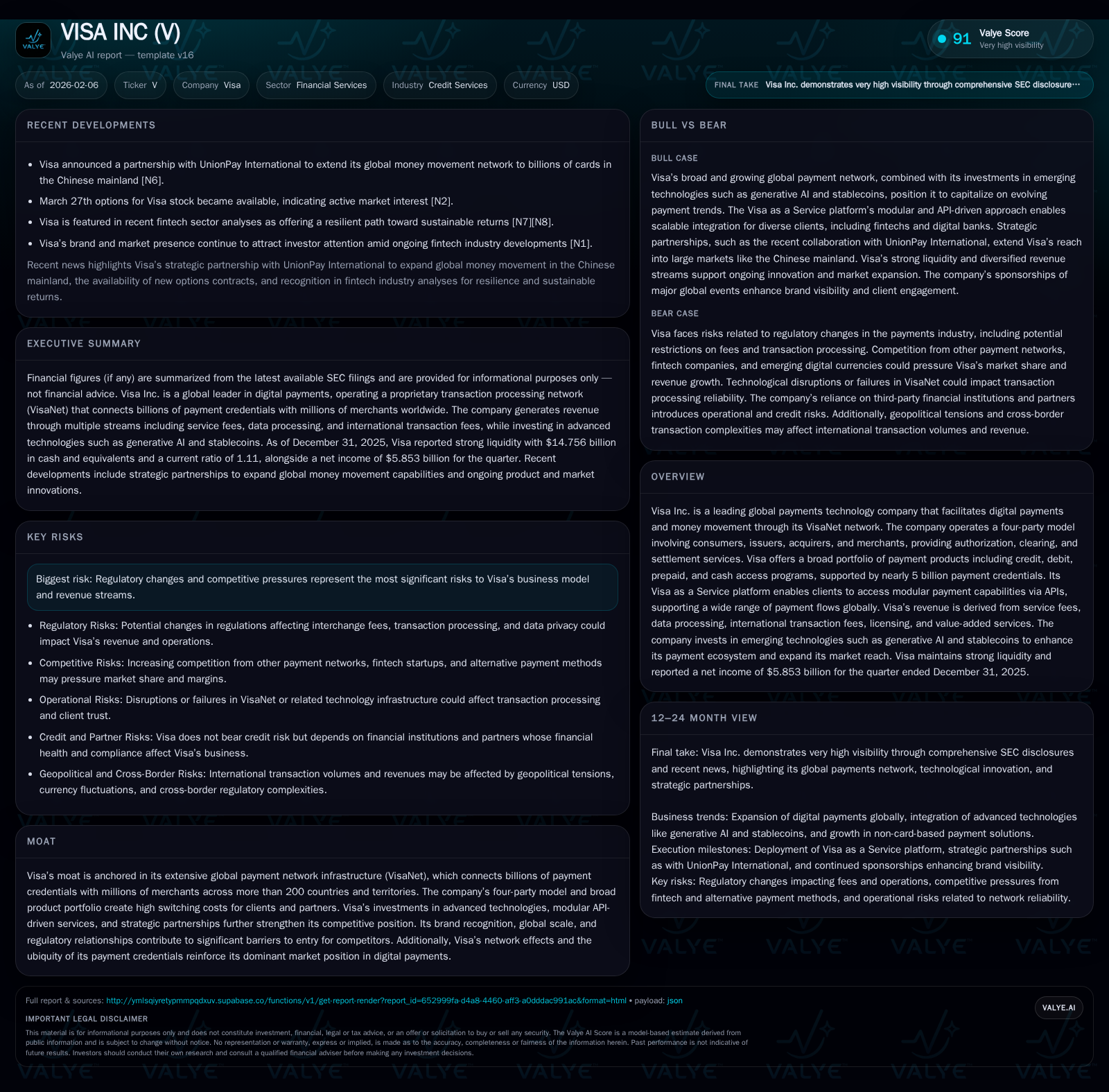
Visa Inc. continues to underpin the global digital payments infrastructure through its extensive VisaNet platform, supporting billions of transactions across more than 200 countries. The company’s recent financial results reflect solid performance driven by growing payment volumes and diversified revenue streams. Visa’s competitive moat stems from its network effects, brand strength, and API-enabled platform stickiness, complemented by innovative moves into generative AI and blockchain technologies such as stablecoins. However, regulatory uncertainties and intensifying competition remain key risks that the company must navigate carefully. Its strategic partnership with UnionPay further broadens its cross-border reach, particularly in Asia, positioning Visa for long-term growth despite evolving headwinds.
Visa’s Payments Empire: Building on a Global Network
At the heart of global commerce stands Visa Inc., an indispensable engine powering countless daily transactions that consumers scarcely notice but fundamentally rely on. Through the VisaNet infrastructure, the company facilitates seamless authorization, clearing, and settlement services via a sophisticated four-party model connecting consumers, issuers (banks), acquirers, and merchants. This architecture underpins an ecosystem accommodating credit, debit, prepaid cards, and cash access solutions backed by close to five billion payment credentials worldwide. Extending across more than 200 countries and territories, Visa’s reach enables it to process an immense volume of daily payments, translating into substantial service fees and data processing revenues that form the backbone of its business [valye_report_excerpt].[S1]
Visa's portfolio diversity complements its extensive connectivity — spanning from traditional card products to emerging digital payment flows enabled by its API-first Visa as a Service platform. This modular design grants partners flexible access to payment functionalities tailored to regional and global needs alike. Such scale creates not merely impressive transaction volumes but entrenched dependencies among stakeholders ranging from financial institutions to retailers.
Financial Pulsecheck: Latest Earnings and Key Metrics
Visa announced first-quarter results for fiscal 2026 showcasing resilient top-line growth with revenues reaching nearly $22 billion (latest reported annual figure) and net income holding strong at approximately $5.85 billion [F1]. The company’s liquidity position remains robust with over $14.7 billion in cash and equivalents as of December 31, 2025 [F1]. Its current ratio of around 1.11 indicates sound short-term financial health despite the capital-intensive nature of payments infrastructure.
Market reception to these results was generally positive with muted volatility post-announcement [N3][N4]. Growth drivers notably include sustained consumer spending levels globally along with expansion in international transaction fees reflecting cross-border activity normalization post-pandemic disruptions. Additionally, emerging digital channels contribute incrementally to processing volumes benefiting both base revenue streams and value-added service fees.
Decoding the Moat: Network, Brand, and Switching Costs
Visa’s competitive advantages emanate primarily from the potent network effects inherent in its global footprint—a virtuous cycle where more cardholders attract more merchants accepting Visa, which in turn entices additional issuers to promote the brand. This interconnectedness builds enormous barriers to entry for new competitors given the cost and complexity involved in replicating such a sprawling four-party system.
Brand equity amplifies this moat; Visa remains synonymous with secure and reliable payments worldwide. Moreover, high switching costs exist because changing payment networks involves not only technological integration challenges but also significant consumer behavior shifts.
The company‘s evolution toward modularity via its API-driven platforms enhances platform stickiness among clients who increasingly integrate Visa’s services deep into their own digital ecosystems [valye_report_excerpt.moat].[S1 Item 1A] However, Visa recognizes weakening forces including evolving regulatory landscapes mandating increased transparency or fee caps plus disruptive entrants offering alternative digital wallets or real-time payments architectures.
Innovation at Play: Generative AI, APIs, and Stablecoins
Keeping pace with technological evolution forms a core pillar of Visa's strategy. Recent investments targeting generative artificial intelligence aim to streamline fraud detection protocols and optimize personalized consumer experiences—elements critical for scaling volume without proportional risk increases [valye_report_excerpt].
Simultaneously, Visa actively explores blockchain applications anchored by stablecoins that promise lower friction cross-border payments with enhanced settlement efficiency [N14]. These initiatives are not mere experimental efforts; instead they align with growing client demands for seamless omnichannel experiences extending beyond traditional card rails.
Visa’s API-centric Visa as a Service platform crystallizes this vision by enabling developers to embed payment functions natively within diverse applications—from retail checkout flows to gig economy disbursements—signaling a shift from monolithic product offerings toward flexible fintech partnerships.
Navigating Regulatory Currents and Competitive Pressures
Global payment networks like Visa face mounting regulatory scrutiny focused on data privacy standards, interchange fee regulation, anti-money laundering protocols, and competition policies [valye_report_excerpt.risks][S1.Item 1A Risk Factors]. Various jurisdictions contemplate measures that could compress fee structures or impose operational constraints, raising uncertainty on future revenue trajectories.
Competition exacerbates these challenges. Fintech disruptors leveraging real-time payments systems or direct bank-to-consumer models chip away at traditional advantages [N13]. While Mastercard presents a parallel case facing similar headwinds yet maintaining optimism through innovation investments [N13], Visa must sustain differentiated offerings aligned with compliance commitments.
Navigating this landscape requires careful balancing—preserving core processing efficiencies while proactively engaging regulators to shape emerging frameworks conducive to continued growth.
Cross-Border Momentum: The Visa-UnionPay Partnership
A noteworthy strategic milestone is the recent linkage between Visa's network and China’s UnionPay [N8]. This arrangement enables smoother cross-border money flows bridging Asia’s dominant payments ecosystems with the rest of the world—beneficial given China's sizeable outbound tourism expenditures and international trade activity.
This partnership potentially unlocks substantial incremental transaction volumes by simplifying acceptance for UnionPay cardholders visiting overseas destinations while allowing merchants globally access to China's vast consumer base without onerous integration overheads.
For Visa, this represents more than revenue upside; it fortifies geographic diversification amidst geopolitical uncertainties affecting other corridors while enhancing competitive positioning vis-à-vis local Chinese platforms seeking global traction.
Investor Lens: Valuation, Dividends, and Market Sentiment
From an investor perspective, Visa combines defensive qualities through consistent dividend payments noted recently alongside ongoing share buybacks that support capital return policies [N6]. Options market activity around near-term expirations indicates steady trading interest without extreme volatility signals [N7].
Analyst commentary remains broadly favorable regarding long-term earnings growth potential fueled by technological adoption trends despite cyclical macroeconomic vulnerabilities highlighted during earnings season [N14]. Relative valuation versus sector peers such as PayPal or American Express reflects premium multiple justified partly by scale advantages albeit tempered cautiously given regulatory risks [N2][N9].
These factors collectively paint a nuanced investor sentiment picture balancing strong fundamentals against external headwinds.
Looking Ahead: Risks and Growth Catalysts for Visa
The road forward for Visa is shaped by dual themes—managing material risks while capitalizing on strategic growth levers. Regulatory uncertainty tops risk considerations as policymakers globally reassess digital finance frameworks impacting fees or data governance directly related to Visa’s core operations [valye_report_excerpt.risks][S1.Item1A].[N3]
On competitive fronts, protecting against encroachment from nimble fintech entrants requires continuous innovation investment coupled with portfolio expansion via partnerships like that with UnionPay fostering cross-border volume gains.
Conversely growth catalysts include accelerating adoption of AI-driven risk management tools improving operational efficiency; expanding stablecoin use cases potentially reducing settlement frictions; evolving API ecosystems enabling tailored client solutions; plus leveraging unparalleled scale through network effects sustaining robust market share [valye_report_excerpt.moat]. These dynamics suggest room for sustained value creation if managed adeptly amid evolving industry structures.
This analysis synthesizes publicly available information as of early 2026. It intends informational clarity rather than investment recommendation. Readers should incorporate their independent judgment considering personal circumstances before making financial decisions.
Disclaimer: This is research-only, informational analysis and not investment advice. It may include AI-generated interpretation and general industry context. Always verify important details using primary sources.

Comments