
Twin Vee PowerCats’ Financial Strides and Strategic Hurdles in Recreational Boating
The company balances incremental revenue growth with persistent losses amid operational complexities and strategic pivots.
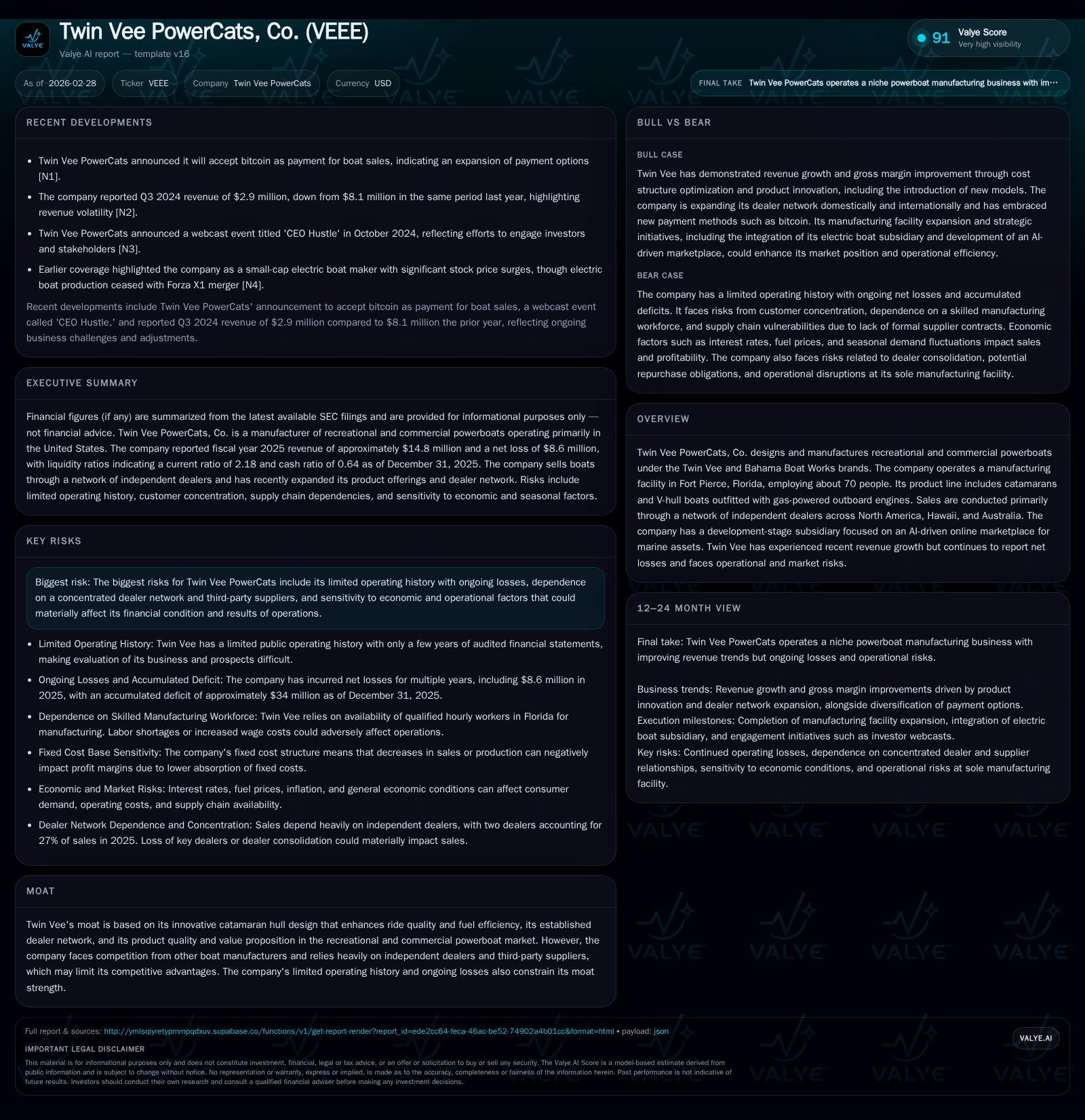
Twin Vee PowerCats has exhibited modest revenue improvement through 2025, leveraging its proprietary catamaran designs and dealer network expansion. Despite this top-line progress, the company continues to grapple with substantial operating losses accentuated by fixed manufacturing overhead and supply chain dependencies. Capital raises, including a $3 million equity offering in early 2026, underpin ongoing liquidity needs, while the firm confronts legal challenges tied to prior mergers. Strategic initiatives such as an AI-driven marine marketplace subsidiary and Black Line Defense reflect management’s push into new markets, albeit with execution risks. Monitoring profitability inflection, cash flow stabilization, and litigation outcomes will be critical going forward.
The Path So Far: Revenue Growth Versus Persistent Losses
Twin Vee PowerCats’ recent financial trajectory reflects a cautious recovery in revenue coupled with continuing operating deficits that underscore structural challenges. In fiscal year (FY) 2025, the company reported revenues of approximately $14.8 million, edging up 3% from $14.4 million in FY2024 [F1]. This follows a more volatile pattern seen in prior years where revenues peaked above $31 million in FY2023 before contracting — likely reflective of market cyclicalities inherent to recreational boating.
Despite this topline resilience, profitability remains elusive. Operating losses though less severe than previous years totaled $8.78 million in FY2025 compared to $14.55 million in FY2024 — an improvement of nearly 40% [F1]. Net losses similarly narrowed from approximately $11 million to $8.6 million over the same period. However, the company’s inability to turn positive underscores persistent fixed production overhead pressures that impair margin expansion when volumes fluctuate.
Operating cash flows have remained negative and largely unchanged at close to -$6.9 million annually over the last two years [F1]. Notably, capital expenditures plunged by two-thirds year-over-year from $6.3 million down to about $2.1 million as the company moderated investment intensity following prior capacity buildouts [F1]. The contraction likely improved cash burn but also signals cautious capital deployment in view of ongoing losses.
Historical performance (annual)
| FY | Rev ($mm) | Net ($mm) | CFO ($mm) | OpInc ($mm) | Rev YoY | Net YoY |
|---|---|---|---|---|---|---|
| 2025 | 15 | -9 | -7 | -9 | +3.0% | +22.1% |
| 2024 | 14 | -11 | -7 | -15 | -57.0% | -53.6% |
| 2023 | 33 | -7 | -7 | -12 | +4.5% | -24.1% |
| 2022 | 32 | -6 | -4 | -6 |
Source: SEC companyfacts cache [F1].
Capital returns and efficiency (annual)
| FY | Buybacks ($) | FCF ($mm) | ROE% |
|---|---|---|---|
| 2025 | -9 | -63.9 | |
| 2024 | 21379 | -13 | -57.5 |
| 2023 | 21379 | -12 | -30.6 |
| 2022 | -8 | -20.4 |
Source: SEC companyfacts cache [F1].
Revenue showed modest growth after a steep decline; operating losses improved notably but remain sizable; capex was aggressively cut.
Manufacturing Footprint and Workforce: Foundation and Risks
The company’s production base is situated at Fort Pierce on Florida’s Atlantic coast where it employs roughly 70 individuals engaged primarily in hour-based fabrication labor essential for composite hull construction [S1]. This workforce forms the shop floor backbone supporting Twin Vee’s vertical integration strategy encompassing lamination processes and CNC tooling.
However local labor market dynamics present tangible challenges — Florida’s low unemployment is elevating wage demands for skilled assemblers and technicians vital to boat manufacturing quality standards [S1]. Twin Vee acknowledges potential unionization efforts may emerge which could raise labor cost volatility further if realized.
Fabrication labor availability directly influences throughput given nuances in mold curing times and precision assembly requirements unique to catamaran hulls versus traditional monohulls [S1]. Wage inflation risk translates into margin pressure since these costs represent a substantial portion of fixed production overhead that cannot be easily scaled down without sacrificing capacity.
Market Positioning: Catamaran Innovation and Competitive Landscape
Twin Vee asserts competitive differentiation based on its dual-hull catamaran design approach that enhances ride smoothness while optimizing fuel efficiency relative to typical V-hull powerboats [F1],[S18]. This engineering edge aims squarely at both recreational users valuing comfort and commercial operators seeking durable utility vessels.
Distribution occurs predominantly through an extensive network of independent dealers dispersed across North America plus key niche markets like Hawaii and Australia where boating culture is robust [S18]. These dealers enable broader market reach though also introduce channel risk particularly under tightening credit conditions impacting consumer financing.
Competition remains intense among powerboat manufacturers offering varying hull styles with differentiated features ranging from luxury outfitting to performance speed boats [S18]. Twin Vee’s continued ability to innovate within its technology niche while maintaining value positioning will be critical against competitors with deeper capital resources or vertically integrated supply chains.
Capital Structure and Liquidity: Recent Equity Raise and Financial Health
Facing sustained losses and cash burn pressures Twin Vee conducted a best-efforts public offering in February 2026 raising approximately $3 million gross proceeds by selling over six million shares at around $0.47 each [S3],[S6],[S9],[F1]. This infusion represents part of an ongoing effort to replenish liquidity after cash reserves dwindled from nearly $7.7 million at end-2024 down to about $1.64 million by end-2025 [F1],[S9].
At December 31st 2025 the current ratio stood at approximately 2.18 indicating short-term obligations can be met given existing assets [F1]. Nevertheless management explicitly highlighted "substantial doubt" regarding going concern viability absent successful capital raises or operational turnaround within the coming year [S9].
The weighted dilution effect related to share issuance should be contextualized against necessity for funding operations as failure would risk production halts or inability to invest in new product development [S9]. Twin Vee carries minimal long-term debt ($522k), suggesting equity capital remains primary financial lever [F1],[S9].
Operational Costs and Fixed Expense Leverage
The company’s manufacturing expense base embodies high fixed components including large-scale composite mold maintenance costs alongside semi-fixed labor contracts [S1],[S7]. Resin-based materials feature prominently in bill of materials whose pricing exhibits sensitivity to oil price fluctuations thereby impacting raw material costs disproportionately versus volume changes [S1].
Energy price swings further amplify operational expenditure unpredictability especially shipping marine units internationally or across U.S regions served by dealers [S1]. The combined effect generates pronounced operating leverage whereby modest downward variations in unit sales disproportionately erode margins given rigid cost structures.
Efforts aimed at cost control during FY2025 manifested as substantially lower capital spending relative to prior years facilitating partial absorption relief on operating losses but are insufficient thus far to restore positive EBITDA performance [S7],[F1].
Litigation Landscape: Potential Impact of Ongoing Legal Proceedings
Since March 2025 Twin Vee has been defending itself against a putative class action lawsuit filed by former Forza X1 shareholders challenging the terms of a merger that integrated Forza into Twin Vee’s corporate structure [S4],[S5],[S11]. Allegations include breach of fiduciary duties directed at certain officers/directors including CEO Visconti.
While management denies wrongdoing vigorously the case remains active with indeterminate ultimate outcomes or financial repercussions; no litigation reserve has been recorded reflecting this uncertainty [S11]. Litigation burdens carry not only direct defense expenses but could cause management distraction or reputational impacts detrimental especially given Twin Vee’s modest scale relative to counterparties involved.
Further contingent liabilities tied to future regulatory or commercial claims exist per ongoing risk disclosures but none have been deemed materially adverse presently [S12],[S17].
Next Horizons: AI-Driven Marketplace and Growth Constraints
Twin Vee maintains an early-stage subsidiary devoted to developing an AI-enabled digital platform aiming to transform online discovery and transaction workflows for marine asset buyers/sellers as well as Black Line Defense — a wholly owned arm focusing on autonomous maritime platforms targeted at government defense/security contracts valued in multiple billions over coming years [S14],[S21]. This leverages existing manufacturing expertise but operates with limited incremental capital deployment assisting prudent risk containment.
However these growth vectors face execution hurdles linked tightly with existing dealer reliance constraining go-to-market flexibility plus unclear roadmap timing for scalable monetization currently lacking public milestones.
Key Metrics to Track: What Investors Should Watch
Looking ahead stakeholders should monitor several leading indicators reflective of Twin Vee’s operational health:
- Revenue trajectory beyond FY2025 gains indicating demand sustainability amid macroeconomic sensitivities affecting discretionary spend on recreational boats.
- Movement toward improved operating margins or positive EPS evidence signaling gradual fixed cost absorption underput volumes rise.
- Operating cash flow trends coupled with capital expenditures revealing whether cash burn narrows or FCF turns positive which are prerequisites for longer-term viability.
- Progress updates on AI-driven marketplace launch timelines plus Black Line Defense contract wins evidencing successful diversification execution.
- Resolution status of material litigation cases involving merger-related shareholder suits impacting risk profile.
- Ongoing liquidity metrics including capital raises frequency plus cash balance evolution that gauge runway extension capability under challenging loss-incurring operation scenarios.
This analysis uses reported financials and disclosed facts strictly as presented without speculative forecasts or investment recommendations.
Disclaimer: This is research-only, informational analysis and not investment advice. It may include AI-generated interpretation and general industry context. Always verify important details using primary sources.

Comments