
Vertex's Recovery Tradeoff: Profitability Improvement Amid Increased Investment and Competitive Risks
Vertex, Inc. has returned to operating profitability in 2025 leveraging its extensive tax-content platform but faces margin pressure from heightened R&D and sales investments.
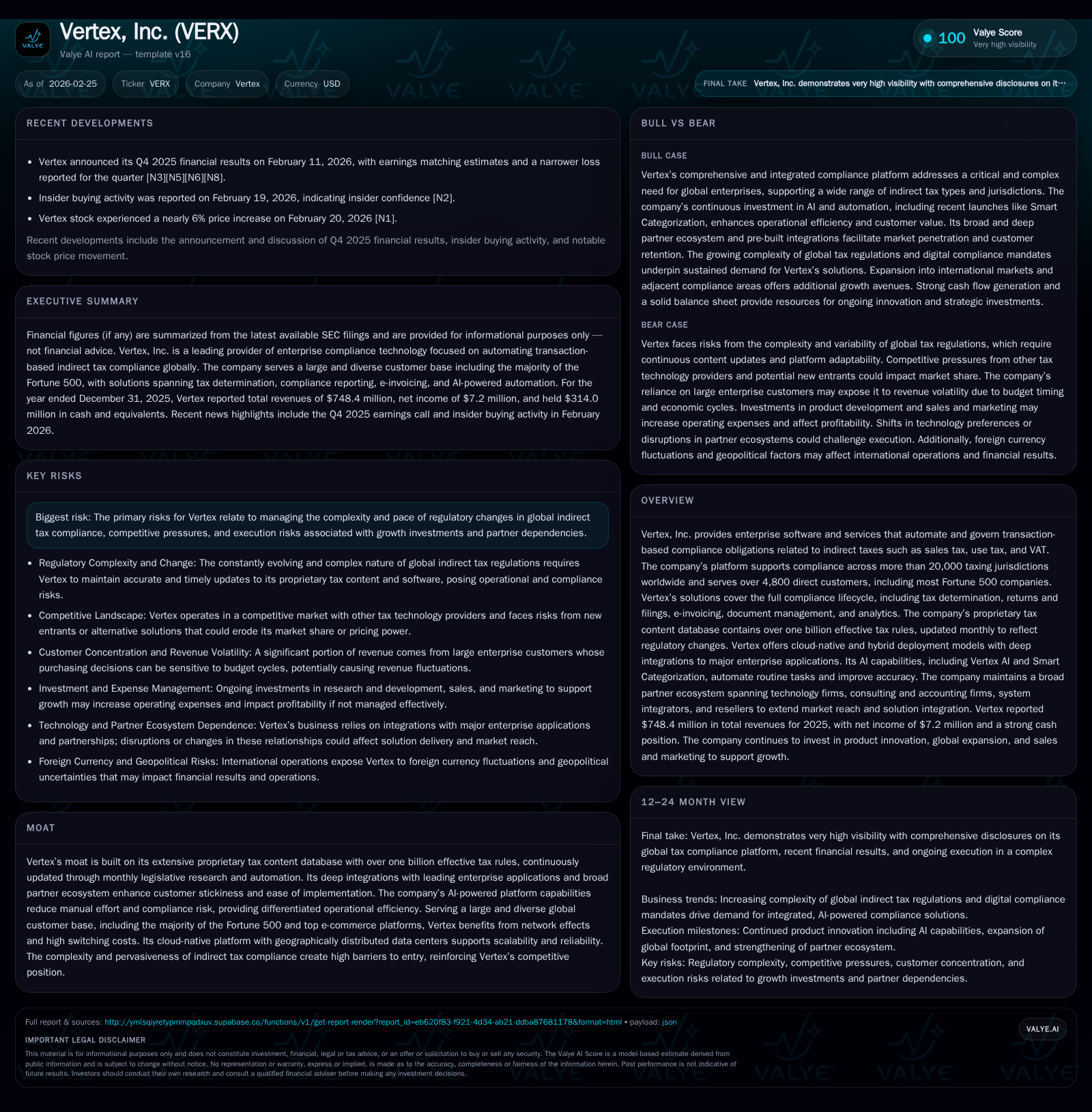
Vertex, Inc., a leading provider of enterprise indirect tax compliance software, reversed multi-year operating losses in 2025, posting $2.3 million in operating income and $7.2 million in net income after significant prior losses. Growth was supported by steady operating cash flow of $165.5 million and investments in AI capabilities and global expansion, reflected in higher R&D and selling expenses. However, free cash flow declined due to elevated capital expenditures, reflecting infrastructure scaling and product innovation efforts. The company retains a robust market position through a vast tax rule database and deep enterprise integrations but must navigate ongoing regulatory complexity, competitive pressures, and execution risks for continued growth.
Company Overview and Competitive Position
Vertex, Inc. stands as a pivotal player in enterprise compliance technology focused on automating indirect tax obligations—sales tax, use tax, VAT—across more than 20,000 taxing jurisdictions worldwide [S1][S7]. The firm addresses the intricate compliance requirements embedded within virtually every sales or purchase transaction performed globally, offering a comprehensive platform covering tax determination, returns filing, e-invoicing, document management, and real-time analytics.
Central to Vertex’s moat is its proprietary tax content database housing over one billion active tax rules that are refreshed monthly via legislative research augmented by automation [S7]. This database serves as a foundational asset enabling superior accuracy and adaptability amidst evolving tax regulations and digital mandates across major markets including the U.S., Canada, Europe, Brazil, and other regions where the company has expanded operations following acquisitions such as ecosio GmbH for e-invoicing capabilities [S11][S18][S24].
Deep integrations with leading ERP platforms (Oracle, SAP, Microsoft Dynamics) and a broad network of system integrators enhance the stickiness of Vertex’s offerings by embedding compliance into customers’ core financial systems [S7][S11]. Approximately 55% of its software subscription revenues now derive from cloud-based solutions (up from 49% the prior year), underscoring a material shift towards scalable deployment models preferred by midmarket to large enterprises [S11].
Historical Financial Performance
Vertex’s financial trajectory entering 2025 reflects a turnaround phase characterized by improved profitability metrics after consecutive years of operating losses:
Historical performance (annual)
| FY | Net ($mm) | CFO ($mm) | OpInc ($mm) | Capex ($mm) | Net YoY |
|---|---|---|---|---|---|
| 2025 | 7 | 166 | 2 | +113.7% | |
| 2024 | -53 | 165 | -2 | -302.7% | |
| 2023 | -13 | 74 | -18 | 49 | -6.4% |
| 2022 | -12 | 77 | -8 | 59 |
Note: Omitted columns lack sufficient annual XBRL coverage in the provided tags (need ≥2 annual points): Rev, Div, Buybacks. Source: SEC companyfacts cache [F1].
Capital returns and efficiency (annual)
| FY | FCF ($mm) | ROE% |
|---|---|---|
| 2025 | 2.8 | |
| 2024 | -29.4 | |
| 2023 | 25 | -5.2 |
| 2022 | 18 | -5.4 |
Source: SEC companyfacts cache [F1]. |* FCF = CFO minus Capex (capitalized software + PPE); Capex approximated **Approximation integrating property & equipment additions plus capitalized software deductions [F1]
~ Despite negative operating income in prior years (notably wide loss of $17.5M in 2023), Vertex achieved modest positive operating profitability in FY25 reflecting substantial progress [F1]. ~ Net income sharply improved from heavy losses reflecting operational leverage gains alongside changes in income tax accounting related to deferred assets (not detailed here). ~ Operating cash flow remained robust above $160 million over the last two years evidencing strong underlying business cash generation independent of GAAP earnings volatility. ~ Capital expenditures remain elevated compared to historical levels as Vertex invests heavily into expanding cloud infrastructure capacity and advancing software innovation.
Drivers Behind Past Performance
Key factors underpinning this financial improvement include:
- Sustained investments enabling cloud transition driving recurring subscription revenue growth.
- Expansion into high-growth compliance segments such as e-invoicing following ecosio acquisition [S18][S24].
- Strengthening partner ecosystems increasing cross-sell opportunities with integrated ERP channels.
- Product innovation centered around AI enhancements including Smart Categorization which automates manual tax classification tasks reducing client friction [S27].
- Improved operational discipline balancing growth investments with cost controls despite rising R&D expenses.
Nonetheless, gross margin pressures emerged due to increased selling & marketing spend (+15%) supporting go-to-market scale required for new customer acquisition as well as retention efforts [S27]. Research & development costs similarly grew markedly (+25%), an indication of strategic prioritization on next-gen AI-powered offerings despite near-term earnings dilution [S27].
Outlook: Growth Prospects and Constraints
Vertex’s future revenue growth is primarily poised to benefit from:
- Increased adoption among existing multinational customers expanding product usage across indirect tax types beyond sales/use to encompass VAT and complex reporting obligations globally [S10][S11].
- Geographic expansion particularly within Europe (leveraging ecosio), Latin America (Brazil via Systax consolidation), Canada alongside strong U.S footprint [S10][S11].
- Continued shift from on-premise deployments to cloud subscriptions accelerating recurring revenue streams benefiting scalability [S11].
- Innovation pipeline including AI-driven automation tools expected to reduce compliance cost burdens creating additional demand drivers [S27].
- Growing penetration into digital marketplaces where complex cross-border transaction taxation is prevalent ensuring steady ecosystem lock-in [S11].
However, several factors could cap this growth trajectory:
- Regulatory risk remains pronounced; keeping pace with monthly macro changes globally requires ongoing content updates which present execution challenges [S15][S19]. Vertex also faces risk relating to potential regulatory reinterpretation regarding its role in money transmission activities tied to remittance services possibly incurring licensing requirements or compliance costs [S23].
- Competitive pressure arises from other major tax-software providers as well as incumbent ERP native functions increasingly integrating indirect tax features forcing continued differentiation through technology or alliances [S1][S15].
- Execution risks around scaling sales efforts efficiently given increased headcount driving disproportionate operating expense growth relative to revenue increments as observed recently.
- Legal proceedings against competitor Avalara pose uncertainties around trade-secret litigation outcomes which could entail operational distraction or financial impact [S15].
- Macroeconomic conditions influencing customer spending on software licensing or upgrades may moderate near-term bookings.
Capital Allocation and Returns
Vertex exhibits cautious capital stewardship balancing reinvestment with shareholder returns:
- Share repurchases totaled $10.1 million during FY25 under an authorized $150 million repurchase program initiated late-2025 — relatively modest compared to operational cash flow capacity indicating preserved flexibility for reinvestment needs or acquisitions [S6][F1].
- No dividends were reported or highlighted suggesting focus remains on growth investment rather than immediate shareholder yield enhancement.
- Cash & equivalents stood at a healthy $314 million at FY-end supporting liquidity positioned for future strategic initiatives or debt servicing if needed [F1].
- Current ratio below parity (~0.98) signals near-term liability commitments roughly matched by current assets; however no major credit concerns are noted given covenant compliance on credit facilities with no borrowings drawn at period-end [S6][F1].
- Approximate return on equity for FY25 calculated at ~2.8%, illustrating nascent profitability recovery though still modest compared to sector norms; improvement reflects transition from heavy prior losses more than sustained earnings strength currently [F1].
Milestones and Forward Indicators to Monitor
Absent explicit company guidance disclosures for FY26 at this time [N1][N3], market watchers should track indicators such as:
- Revenue or ARR trajectories specifically by geography division showing progress in international expansion efforts.
- Cloud subscription mix percentage increases indicating accelerated customer migration benefits.
- R&D expense trends signaling intensity of innovation pipeline activity balanced against margin impacts.
- Quarterly commentary on legal proceeding developments regarding Avalara lawsuit which remains ongoing.
- Updates around regulatory landscape shifts notably relating to real-time compliance mandates or money transmitter classifications impacting operational scope.
- Free cash flow trends highlighting ability to sustain investments while generating discretionary capital for shareholder programs.
Conclusion
Vertex is navigating a pivotal phase where foundational technological assets coupled with broad enterprise integrations have delivered modest profitability gains reversing several years of loss-making performance despite macro complexity inherent in indirect tax compliance globalization. The firm’s large proprietary rule set combined with innovative AI-powered automation tools strengthens competitive barriers while multiple distribution channels via ERP partners reinforce ecosystem entrenchment. However growth is tempered by increasing investment demands reflected in narrowed free cash flows alongside uncertainties tied to evolving regulations and legal challenges thus preserving execution risk vigilance as essential going forward. Continuing transformation toward cloud-native solutions aligned with customer digital modernization potentially sets stage for sustainable long-term expansion contingent upon balancing innovation costs against scalable profitability ramps.
Disclaimer: This analysis is intended solely for informational purposes based on publicly available data as of early 2026 without offering investment advice.
Disclaimer: This is research-only, informational analysis and not investment advice. It may include AI-generated interpretation and general industry context. Always verify important details using primary sources.

Comments