
Vicor Corp Expands Modular Power Solutions Amid Intensifying AI and HPC Demand
Vicor leverages proprietary Factorized Power Architecture to serve high-growth data center and industrial segments with modular power components.
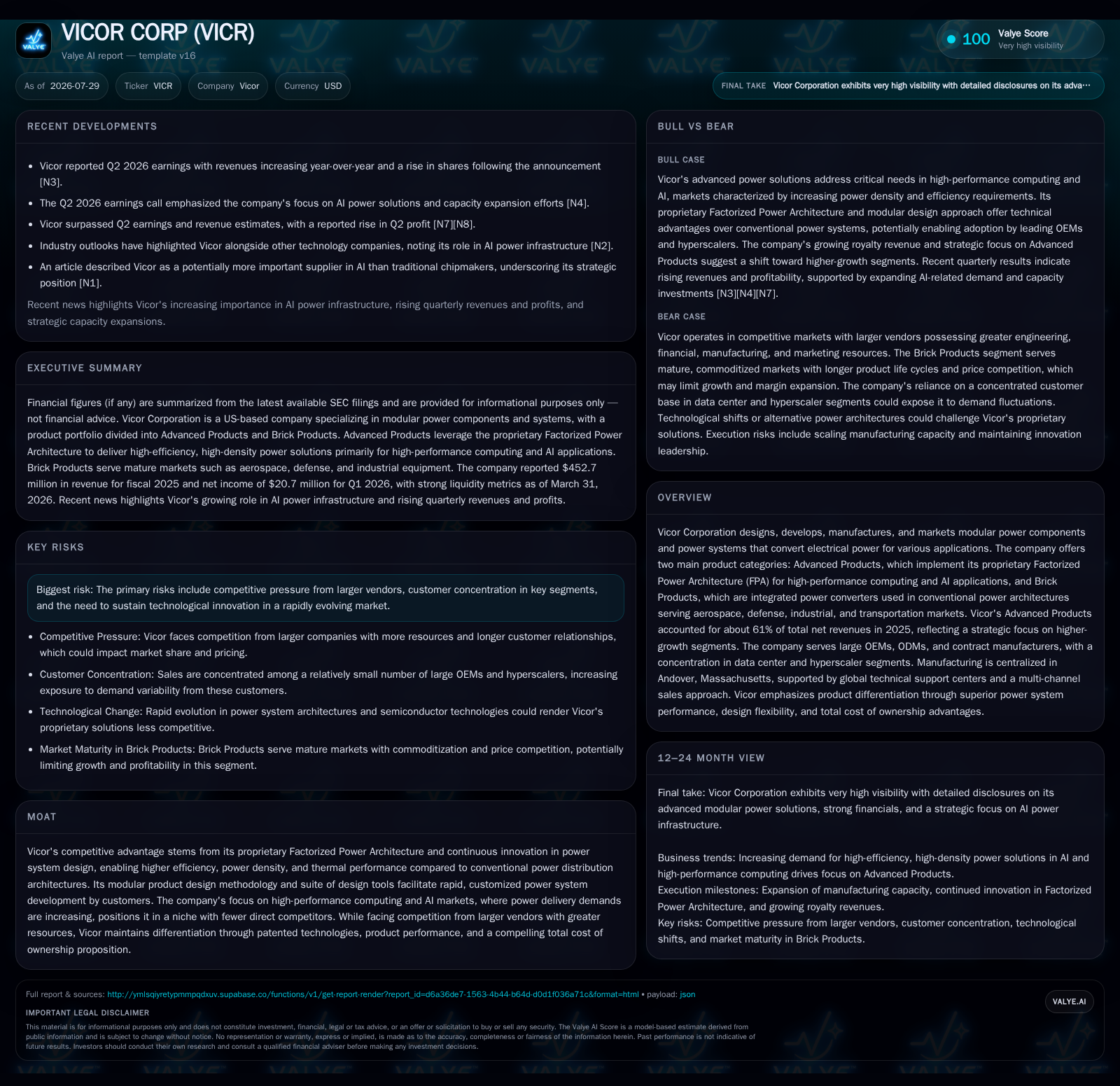
Vicor Corporation’s latest quarterly filing reveals continued strategic emphasis on modular power systems tailored for high-performance computing (HPC) and AI applications, with Advanced Products representing the majority of revenues. The company maintains competitive differentiation through patented power conversion technologies and a concentrated customer base predominantly in hyperscale data centers. Operating risks center on customer concentration, supply chain complexity, and sustaining innovation in semiconductor-based power modules. Vicor’s financial position remains strong, supported by ample liquidity and efficient capital management, positioning the company to capitalize on growing demand driven by AI workloads and electrification trends.
Recent Operating Update: Q2 2026 Highlights
Vicor Corporation reported strong operational momentum in Q2 2026, driven by robust order backlogs entering Q3 that reflect sustained demand from OEMs for modular power components tailored to AI accelerators and high-performance computing (HPC) infrastructure [N1]. The company continues to operate under a consolidated single-segment structure, integrating design, manufacturing, sales, and engineering support functions to optimize resource allocation and financial oversight [S2]. This streamlined organizational model enhances Vicor’s agility in responding to the cyclical and often volatile order patterns typical of hyperscale data center customers.
Q2 revenues and operating profitability exceeded consensus expectations, supported by increased shipments of Advanced Products—Vicor’s high-efficiency modular power converters leveraging its proprietary Factorized Power Architecture (FPA)—which accounted for approximately 61% of net revenues in 2025 [S1][S2][N2]. The company’s order backlog grew sequentially, signaling stable demand visibility despite the inherent cyclicality associated with large-volume hyperscaler contracts [S1].
Business Model: Modular Power Systems with Proprietary Architecture
Vicor’s revenue generation centers on the design, manufacturing, and sale of modular AC-DC and DC-DC power conversion systems primarily to OEMs, original design manufacturers (ODMs), and contract manufacturers serving hyperscale data centers, aerospace and defense electronics, industrial equipment, transportation electrification (including autonomous and electric vehicles), and telecommunications infrastructure [S1]. The company’s product portfolio is bifurcated into Advanced Products—featuring the patented FPA technology optimized for ultra-high power density and conversion efficiency—and Brick Products, which are more conventional integrated power modules targeting established aerospace and industrial applications.
The monetization model relies on fulfilling large-volume contracts with a concentrated customer base that demands highly customized, compact power solutions capable of delivering superior wattage per volume (power density) and minimizing energy loss (conversion efficiency). Vicor’s competitive differentiation stems from continuous innovation in semiconductor switching topologies, advanced packaging techniques, and proprietary magnetic component designs embedded in patented semiconductor modules [S1]. This technology enables customers to integrate modular power building blocks rapidly into their hardware platforms, supported by Vicor’s comprehensive suite of design tools and engineering collaboration.
In addition to direct product sales, Vicor generates royalty revenue by licensing its patented FPA technology to partner manufacturers [S1]. This licensing strategy extends the company’s market reach and creates recurring income streams beyond hardware shipments, supporting ecosystem expansion and reinforcing competitive barriers
Industry Structure and Competitive Position
Operating within the midstream segment of the power electronics value chain, Vicor competes against integrated circuit manufacturers specializing in power management (such as Texas Instruments’ power segment) and modular power module suppliers like Analog Devices. The company’s patented FPA architecture provides a technological edge by delivering higher conversion efficiencies and power densities compared to conventional power conversion architectures, which is critical in AI and HPC applications where thermal performance and space constraints are paramount.
Customer concentration is a notable characteristic of Vicor’s business, with a limited number of hyperscale data center OEMs accounting for a significant portion of revenues. This concentration introduces revenue volatility linked to the timing and scale of large project deployments but also fosters deep collaborative relationships that enhance product customization and switching costs. Key operating metrics for benchmarking include power conversion efficiency percentages, watt-to-volume ratios reflecting thermal and spatial optimization, R&D expenditure as a percentage of sales indicative of innovation intensity, and order backlog trends that provide forward-looking demand visibility.
Growth Drivers
Vicor’s growth trajectory is closely tied to the escalating power delivery demands driven by AI training and inference workloads proliferating across global data centers. These workloads increase aggregate system power densities, necessitating advanced semiconductor-based converters that offer exceptional efficiency gains within smaller form factors—areas where Vicor’s proprietary FPA technology is particularly relevant [N8][N10].
Simultaneously, the expansion of transportation electrification—including hybrid and electric vehicles as well as autonomous mobility platforms—opens new application niches requiring ruggedized, modular power systems adaptable to diverse voltage and current specifications. The aerospace and defense sectors continue to provide steady demand, particularly for Vicor’s Brick Product lines, which are valued for reliability and compliance with stringent operational standards [S1].
The licensing model adds an additional growth vector by monetizing intellectual property beyond hardware sales, providing revenue diversification and scalability. Concurrent investments in semiconductor fabrication capacity and manufacturing process improvements aim to alleviate supply constraints, improve production capacity utilization, and reduce lead times—critical factors for meeting surge orders efficiently without compromising yield or quality.
Risks and Watchpoints
High customer concentration remains a material risk factor; unexpected delays or cancellations from key hyperscale clients could disproportionately affect quarterly revenues due to the strategic emphasis on large-volume accounts [S1]. Supply chain dependencies for specialized semiconductor materials and proprietary components pose operational challenges, as limited alternative suppliers exist for these critical inputs. Any disruption in sourcing could delay production schedules or increase costs.
Sustaining technological leadership through continuous innovation in switching topologies, packaging, and materials is essential to avoid commoditization pressures that could erode pricing power and margins. Competition from larger firms with broader resources intensifies pressure on R&D investments and market share.
Operational risks include managing complex product qualification cycles demanded by hyperscale customers, which can extend average delivery lead times and impact revenue recognition timing. Additionally, compliance with evolving global regulatory standards—particularly environmental and manufacturing quality regulations—adds complexity and potential cost burdens.
What To Watch Next
Key indicators to monitor include sequential changes in order backlog reported in upcoming quarterly filings, which serve as leading signals of demand momentum. Progress updates on capacity expansion initiatives and semiconductor fabrication upgrades will be critical for assessing Vicor’s ability to scale production economically and meet growing AI-driven demand.
Shifts in the revenue mix between Advanced and Brick Products will provide insight into the company’s success in capturing higher-margin, high-growth AI/HPC segments. Royalty revenue trends will also be important to evaluate the effectiveness of the licensing strategy in broadening intellectual property monetization [N3][N5]. Finally, management commentary on supply chain resilience and risk mitigation amid geopolitical uncertainties will offer perspective on operational stability.
Financial Profile Discussion
As of March 31, 2026, Vicor reported cash and cash equivalents of approximately $404 million against current liabilities of $42 million, resulting in a strong current ratio of about 14.3x, which provides substantial liquidity and operational flexibility amid cyclical demand fluctuations and capital expenditure needs [F1][S2]. This robust balance sheet supports ongoing investments in R&D and capacity expansion critical for sustaining competitive advantage in fast-evolving markets.
The company’s latest full-year operating income was $81.8 million, with net income exceeding $118 million, reflecting solid profitability relative to peers in the R&D-intensive power conversion sector [F1]. However, vigilance is warranted regarding margin sustainability given potential inflationary pressures on costs and competitive pricing dynamics.
Capital allocation appears balanced, with reinvestment into manufacturing capacity and technology development aligned with strategic priorities addressing the expanding AI and electrification markets.
This analysis integrates recent SEC filings with industry-standard KPIs relevant to Vicor Corporation’s role in modular power conversion systems. It underscores the company’s competitive positioning driven by proprietary Factorized Power Architecture technology amid rising power demands from AI computing and electrified transportation sectors, while outlining operational and market risks related to customer concentration, supply chain dependencies, and innovation requirements. All statements are grounded in publicly filed financial disclosures and documented company communications.
Disclaimer: This is research-only, informational analysis and not investment advice. It may include AI-generated interpretation and general industry context. Always verify important details using primary sources.

Comments