
Vital Farms Advances Ethical Food Leadership with Capacity Expansion
A family-farm rooted pioneer in pasture-raised foods grows via network expansion and infrastructure investment amid evolving market dynamics.
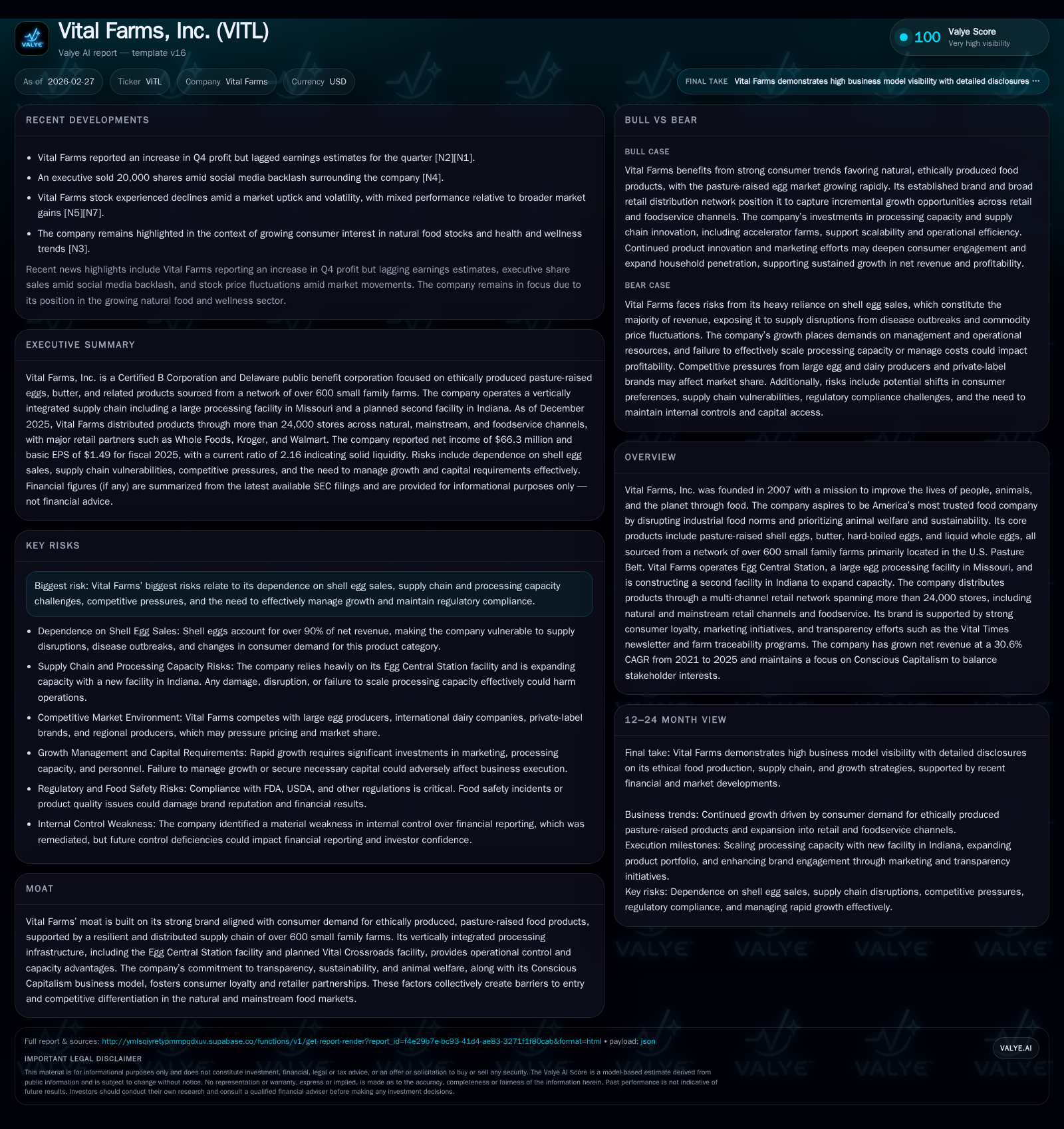
Vital Farms, Inc. has evolved from a small Texas startup into a national leader in ethically sourced pasture-raised eggs and dairy, supported by a distributed network of over 600 family farms and vertically integrated processing. The company’s strong growth in operating and net income through fiscal 2025 reflects successful brand differentiation and expanded retail reach. However, heavy reliance on shell egg sales, supply chain constraints, and regulatory complexities present ongoing risks. Vital Farms has responded by aggressively expanding capacity with its Egg Central Station facility and constructing the Vital Crossroads plant, aiming to mitigate bottlenecks and deepen control over quality and throughput. Cash flow pressures from rising capital expenditures underscore the tradeoff between scaling infrastructure and maintaining financial flexibility.
From Humble Beginnings to National Footprint: Historical Growth and Drivers
Founded in 2007 on a small Texas farm plot with a visionary commitment to ethical food production, Vital Farms has grown into one of the most recognized brands for pasture-raised eggs and dairy in the U.S. Leveraging its core belief that better animal welfare leads to superior products, the company built a resilient supply system comprised of over 600 small family farms predominantly in the U.S. Pasture Belt. This decentralized approach underpins both quality consistency and supply chain resilience.
Financially, Vital Farms demonstrated robust growth through fiscal year 2025. Operating income rose substantially by 39.1% to $88.4 million from $63.6 million in FY24 [F1], validating the firm’s ability to scale profitably amidst broader industry shifts away from factory-farmed products. Net income increased by 24.2% year-over-year to $66.3 million in FY25 from $53.4 million the prior year [F1], signaling improved operational leverage despite inflationary cost headwinds.
The following table summarizes key income and cash flow metrics reflecting this trajectory:
Historical performance (annual)
| FY | Net ($mm) | CFO ($mm) | OpInc ($mm) | Capex ($mm) | Net YoY |
|---|---|---|---|---|---|
| 2025 | 66 | 34 | 88 | 82 | +24.2% |
| 2024 | 53 | 65 | 64 | 29 | +108.8% |
| 2023 | 26 | 51 | 33 | 12 | +1943.6% |
| 2022 | 1 | -8 | 2 | 10 |
Source: SEC companyfacts cache [F1].
Capital returns and efficiency (annual)
| FY | FCF ($mm) | ROE% |
|---|---|---|
| 2025 | -48 | 18.9 |
| 2024 | 36 | 19.8 |
| 2023 | 39 | 13.3 |
| 2022 | -19 | 0.8 |
Source: SEC companyfacts cache [F1].
Significant reinvestment through capital expenditures fueled infrastructure enhancements while cash flows from operations declined notably, highlighting reinvestment outpacing operational cash generation [F1].
Core Product Reliance and the Shell Egg Market Dynamics
Vital Farms derives the vast majority of revenue from shell eggs, making this category critical but also a source of concentration risk [S1],[S2]. Market prices for commodity shell eggs can fluctuate widely based on supply-demand imbalances influenced by factors such as avian diseases or input cost volatility.
This dependence exposes Vital Farms' financial health to risks including pricing pressure relative to commodity competitors who may not adhere to pasture requirements or ethical sourcing standards. Although premium pricing garners consumer loyalty willing to pay a premium for certified pasture-raised eggs, any erosion of this niche could materially impact revenues.
Additionally, as disclosed in filings, failure to introduce successful new products or diversify beyond eggs could cap growth prospects if consumer preferences shift or competitive offerings intensify [S1],[S2]. The company's focus on related products like butter seeks to mitigate some of this concentration but remains secondary.
Expanding Infrastructure: The Role of Egg Central Station and Vital Crossroads
Operational control is anchored by Egg Central Station in Missouri—a large-scale egg washing and packing facility—where Vital Farms has focused on integrating vertical operations within its supply chain [S1],[S2]. This facility is pivotal yet also a single point of potential disruption; any damage or downtime here could significantly affect output.
To address this capacity constraint risk, Vital Farms is constructing the Vital Crossroads facility in Indiana designed with onsite cold storage capabilities that will effectively double their processing throughput when fully operational [S1],[S2]. This expansion represents an aggressive move toward bolstering supply chain resilience while reducing lead times.
The elevated capital expenditures in FY25—up nearly threefold year-over-year—reflect these strategic capacity investments aimed at sustaining growth momentum amid increasing demand for natural foods [F1]. However, such capex surges also amplify near-term cash burn.
Looking Ahead: Growth Prospects and Industry Challenges
Vital Farms plans include accelerating ownership of select "accelerator farms" where innovative farming techniques are piloted before scaling throughout their network—a model intended to enhance productivity without sacrificing animal welfare standards introduced since early FY25 [N4],[S1],[S2]. Further product innovation beyond eggs remains a potential vector but lacks articulated near-term launch specifics.
However, growth is tempered by operational complexities including managing rapid scale-up without diluting quality or breaching stringent regulatory frameworks spanning various U.S states as well as federal agencies overseeing food safety compliance [S7],[S29]. Market changes such as shifting consumer dietary trends or intensified competition from plant-based alternatives also bear monitoring.
Capital Deployment: Investments, Cash Flows, and Shareholder Returns
Vital Farms’ financial strategy balances reinvestment with capital return ambitions under current credit agreements which impose restrictive covenants limiting dividend distributions and share repurchases absent covenant compliance [S5],[S6].
In FY25, operating cash flow declined almost by half versus prior year levels ($33.7 million down from $64.8 million), largely due to surging capital expenditures at $81.9 million—more than doubling previous year spend—resulting in free cash flow turning negative by roughly $48 million [F1].
Equity grew steadily owing primarily to retained earnings accumulation reaching approximately $351 million at fiscal end ’25 with an approximate ROE near 18.9%, demonstrating effective equity utilization despite expanding capex commitments [F1].
Board approval of a $100 million stock buyback program signals intent for shareholder value enhancement; however actual repurchase activity may be curtailed depending on cash flow evolution and debt covenant adherence [S21],[F1].
Competitive Landscape and Brand Differentiation in Natural Foods
Vital Farms’ moat arises from intertwining factors rarely matched concurrently: an ethical brand positioned strongly among progressive consumers demanding pasture-raised certification; an extensive network exceeding 600 independently verified family farms ensuring supply diversity; vertically integrated processing facilities enhancing margin control; plus an explicit commitment to Conscious Capitalism focused on balanced stakeholder value creation beyond pure profit motives ,[N5].
Consumer engagement tools like Traceability initiatives letting buyers see exactly which farm laid their eggs foster trust uncommon among larger industrial producers further cementing loyalty across over 16 million U.S households as noted recently .[N5]
This combination erects substantial barriers against commoditized entrants lacking footprint scale or ethical credentials vital for shelf-space access within natural and mainstream retail channels.
Risk Factors: Supply Chain Fragilities and Regulatory Pressures
Known vulnerabilities intersect product concentration with external shocks including avian influenza outbreaks and egg drop syndrome—all capable of rapidly contracting raw material availability threatening production continuity and product freshness standards required under premium branding mandates [S1],[S7],[S29].
Moreover, the dependency on Egg Central Station exacerbates operational risk concentration raising concerns about single-site disruptions impacting multi-state distribution.
The complex regulatory environment encompasses overlapping FDA food safety standards, state-level cage-free mandates, environmental regulations affecting farmer practices, labor laws governing crew members, advertising claims controls preventing misleading nutrient assertions—as detailed extensively across annual reports—and demands consistent legal oversight alongside compliance investment .
Any lapses potentially trigger costly recalls diminishing brand reputation or fines restricting marketing claims further complicating growth execution.
What to Watch: Earnings Signals and Capacity Utilization Milestones
Upcoming quarterly reports starting with recent Q4 disclosures revealed mixed outcomes where earnings margins showed pressure amid volume increases highlighting operating leverage limits faced during scale ramp-ups [N1],[N4].[N7]
Therefore critical near-term markers include:
- Successful commissioning ramp at Indiana-based Vital Crossroads without substantial delays or equipment issues,
- Sustained operating income margin recovery indicating absorptive cost efficiencies,
- Growth stabilization post-accelerator farms deployment translating pilot learnings into wider network productivity gains,
- Pricing power retention despite inflationary input costs spanning feedstock transport. Monitoring these developments will clarify if current capacity expansions translate into durable top-line acceleration while preserving Vital Farms’ signature quality premium leadership position.[N1][N4][N7]
Disclaimer: This report relies solely on publicly available data from SEC filings, Nasdaq news articles, company disclosures as of February 27th, 2026, plus Valye News research processes summarized herein; it does not constitute investment advice or recommendations.
Disclaimer: This is research-only, informational analysis and not investment advice. It may include AI-generated interpretation and general industry context. Always verify important details using primary sources.

Comments