
Viking Therapeutics Advances Metabolic Drug Pipeline Amid Licensing and Regulatory Challenges
Clinical-stage biotech Viking progresses VK2735 Phase 3 trials while navigating critical licensing litigation and competitive pressures in obesity therapy.
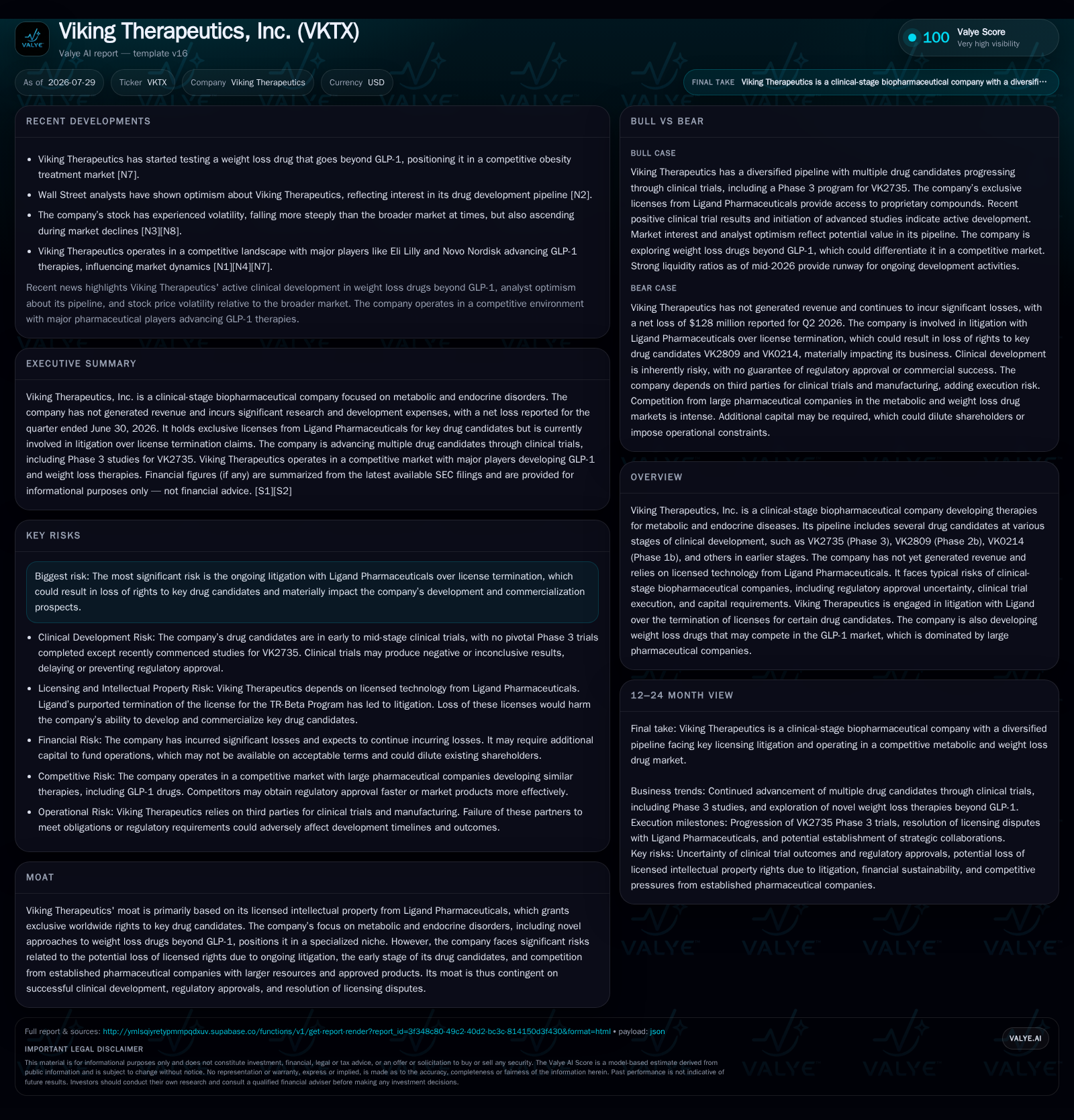
Viking Therapeutics remains a clinical-stage specialist developing novel metabolic and endocrine disorder therapies, with VK2735—their dual GLP-1/GIP agonist—advancing through Phase 3 subcutaneous trials. Their oral formulation also demonstrated positive Phase 2b results, positioning them strategically in obesity treatment beyond the dominant GLP-1 market. However, ongoing licensing disputes with Ligand Pharmaceuticals pose substantial risks to their pipeline’s integrity. The company’s financial health, underpinned by approximately $126 million in cash and a strong current ratio of 4.72, supports sustained R&D investments as Viking targets regulatory milestones amid intense competition from large pharmaceutical incumbents.
Recent Operating Update and Clinical Progress
Viking Therapeutics’ latest quarterly filing dated July 29, 2026 details continued progress on its lead metabolic drug candidate, VK2735, a novel oral and subcutaneous dual agonist targeting GLP-1 and GIP receptors for obesity treatment [S2]. This comes following successful completion of their Phase 2b oral dosing trial announced in August 2025 with statistically significant body weight reductions versus placebo after 13 weeks of daily oral dosing [S1]. The positive result triggered the planned initiation of Phase 3 oral dosing studies expected in Q3 2026, complementing their ongoing Phase 3 subcutaneous VANQUISH-1 and -2 studies where enrollment has completed as of late 2025 [S1].
This phased development approach for both delivery routes reflects industry recognition that patient preference and adherence can vary significantly between injectable and oral formulations — key factors affecting commercial adoption in obesity therapeutics. Viking’s strategy to explore maintenance dosing regimens via both modalities further emphasizes a nuanced attempt to differentiate within the crowded GLP-1 space where giants like Novo Nordisk with Ozempic/Wegovy and Eli Lilly with their portfolios dominate [N11].
VK2735's clinical data so far demonstrate promising efficacy endpoints (up to approximately 14.7% mean weight loss subcutaneously) alongside manageable safety profiles marked mainly by mild or moderate adverse events, which underscores potential label competitiveness if later phase trials replicate these findings [S1]. Such data has implications for payer acceptance and formulary placement down the road – pivotal for eventual commercialization given increasingly cost-conscious healthcare systems.
Business Model Overview
As a clinical-stage biotechnology company focused on metabolic and endocrine disorders, Viking Therapeutics’ revenue essentially hinges on successful drug development milestones followed by regulatory approval and eventual commercialization — none of which have yet occurred [S1]. Their primary revenue source today is nonexistent while R&D expenses dominate operating costs due to extensive ongoing clinical trials, supported by an active pipeline of candidates including VK2809 (Phase 2b) and VK0214 (Phase 1b) addressing diseases such as nonalcoholic steatohepatitis (NASH) [S1].
The company operates under licensing agreements primarily with Ligand Pharmaceuticals granting exclusive worldwide rights to several key compounds underlying their pipeline candidates. This intellectual property model is standard among mid-tier biotech firms that conserve capital by outsourcing early-stage discovery or utilizing existing licensed platforms rather than pursuing fully proprietary compounds [S1]. Monetization plans involve milestone payments from development progress and ultimately product sales royalties post-commercialization.
Contract Research Organizations (CROs) predominantly execute Viking’s clinical trial activities on its behalf [S2]. While this reduces capital-intensive infrastructure requirements, it introduces dependency risks around timely patient recruitment, regulatory compliance adherence during multi-center studies, and data integrity—all critical to maintain momentum especially as they scale into Phase 3 development with high absolute costs
Industry Structure and Competitive Position
Viking operates within the highly competitive metabolic disease therapeutics sector currently dominated by large pharmaceutical companies holding approved GLP-1 receptor agonists. Novo Nordisk controls a leading share with products like Ozempic/Wegovy across multiple indications; Eli Lilly has gained significant ground with its growing portfolio including recently approaching regulatory filing milestones for next-generation agents [N1][N7].
Unlike these incumbents who benefit from established commercial infrastructure including sales forces skilled at insurer negotiations worldwide, Viking’s current value proposition rests on potential innovation via dual receptor targeting (GLP-1/GIP) potentially enabling enhanced efficacy or tolerability profiles alongside an oral tablet format—still relatively rare compared to injectables in this class [N11]. This could represent meaningful differentiation if clinical outcomes confirm superiority or improved patient adherence.
However, as a smaller biotech reliant on licensing agreements for core intellectual property rights, Viking faces notable vulnerabilities absent in vertically integrated competitors. The ongoing litigation with Ligand Pharmaceuticals over license terminations raises questions about long-term pipeline control—a central business risk factor that creates uncertainty around drug candidate continuity and investment returns [S7][S22].
From an industry value chain perspective, Viking primarily occupies the drug discovery through late-stage clinical validation segments but lacks internal manufacturing or commercialization capabilities at present. They must therefore plan future partnerships or build-out arrangements post-approval to realize commercial revenues effectively.
Growth Drivers
Key growth drivers center substantially on clinical trial progression through pivotal phases yielding regulatory approvals. The imminent launch of Phase 3 oral dosing studies offers a major upcoming catalyst supported by positive earlier phase data delineating safety and efficacy benchmarks [S1][S2]. Successful completion of VANQUISH studies remains equally critical since these underpin their core subcutaneous VK2735 program.
Expansion of their candidate portfolio beyond VK2735 may mitigate concentration risk somewhat; VK2809 aims at NASH/MASH indications currently addressed inadequately by available therapies—a market segment projected to expand significantly given rising global prevalence. Similarly, early stage efforts with VK0214 could pave additional avenues should these candidates demonstrate convincing human data.
Strategic collaboration deals could supplement internal funding needs or provide commercialization platforms later; however, no material partnerships were disclosed recently suggesting reliance primarily on internal financing for near-term objectives [S2][S3].
Innovation in drug delivery mechanisms—especially oral formulations that improve patient experience over injectables—is another key potential differentiator aligned with patient-centric care models evolving across chronic disease management sectors.
Risks and Watchpoints
Foremost among risks is the ongoing litigation concerning license terminations from Ligand Pharmaceuticals. Loss or curtailment of these license rights would materially disrupt Viking’s lead programs thus undermining pipeline viability profoundly given lack of alternative late-stage assets [S7][S22]. This legal environment also increases uncertainty around timelines and resource allocation.
Regulatory approval outcomes remain inherently uncertain despite encouraging preliminary data [S2][S19]. Delays or failures in meeting primary endpoints could damage stock valuation sharply given the company’s lack of revenue buffer and high R&D burn rates
Execution risks linked to outsourcing CRO relationships could cause patient enrollment slowdowns or non-compliance issues that delay trial completion timelines impacting cash burn and requiring potential capital raises on onerous terms.
Competition poses structural threat since incumbent pharmaceutical companies possess advantages ranging from extensive marketing resources to established payer contracts—raising barriers to market entry even after approval.
Fluctuations in macroeconomic conditions potentially limit access to capital markets crucial for ongoing financing given typical biotech negative cash flow profiles prior to commercial product launches.
Finally, regulatory changes under U.S. administrations or shifts induced by Supreme Court decisions such as Loper Bright v. Raimondo contribute unpredictability to FDA approval frameworks impacting overall business outlook [S5][S9]
What To Watch Next
Investors should monitor key readouts from ongoing Phase 3 VK2735 subcutaneous trials expected over the next quarters alongside initiation timelines for oral tablet Phase 3 programs slated for Q3/Q4 2026 start dates [S2]. Further progress on licensing litigation proceedings will be pivotal since outcomes directly affect asset ownership confirming or undermining projected development trajectories.
Pipeline updates regarding earlier stage clinical milestones for candidates like VK2809 addressing liver diseases are relevant longer-term indicators to assess portfolio diversification progress.
Competitive actions such as new product launches or label expansions by companies like Novo Nordisk and Eli Lilly will shape market dynamics influencing Viking’s positioning prospects indirectly.
Financial Profile Discussion
As of June 30, 2026, Viking Therapeutics held $125.75 million in cash and equivalents alongside total current assets of approximately $517.56 million against current liabilities of $109.66 million resulting in a robust current ratio of roughly 4.72 indicating strong short-term liquidity supporting near-term operational needs [F1]
The company continues showing substantial net losses consistent with heavy R&D investment characteristic of clinical-stage biotech firms: operating loss was $393 million at fiscal year-end December 31, 2025 reflecting scaling clinical activities across multiple candidates [S1]. Expense acceleration primarily driven by personnel costs related to scientific staff expansion plus payments made under contracts with CROs managing increasingly complex pivotal programs.
No revenue generation has commenced yet since none of their drug candidates have reached regulatory approval or commercialization stages—a common biotech profile pre-revenue realization phase requiring capital market access or partnerships for sustainability until earnings start flowing post-launch.
Current financial resources appear adequate for sustaining planned Phase 3 activities based on disclosed cash levels; however any unexpected trial delays or legal expenses could necessitate raising external funds which might dilute existing shareholders given typical biopharma capital structures [F1][S15]
This analysis incorporates only publicly available information up through July 29, 2026 filings without forward-looking statements or investment research views.
Disclaimer: This is research-only, informational analysis and not investment advice. It may include AI-generated interpretation and general industry context. Always verify important details using primary sources.

Comments