
VitaNova Life Sciences Expands Dual-Brand and Healthy Foods Strategy Amid Competitive Nutritional Supplements Market
Latest quarterly filing reveals a focused asset-light model with evolving product lines and multi-channel B2B distribution.
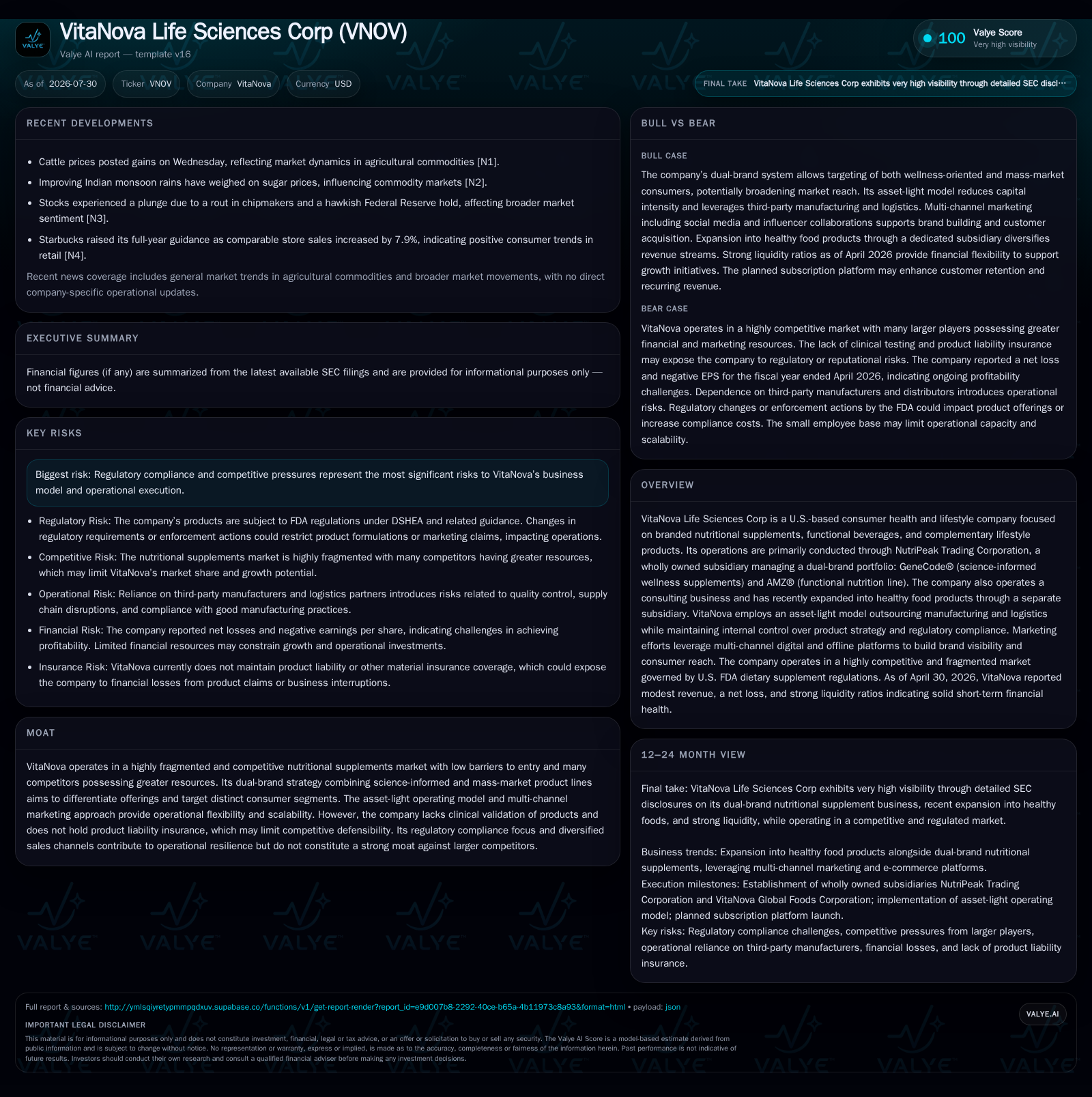
VitaNova Life Sciences Corp (VNOV) operates a dual-brand nutritional supplement portfolio through NutriPeak Trading Corporation, targeting distinct consumer segments with a science-informed brand and a mass-market functional nutrition line. Recently, the company has expanded into healthy food products via a dedicated subsidiary. Operating primarily under a B2B commercial model, VitaNova leverages third-party contract manufacturing and logistics to maintain operational flexibility. Its latest filings emphasize competitive pressures, regulatory compliance focus, and diversified sales channels as key strategic aspects. While current financials show modest profitability alongside net losses, the company seeks growth through innovation, expanded distribution, and new product categories.
Recent Operating Update
VitaNova Life Sciences Corp’s latest quarterly filing for the period ended April 30, 2026 highlights continued execution of an asset-light business model focused on branded nutritional supplements distributed primarily through B2B channels ([S2], [S3]). The company operates mainly via NutriPeak Trading Corporation (NTC), established in late 2023 to consolidate dietary supplement operations under a dual-brand strategy that targets distinct consumer segments through differentiated formulations: GeneCode®, for science-informed wellness consumers seeking cognitive and cellular health support; and AMZ®, a mass-market functional nutrition line targeting broader daily wellness needs ([S1], [S3], [S5]).
Significantly, VitaNova has expanded beyond supplements into healthy food products during the fiscal year ending April 30, 2026 via its wholly owned VitaNova Global Foods Corporation subsidiary. This new line includes products such as olive juice, white sesame oil, and aloe vera drinks aimed at leveraging rising consumer demand for natural health-oriented foods ([S3], [S5]). Although still early stage, management views the food trading business as a complementary source of revenue and cash flow to support overall operations.
The company’s commercial approach remains concentrated on partnering with regional distributors and channel partners who exploit diversified online traffic platforms including Chinese-origin e-commerce sites like Douyin Cross-border and Weidian Cross-border along with U.S.-based direct-to-consumer sales outlets. This multiplatform B2B model facilitates rapid market expansion by tapping into established sales infrastructures while maintaining scale flexibility ([S1], [S3]).
Business Model
VitaNova’s revenue mechanics hinge on developing proprietary brand portfolios that combine formulation oversight internally with outsourced contract manufacturing compliant with good manufacturing practices (cGMP) ([S3], [S17]). By controlling ingredient selection and compliance without owning production facilities directly, VitaNova minimizes fixed costs and capital intensity while retaining strategic control over product positioning.
The GeneCode® brand leverages publicly available nutritional-science literature to shape formulations that support general physiological functions without making clinical or therapeutic claims. The absence of clinical trials or regulatory approval processes aligns their products strictly as dietary supplements limited to structure/function claims compliant with FDA guidelines ([S11], [S13], [S19]).
AMZ® complements this with more accessible pricing designed for high-velocity e-commerce marketplaces focusing on functional nutrition categories like metabolic balance and digestive wellness. Shared manufacturing standards between the two brands achieve scale efficiencies while permitting tailored marketing tactics aimed at diverse customer groups ([S5]).
Multi-channel marketing plays a pivotal role in customer acquisition: social media influencers (KOLs), livestreaming platforms for real-time consumer engagement, retail partnerships for offline presence expansion, and plans for launching subscription models intended to enhance retention and purchase frequency are central to scaling sales volume ([S4]). Sales volumes by channel – B2B distributors versus direct-to-consumer e-commerce – drive revenue growth dynamics although exact breakdowns are undisclosed.
Supporting activities include a small consulting arm rendering financial advisory services domestically and internationally since mid-2021 which adds incremental revenues but remains peripheral to core supplement and food operations ([S1], [S3]).
Industry Structure & Competitive Position
The consumer nutritional supplements sector in which VitaNova competes is characterized by extremely low entry barriers producing a highly fragmented marketplace populated by firms ranging from global branded players (e.g., Herbalife Nutrition, GNC Holdings) to agile digital-native challengers (). This intensely competitive environment exerts pricing pressures limiting gross margin expansion potential.
VitaNova attempts differentiation through its dual-brand strategy: GeneCode® emphasizes science-informed brand credibility albeit without clinical validation or efficacy proof points commonly pursued by larger peers like Nature's Bounty or USANA Health Sciences. AMZ® targets everyday functional nutrition consumers through affordable price points optimized for large-scale e-commerce channels. While this structural segmentation enables broader consumer coverage than single-brand approaches allow, the absence of product liability insurance or clinical substantiation limits defensibility against better-capitalized peers entrenched in clinical research or proprietary ingredient patents ([S1], [S14], ).
Reliance on third-party contract manufacturers licensed under cGMP ensures adherence to regulatory standards though introduces operational dependencies typical in the sector. Established quality agreements mitigate supply risk though supply chain disruptions remain possible given industry-wide global sourcing challenges ([S17]).
Regulatory oversight by watchdog agencies such as the FDA tightly governs permissible claims labeling under DSHEA/FD&C Act statutes. VitaNova maintains an internal regulatory team tasked with navigating structure/function claim compliance without triggering unauthorized drug indications. This focus helps mitigate enforcement risk though sustained vigilance is necessary given FTC scrutiny over false advertising in supplements ([S12], [S20]).
Growth Drivers
Key drivers underlying VitaNova's growth prospects include:
- Increasing mainstream global consumer interest in preventive health measures fueling demand for dietary supplements and functional foods.
- Expansion of digital B2B distribution platforms especially cross-border e-commerce channels linking Asian traffic sources (Douyin/Weidian) with U.S. markets enhances reach efficiency.
- Ongoing product innovation grounded in evolving nutritional science frameworks supports regular SKU refreshes boosting consumer engagement amid category saturation.
- Rising popularity of functional beverages along with convenient ready-to-drink formats broadens addressable market beyond capsules/powders.
- Strategic influencer partnerships (KOLs) cultivate brand trust accelerating adoption particularly within digitally savvy younger demographics.
- Geographic market diversification beyond U.S. mitigates local market cyclicality while opening new growth avenues.
- Introduction of recurring revenue mechanisms such as subscription commerce platforms anticipated to increase average order value (AOV) and customer lifetime value through improved retention ([S4], ).
The recent launch of healthy food products through VGFC creates complementary cross-selling synergies potentially enlarging total addressable market though this initiative is nascent ([S5]).
Risks & Watchpoints
VitaNova faces multiple execution and structural risks:
- Regulatory risk remains material due to stringent FDA rules limiting health claims in dietary supplements coupled with proactive Federal Trade Commission enforcement actions against misleading advertising which can cause costly recalls or brand damage if compliance fails ([S12], [S20]).
- The crowded competitive landscape comprises rivals with stronger capital backing capable of rapid innovation cycles or aggressive marketing spend putting pressure on pricing and market share gains ([S14],).
- Absence of product liability insurance exposes the company financially should safety issues arise.
- Dependence on third-party contract manufacturers introduces potential supply disruptions or quality-control lapses affecting fulfillment reliability ([S17]).
- Vulnerability exists to shifts in consumer preferences influenced by emerging wellness trends requiring adaptive R&D responsiveness.
- Heavy reliance on evolving digital marketing algorithms implies potential volatility in customer acquisition costs impacting profitability.
- Intellectual property protections are minimal without clinical validation or patents limiting ability to create sustainable barriers against private label substitution.
- Exchange rate fluctuations could affect cost structures due to cross-border sourcing inherent in both supplement ingredients and food products.
Monitoring progress on these fronts alongside tracking regulatory updates notably around New Dietary Ingredient Notification (NDIN) requirements is critical going forward ([S6],[S19],).
What to Watch Next
Investors should focus on several key upcoming milestones:
- Update disclosures regarding expansion pace of healthy foods segment contribution to consolidated revenues providing insight into diversification success.
- Rollout progress for the announced subscription platform serving both GeneCode® and AMZ® customers potentially improving retention metrics.
- Evidence of product innovation velocity measured by new SKU/formulation introductions aligned with scientific literature incorporating novel ingredients supporting differentiated claims.
- Any material regulatory developments especially FDA guidance implementation impacting NDIN submissions or labeling that could alter compliance costs or timing.
- Channel sales mix evolution between direct-to-consumer versus B2B distributor reliance offering clues on margin enhancement opportunities.
- Marketing program efficacy data including return on investment from influencer campaigns and livestream events signaling brand scaling effectiveness.
- Changes in competitive positioning relative to peer benchmarks regarding pricing flexibility amidst intensifying industry rivalry.
Confirming traction across these dimensions will be critical signals validating whether VitaNova can leverage its asset-light model into sustainable growth pathways ([F1], [S4], [S19]).
Financial Profile Discussion
While operating income was recorded positively at approximately $3,601 for the quarter ended April 30, 2026, net income remained negative at -$37,304 reflecting ongoing investments in marketing expansion and new initiatives such as healthy foods development ([F1]). Cash resources exceed $800K providing adequate liquidity buffer complementary to a robust current ratio exceeding sixfold coverage of current liabilities highlighting sound short-term financial health ([F1]).
The data indicates early-stage commercialization typical for emerging consumer health brands deploying asset-light infrastructure to manage capital intensity conservatively while scaling sales via outsourcing partners ([F1]).
Investors should track margin trends particularly gross margin per product line alongside selling general & administrative expense progression as proxies for operating leverage potential. Cash conversion cycle efficiency improvement from inventory turns through optimized supply chain coordination also remains a key metric influencing free cash flow generation capacity typical in this sector.
Disclaimer: This analysis does not constitute investment advice nor research views regarding security transactions. It synthesizes publicly filed company disclosures combined with industry knowledge frameworks to provide an informed perspective on VitaNova Life Sciences Corp's business model dynamics, competitive context, operating risks, growth opportunities, and recent financial developments.
Disclaimer: This is research-only, informational analysis and not investment advice. It may include AI-generated interpretation and general industry context. Always verify important details using primary sources.

Comments