
Valley National Bancorp’s Regional Concentration and Tech Integration Shape 2025 Gains and Future Risks
Strong 2025 earnings reflect regional loan growth and fee income, balanced by evolving AI adoption and concentrated market exposure.
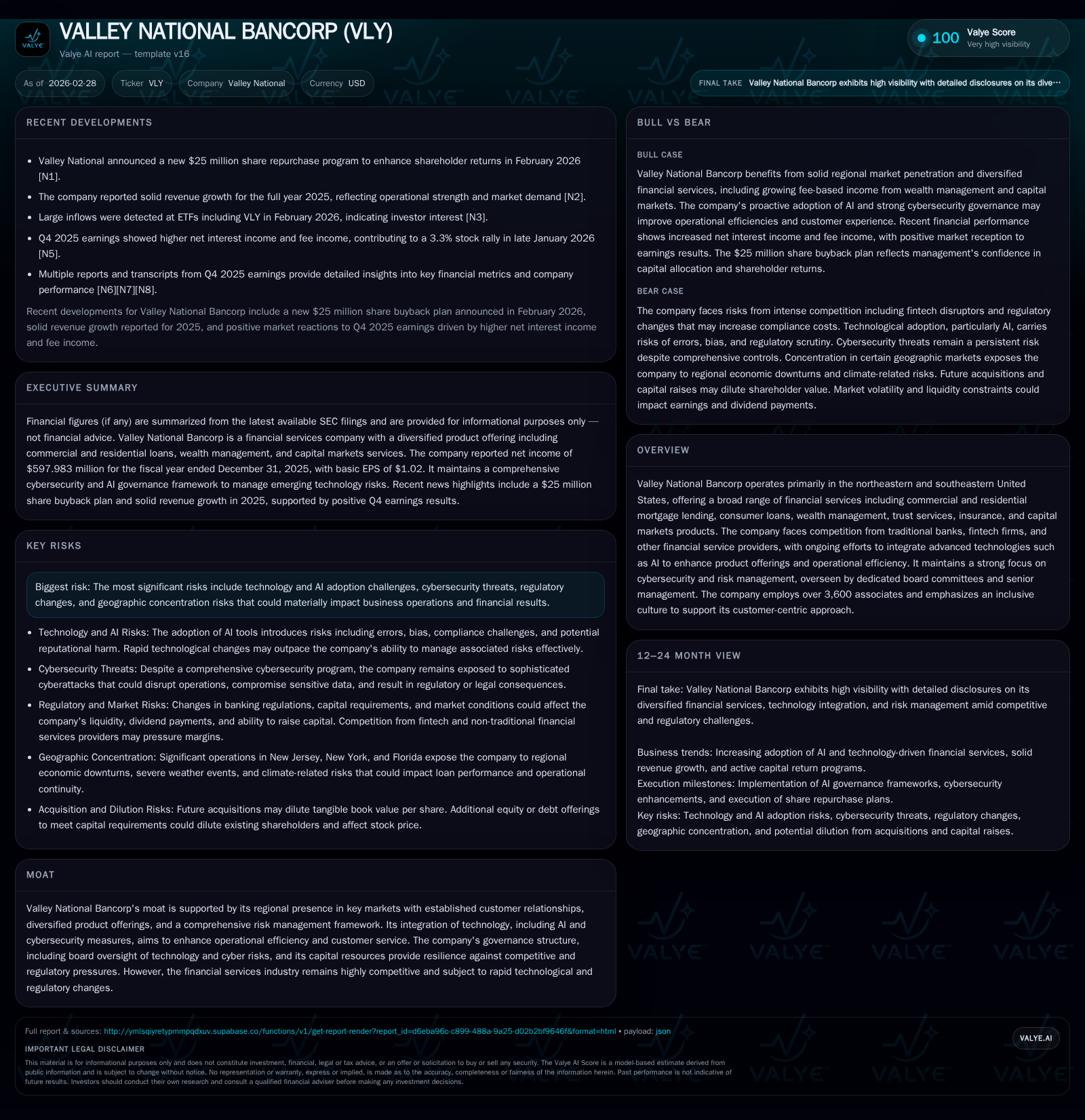
Valley National Bancorp delivered a notable 57% net income increase in 2025, driven largely by expanded commercial real estate lending in its core Northeast and Southeast U.S. markets and solid fee income growth. The bank’s strategic emphasis on AI and cybersecurity aims to bolster operational efficiency amid rising fintech competition, but technology integration risks and geographic concentration remain material challenges. Operating cash flow declined year-over-year despite strong profitability, while capital allocation included increased share repurchases alongside steady dividends. Key milestones to watch include credit quality trends within commercial real estate, regulatory developments affecting capital planning, and execution of digital transformation efforts.
Historical Performance and Growth Drivers
Valley National Bancorp posted significant financial gains in fiscal year 2025, with net income reaching approximately $598 million—a 57% increase compared to $380 million in the prior year [F1]. This marked acceleration followed more moderate fluctuations in earlier years. Growth drivers included expanded net interest income alongside solid fee income contributions highlighted in quarterly earnings reports that surpassed analyst estimates [N3][N6].
The company maintains a focused regional lending strategy concentrated primarily across New York (30% of loans), Florida (27%), and New Jersey (22%) [S1][S6]. These states represent the core of Valley's loan portfolio exceeding $50 billion, dominated by commercial real estate (CRE) and commercial & industrial loans. This geographic concentration leverages deep client relationships and localized market knowledge.
Despite robust profitability, operating cash flow declined notably—down about 37% year-over-year to $344 million from $549 million in 2024—suggesting shifts in working capital dynamics or loan servicing activities [F1].
Capital allocation priorities reflected a focus on shareholder returns: dividends increased moderately by roughly $21 million to nearly $249 million for the year while share repurchases accelerated significantly from under $9 million in 2024 to $63 million in 2025. This was supported by a new buyback authorization announced early 2026 [F1][N10]. Shareholders’ equity also grew slightly due to retained earnings.
Loan Portfolio Composition & Risk Management
Valley’s loan book remains heavily weighted toward CRE exposures within its key markets. While these loans contribute attractive yields fueling net interest income growth, they attract regulatory attention due to concentration risks under Basel III standards and ongoing post-pandemic risk monitoring [S19]. Underwriting guidelines generally cap loan-to-value ratios between approximately 60% and 80%, depending on loan categories, supported by independent appraisals [S14].
Credit risk management incorporates rigorous due diligence processes including third-party valuations and credit scoring models utilizing FICO scores among other analytics [S5][S7]. Despite prudent underwriting practices, the bank acknowledges sensitivity to economic downturns that could affect occupancy rates or property valuations.
Risk governance is comprehensive with dedicated Board Risk Committee oversight covering credit risk as well as information security—including cybersecurity programs—and operational risk controls addressing increasing cyber threats [S1][S17]. Valley also performs internal stress testing aligned with regulatory expectations to evaluate potential impacts on liquidity and capital adequacy.
Technology Adoption & Innovation Risks
A strategic focus for Valley is investment in artificial intelligence (AI) tools aimed at improving efficiency across credit underwriting, customer service interactions, fraud detection, among others. These include generative AI models along with machine learning solutions deployed internally as well as through third-party vendors [S18].
Management recognizes that AI introduces new risk dimensions including potential algorithmic errors, fairness concerns affecting compliance with lending laws, inaccuracies or "hallucinations" from models that could lead to operational or reputational harm. These considerations are integrated into the firm’s enterprise-wide risk management framework ensuring responsible adoption amid rapid fintech evolution.
Competitive Positioning & Strategic Outlook
Valley benefits from a defensible regional franchise combined with diversified offerings spanning commercial/residential mortgages, consumer lending lines such as home equity loans and auto financing, trust services, and capital markets products. This diversity supports revenue resilience across economic cycles. However, competition intensifies from both large national banks expanding digital capabilities and agile fintech firms innovating rapidly.
The bank's emphasis on customer-centric culture supports deposit retention despite industry trends toward online banking which could reduce deposit "stickiness" over time [S15]. Geographic concentration offers advantages but also concentrates exposure should regional economies or real estate markets face downturns.
Near-term milestones include tracking credit quality metrics especially within CRE portfolios where rental or occupancy shifts may signal stress; evaluating outcomes from AI technology deployments; executing enhanced share repurchase programs announced early 2026; plus navigating evolving regulatory landscapes that may impact dividend policies or capital requirements [N10][S11].
Financial Summary Table
Historical performance (annual)
| FY | Net ($mm) | CFO ($mm) | Capex ($mm) | Net YoY |
|---|---|---|---|---|
| 2025 | 598 | 344 | 18 | +57.3% |
| 2024 | 380 | 549 | 16 | -23.7% |
| 2023 | 499 | 378 | 76 | -12.4% |
| 2022 | 569 | 1428 | 69 |
Source: SEC companyfacts cache [F1].
Capital returns and efficiency (annual)
| FY | Div ($mm) | Buybacks ($mm) | FCF ($mm) |
|---|---|---|---|
| 2025 | 249 | 63 | 326 |
| 2024 | 228 | 9 | 532 |
| 2023 | 225 | 11 | 302 |
| 2022 | 206 | 24 | 1360 |
Source: SEC companyfacts cache [F1]. Net income surged strongly in FY25 while operating cash flow declined; capex normalized after elevated spend in FY23; shareholders benefited from increased dividends and accelerated buybacks.
Conclusion
Valley National Bancorp stands at a critical juncture balancing concentrated regional expertise driving profitable lending growth—particularly in commercial real estate—with strategic investments in AI-driven modernization amid heightened operational risks. Recent strong financial performance is tempered by cyclical sensitivities inherent in its markets alongside execution challenges related to digital transformation.
Investors should monitor how Valley manages credit quality fluctuations especially within CRE sectors during potential market softness; addresses cybersecurity risks amid increasing data privacy demands; sustains disciplined capital deployment enhancing shareholder value; and adapts risk frameworks encompassing emerging AI-related uncertainties within an intensifying competitive landscape favoring scale yet rewarding agility.
This analysis uses available company filings and news sources without offering investment recommendations.
Disclaimer: This is research-only, informational analysis and not investment advice. It may include AI-generated interpretation and general industry context. Always verify important details using primary sources.

Comments