
Viper Energy Strengthens Permian Foothold With Strategic Asset Moves
Viper Energy’s focused expansion in the Permian Basin through acquisitions and asset divestitures redefines its capital structure and growth potential in 2025.
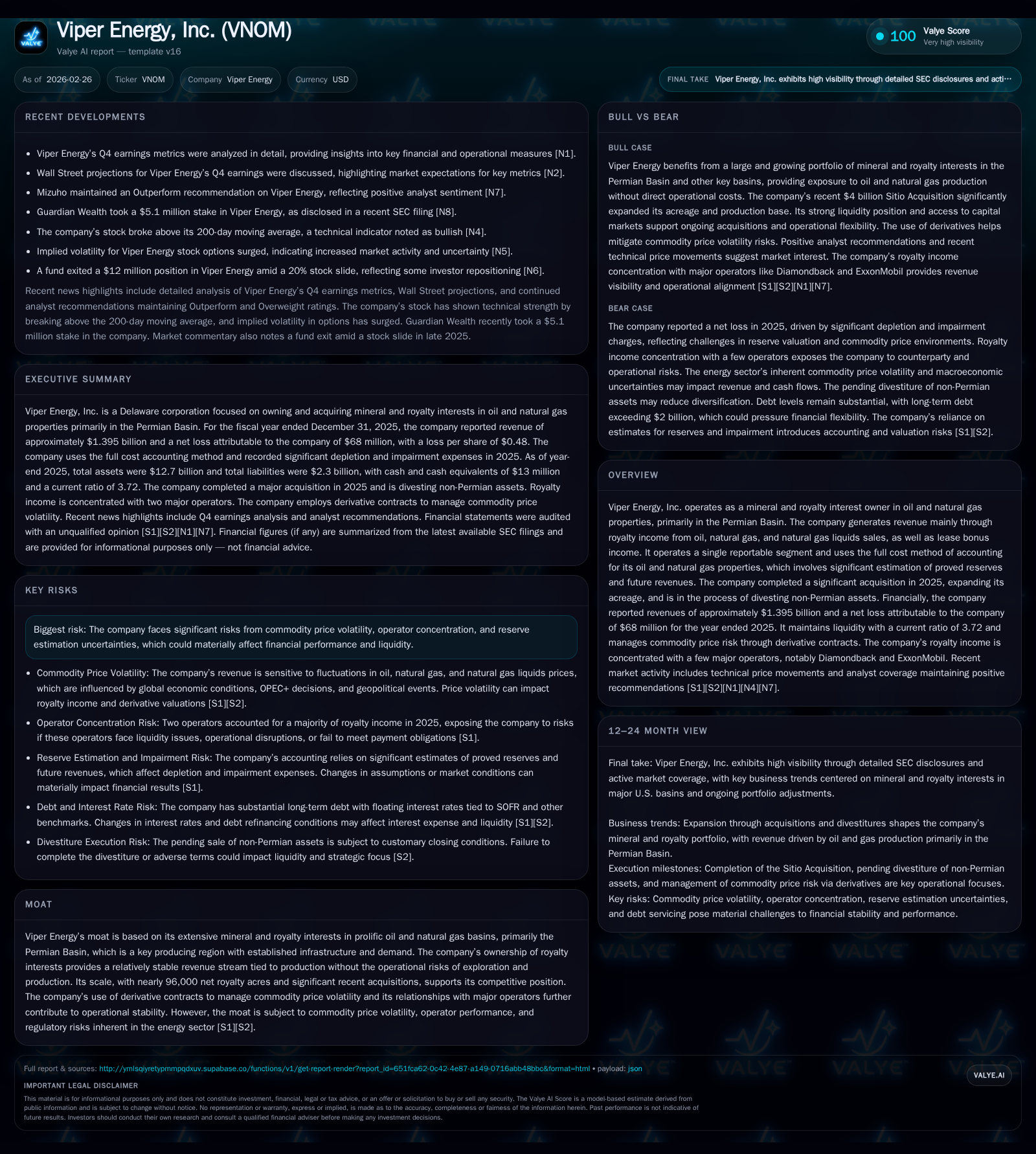
In 2025, Viper Energy, Inc. executed transformative transactions that reshaped its asset footprint and financial foundation. The company’s all-stock acquisition of Sitio Energy added approximately 25,300 net royalty acres in the Permian Basin, augmenting its scale to nearly 96,000 net royalty acres. Concurrently, it divested non-core non-Permian assets generating $617 million in proceeds to streamline focus and retire debt. Despite record revenue of $1.395 billion, Viper reported an operating loss due to derivative impacts and reserve impairments amid commodity volatility. Its capital allocation strategy combined dividend increases with opportunistic buybacks under expanded authorizations. Moving forward, Viper’s capacity to navigate price swings, operator concentration risks, and successful integration will be pivotal.
Foundations of Growth: Historical Revenue and Profit Trends
Viper Energy's revenue trajectory culminated in a record $1.395 billion for fiscal year 2025 [F1]. This significant top-line growth reflects its expanded royalty acreage following the transformative Sitio acquisition during the year. However, this growth masked underlying income statement challenges as the company reported an operating loss of $140 million in 2025 [F1] despite these elevated revenues. Net loss attributable stood at $68 million for the year [F1], impacted primarily by commodity derivatives volatility and non-cash ceiling impairments related to reserve valuations.
Historical performance (annual)
| FY |
|---|
| 2025 |
Source: SEC companyfacts cache [F1].
The lack of comparable prior years' numbers in structured data limits direct YoY comparisons; however, commentary indicates a meaningful step-up in scale post-Sitio acquisition which closed August 19, 2025 [S2]. The swing into operating losses reflects acquisition integration costs, derivative mark-to-market effects, and impairment provisions.
Key Growth Drivers: Mineral Acres, Production Mix, and Commodity Pricing
The cornerstone driver for Viper’s growth is its mineral and royalty interests concentrated heavily in the Permian Basin — an established oil and gas producing region with developed infrastructure supporting demand [S2]. Following the Sitio deal, Viper’s portfolio comprises approximately 96,000 net royalty acres with about two-fifths operated by Diamondback [S2][S9]. These earnings are derived largely from royalty incomes on hydrocarbons produced by third-party operators without operational control but benefiting from production volumes and prices.
Commodity price volatility remains a significant variable impacting revenue streams given the company's royalty model sensitivity [S1][S19]. Viper employs commodity price derivative instruments including fixed price swaps, basis swaps, deferred premium puts, costless collars, and options to hedge price fluctuations [S1][S19]. At year-end, a net asset derivative position of $21 million was recorded with sensitivity analyses showing modest changes in fair value under ±10% price shifts [S1].
Concentration risk must be noted as two operators accounted for more than 10% each of income over recent years [S1], underscoring dependency on select counterparties’ production performance.
Strategic Asset Footprint Optimization: Acquisitions and Divestitures
The strategic acquisition of Sitio was a landmark transaction for Viper — an all-equity deal valued at roughly $4 billion (inclusive of assumed Sitio net debt about $1.2 billion) finalized August 2025 [S2]. The transaction added roughly 25,300 Permian net royalty acres plus approximately 9,000 net acres across Denver-Julesburg (DJ), Eagle Ford, and Williston basins.
Shortly after closing this major expansion outside its core focus areas, Viper initiated a divestiture process for all non-Permian assets acquired from Sitio totaling approximately $670 million sale consideration expected to close Q1 2026 [S2]. This deal closed by early February with proceeds around $617 million applied mainly toward retiring Sitio legacy debt facilities including full repayment of the $500 million Term Loan plus revolver borrowings and general corporate uses [S18][S27].
Smaller proprietary acquisitions totaling about 270 net Permian acres complemented portfolio growth during the first nine months of 2025 at aggregate cost near $72 million [S2]. This acreage diversification within the Permian enhances operational stability amid typical basin-focused industry risks.
Financial Performance: Operating Income Dynamics and Earnings Quality
The negative operating income of -$140 million juxtaposed against strong total revenues highlights the influence of derivative positions coupled with reserve impairments inherent in full cost accounting methods employed by Viper [F1][S3][S15].
The company recorded substantial non-cash ceiling test impairments amounting to approximately $768 million for FY 2025 related to reserve valuation downturns driven by commodity price assumptions [S21]. These charges do not affect cash flow directly but weigh heavily on reported profitability.
Year-end derivative assets increased from prior periods resulting from marking-to-market contracts designed to smooth commodity revenue volatility; however, realized gains or losses on these derivatives offset corresponding fluctuations in underlying production sales values creating earnings noise rather than fundamental cash basis impact [S1][S26].
Capital Structure Evolution: Debt Refinancing and Liquidity Profile
Capital structure improvements have been central following the Sitio acquisition financing needs.
In July 2025, Viper issued $1.6 billion aggregate principal Guaranteed Senior Notes composed of $500 million at 4.9% due 2030 and $1.1 billion at 5.7% due 2035 used principally to redeem older notes worth approximately $780 million and retire higher coupon Sitio debt along with revolving credit paydowns [S4][S5][S25][S26]. Interest rates reflect current market conditions yielding weighted averages around low- to mid-6% territory on revolving loans with similar fixed senior notes due mid-2030s.
A new unsecured revolving credit facility with total commitments near $1.5 billion matures in June 2030 offering ample liquidity headroom; borrowings were modest at year-end ($105 million outstanding) contributing to robust current ratio standing at roughly 3.72x indicating good short-term liquidity management [F1][S4].
The $500 million Term Loan executed concurrent with Sitio closing has been fully repaid post-divestiture using asset sale proceeds as highlighted above ensuring cleanup of transitional obligations [S10][S23].
Capital Allocation Framework: Dividends, Buybacks, and Cash Flow Use
Viper operates a disciplined capital return program balanced between dividends and share repurchases aligned with available cash flow dynamics [S6][S7]. Quarterly dividends include a base plus variable component derived from discretionary cash available post-operational needs; as of early 2026 an annualized base dividend increased to $1.52 per share illustrating confidence in cash generation capacity moving forward [N1][S13][S27].
Buyback authorization initially set at $750 million was expanded significantly to up to $1.75 billion excluding excise tax as of February 2026; actual repurchases through year-end totaled $194 million leaving substantial scope for opportunistic stock accretive purchases funded by free cash flow or asset rationalization events such as non-Permian disposals [N1][N6][S6][S7][S27].
ROE remains negative at -1.5% influenced by net losses stemming from accounting charges rather than operational cash constraints implicating buybacks as an efficient shareholder return lever when price dislocations arise [F1].
Risk Factors Impacting Future Performance
Intrinsic risks center on commodity price volatility inherent in oil and gas cycles despite derivative hedging programs designed to mitigate some exposures but never fully eliminate them due to timing and volume uncertainties [S1][S19][S22]. Market disruptions can impact both top-line royalties received and counterparty credit quality given concentration among few operators responsible for >10% income each creating potential receivables risk exposure.
Reserve estimations used for impairments carry judgment-based assumptions subject to downward revisions if commodity prices or production decline unexpectedly adding earnings volatility risks going forward [S21][S22]. Regulatory uncertainty tied to environmental policies impacting hydrocarbons development also injects caution into future planning horizons.
Future Outlook: Market Expectations and Operational Milestones
Market watchers anticipate further clarity on annual distribution patterns supported by increased base dividends along with variable dividend components reflecting quarterly operating results disclosed in recent earnings releases alongside enhanced buyback capacities approved early 2026 [N1][N2][N3][S3].
Expected closure of remaining divestitures outside Permian marks critical next-step milestone streamlining focus on highest-return core acreage which will be closely monitored for production trends especially given operator concentrations within those blocks impacting royalty flows.
Commodity price environments remain key external drivers influencing revenue bases that govern both distribution size and capacity to fund share repurchases or debt reductions going forward.
What to Watch: Triggers for Next-Phase Growth or Financial Shifts
Investor attention should hone in on completion confirmation of non-core asset dispositions locking in gains used for deleveraging which removes legacy encumbrances enhancing balance sheet flexibility [N3][N4]. Monitoring implied volatility metrics derived from VNOM options pricing offers sentiment insight regarding perceived near-term uncertainty levels or momentum shifts within trading circles though such measures serve only as one input among multiple fundamental factors [N6].
Operational developments within Permian acreage governed primarily by Diamondback operatorship performance will materially influence realized royalty streams amid evolving drilling activity levels or service cost inflation risks often seen across basin cycles.
Any material shifts in debt ratings affecting borrowing spreads or covenant structures would represent pivotal junctures requiring ongoing scrutiny given existing sizable note maturities extending into next decade timelines.
This report is based exclusively on publicly available information as cited without any endorsement or prediction regarding investment decisions concerning Viper Energy, Inc. It endeavors solely to illuminate historical facts, current structures, risks identified by the company itself, and reasonable points worthy of watchfulness without speculative forecasting or valuation judgments.
Disclaimer: This is research-only, informational analysis and not investment advice. It may include AI-generated interpretation and general industry context. Always verify important details using primary sources.

Comments