
VeriSign’s Internet Infrastructure Dominance Spurs Growth Amid Regulatory and Liquidity Headwinds in 2025
VeriSign’s pivotal domain registry role underpins solid financial performance, while evolving regulatory and liquidity challenges test its resilience.
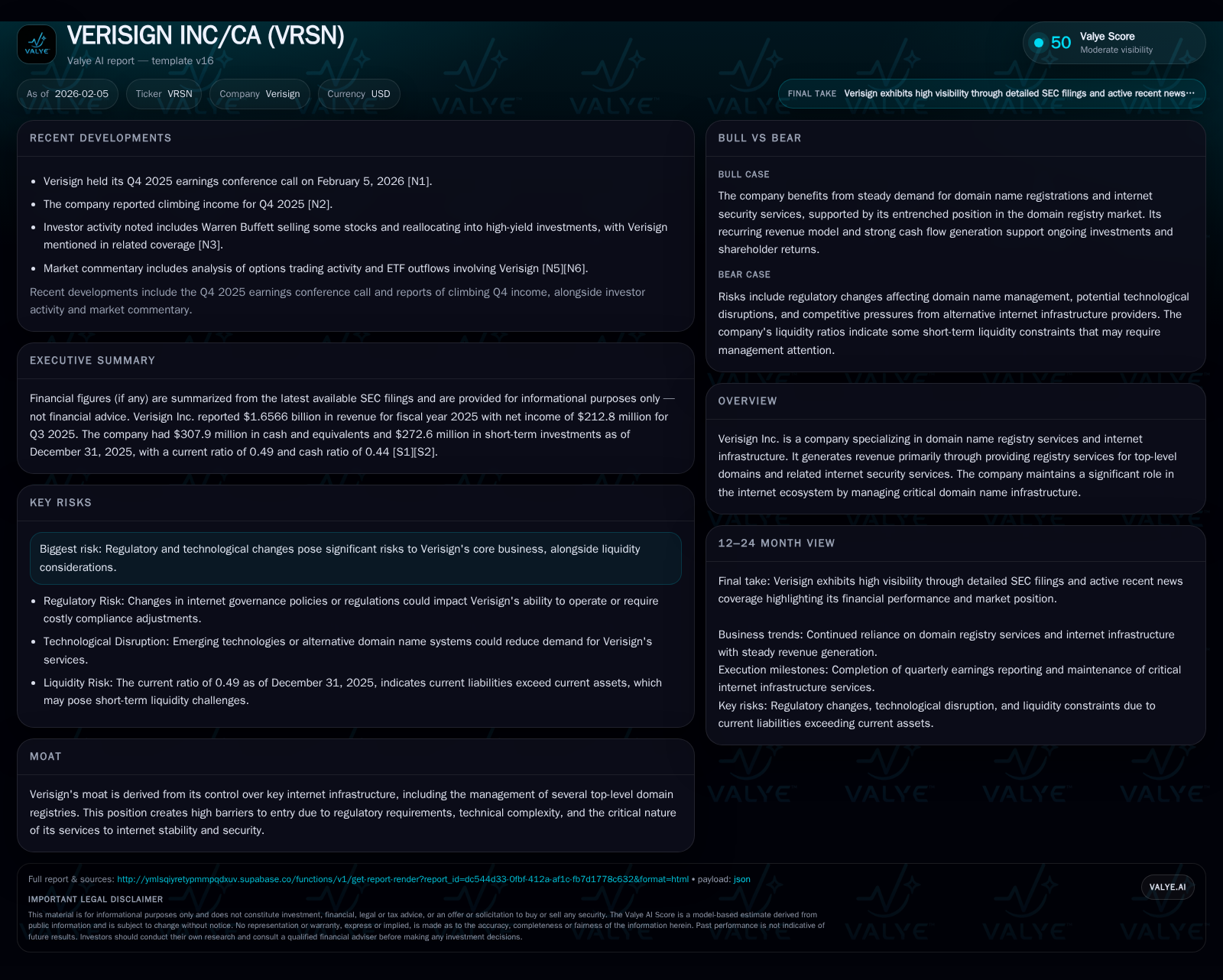
VeriSign Inc. continues to command a central position in the internet ecosystem through its stewardship of critical domain infrastructures, supporting strong revenue growth that reached $1.66 billion in 2025. Its unique regulatory moat and technical complexity sustain this dominance despite emerging liquidity constraints and increasing regulatory scrutiny. Institutional dynamics, including Warren Buffett's recent portfolio shifts, and options market signals hint at nuanced market sentiment. Looking ahead, VeriSign's strategic adaptability amid changing cloud and internet landscapes will be crucial to preserving its foundational role.
Guardians of the Domain: Verisign’s Unique Role in Internet Infrastructure
Beneath the dazzling surface of the internet lies an indispensable latticework of domain name registries that orchestrate how billions find their way online. VeriSign Inc., often unseen by everyday users, safeguards this digital backbone by operating key top-level domains (TLDs), including the venerable ".com" and ".net" namespaces. This stewardship is not merely administrative; it is a technically demanding responsibility that underpins global internet stability and trustworthiness. The Valye overview concisely captures this centrality: VeriSign "generates revenue primarily through providing registry services for top-level domains and related internet security services," cementing its critical role within the digital ecosystem [F1][S1].
This unique positioning establishes a formidable competitive moat. Unlike typical commercial ventures, VeriSign’s operations are subjected to rigorous regulatory oversight coupled with sophisticated technical demands—creating barriers so intricate that replication or displacement is prohibitively arduous for potential competitors. The company’s hold over official global identifiers means it acts as a gatekeeper for much of internet naming architecture, conferring unparalleled strategic advantage.
2025 Financial Performance Deep Dive: Growth Stories Behind the Numbers
VeriSign’s 2025 financial disclosures paint a picture of resilience and expanding profitability. The company reported total revenues of approximately $1.66 billion for the year ending December 31, 2025—a robust figure underscoring healthy demand for its registry services [F1]. Notably, Q4 saw net income increase to $212.8 million as per the September quarter figure available; while this snapshot precedes full-year final income detail, analysts highlight it as indicative of sustained momentum entering year-end [N1][N3][S1].
Operational cash flows remain strong; however, the balance sheet reveals brewing liquidity considerations. Current assets stood at $652.5 million against current liabilities totaling $1.33 billion at year-end 2025, yielding a current ratio near 0.49—well below conventional comfort thresholds for short-term solvency [F1]. This imbalance is a caution flag signaling that despite profit generation, VeriSign faces near-term funding pressures or must carefully manage working capital and obligations.
This juxtaposition—solid earnings performance challenged by liquidity strain—reflects intricate capital management decisions in an environment where regulatory obligations and technology investments command steady expenditure.
The Moat That Shapes an Empire: Regulatory & Technical Barriers to Entry
VeriSign’s empire rests on more than scale—it is the granite foundation of regulatory exclusivity combined with complex infrastructure that ensures internet continuity. The company’s contracts with ICANN (the Internet Corporation for Assigned Names and Numbers) dictate tight controls over select TLDs that no other player can easily enter or replicate [Valye_report_excerpt.moat][S1][S2].
These agreements are accompanied by stringent compliance frameworks requiring constant audits and security upgrades—heightening operational complexity far beyond typical tech firms. Such requirements dissuade entrants due to immense costs, prolonged approval processes, and specialized expertise needed.
Additionally, VeriSign’s service integrates deeply within the Domain Name System (DNS), involving globally distributed systems resilient against cyber threats—a capability built over decades making this 'invisible infrastructure' uniquely defensible.
Navigating Stormy Waters: Liquidity Challenges and Market Sentiment Signals
While fundamentals portray strength, recent data signals murkier sentiment around liquidity health for VeriSign. ETF outflow trends reported in late January 2026 underscore investors trimming exposure in technology-related registries including VeriSign [N6]. This selling pressure coincides with the low current ratio identified in filings—suggesting market concerns about short-term financial sturdiness despite profitability [F1][Valye_report_excerpt.risks].
Parallel to these cash flow worries is unusual options market activity flagged earlier in January 2026 revealing heightened speculative interest or hedging behaviors around shares [N7]. Options traders are typically prescient in pricing expected volatility or directional shifts; thus this elevated derivatives interest could signal anticipations of upcoming developments affecting share valuations.
Taken together, these indicators reflect a market balancing the company's entrenched strength against emerging funding challenges.
Investor Spotlight: Warren Buffett’s Transition and Market Reactions
No analysis of large-cap tech stocks is complete without examining institutional heavyweight influence—particularly Warren Buffett's Berkshire Hathaway maneuvers relating to VeriSign. According to recent news reports around Buffett's impending retirement timeline, he divested six stocks including portions of his stake in VeriSign while increasing allocations elsewhere [N4]. Preceding performance analysis shows some optimism about former Buffett stocks' trajectories but also hints at selective repositioning [N5].
Buffett’s reduction may be interpreted less as indictment than prudent portfolio rotation given age-related succession planning; nonetheless it provides a lens into cautious institutional recalibration amid sector-specific risks around regulation and digital infrastructure disruption.
The Whisper of Options: What Derivatives Indicate About Future Moves
An intriguing subplot has emerged from derivatives markets where options trading volume surged unexpectedly on VeriSign shares earlier this year [N7]. These trades sometimes foreshadow significant moves or insider anticipation absent from public narratives.
Scrutinizing these patterns alongside fundamentals suggests traders might be pricing-in volatility linked to upcoming regulatory decisions or negotiating contract renewals regarding key TLD administration rights.
While purely speculative derivative positions should neither be overstated nor dismissed outright—they offer an additional layer of market intelligence reflecting collective professional expectations concerning future stock behavior.
Risks Ahead: Anticipating Regulatory Changes Impacting Core Registries
The greatest existential threat shadowing VeriSign stems from shifting regulatory landscapes and rapid technological evolution that could redefine how domain registries operate worldwide. The company itself highlights "regulatory and technological changes" as principal risks capable of materially impacting its operational framework [Valye_report_excerpt.risks][S1].
Potential scenarios include ICANN policy reforms altering contracted control terms or new cybersecurity standards requiring heavy investments with uncertain returns. Additionally, emergent technologies like blockchain-based naming systems propose alternative decentralized approaches challenging traditional registry models.
Keeping abreast with these developments will be vital as any diminution in exclusivity or operational flexibility could erode revenues tightly linked to proprietary domain management rights.
Strategic Positioning and Forward-Looking Scenarios as Cloud Dynamics Evolve
Looking beyond domains alone reveals broader opportunities and challenges entwined with cloud computing growth and increasingly complex internet architectures. VeriSign’s expansion into adjunct internet security services reflects recognition that maintaining relevance requires evolving beyond foundational DNS roles [Valye_report_excerpt.overview][N1].
Strategic initiatives may encompass enhanced cyber defense capabilities tied to domain validation or integration into multifaceted identity verification platforms catering to cloud providers—all aimed at reinforcing customer lock-in while diversifying revenue streams.
As enterprises accelerate digital transformation journeys dependent on stable naming infrastructures augmented by security overlays, VeriSign stands at crossroads where nimble innovation could safeguard its moat even as competitive pressures mount.
Disclaimer: This analysis presents factual information based on publicly available data as of February 2026 and independent industry context. It does not constitute investment advice or recommendations. Readers should conduct their own due diligence before making any decisions related to Verisign Inc.
Disclaimer: This is research-only, informational analysis and not investment advice. It may include AI-generated interpretation and general industry context. Always verify important details using primary sources.

Comments