
Viasat’s Strategic Reset: Financial Resilience and Industry Dynamics for 2026
Viasat’s latest quarterly results and governance shifts underscore its strategic positioning amid competitive satellite telecom challenges and legal risks.
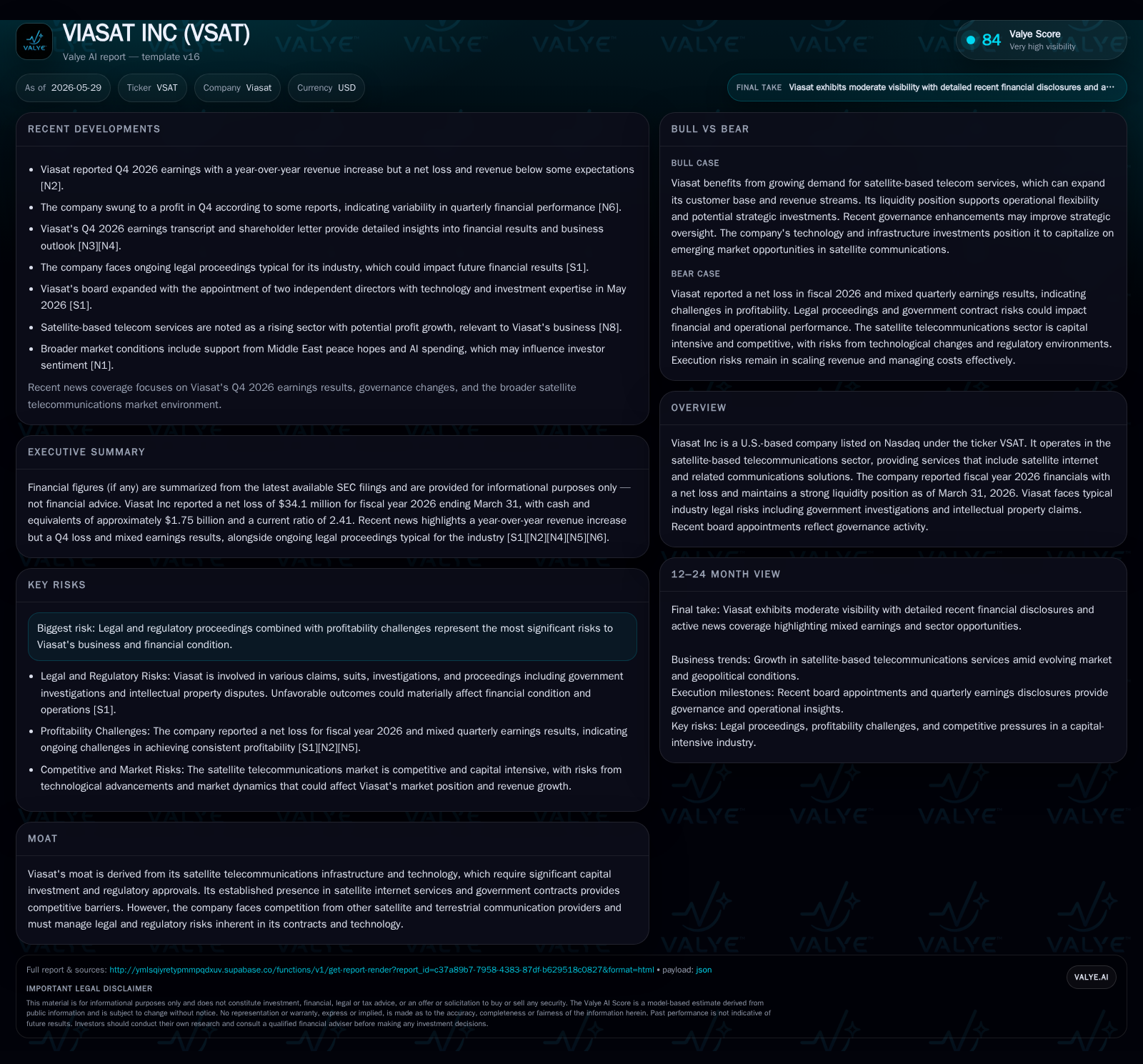
Viasat reported Q4 fiscal year 2026 results highlighting revenue rises but persistent net losses, accompanied by key board additions signaling governance evolution. Its business model centers on capital-intensive satellite broadband and government contracts, a space with high barriers to entry but regulatory complexity. Growth drivers include network expansion and technology innovation targeting underserved markets, yet legal proceedings and profitability issues remain headwinds. Solid liquidity cushions ongoing investment efforts with demand momentum and strategic milestones to watch in the near term.
Recent Operational Update: Q4 2026 Results and Board Changes
On May 28, 2026, Viasat disclosed its fiscal year-end results alongside a shareholder letter providing additional context on fourth quarter performance [S3]. The company reported an increase in revenue during the period; however, expenses remained elevated leading to a net loss position that continued despite operational efforts [S2][N2]. This gap underscores persistent challenges in controlling cost structure relative to sales scale.
Governance developments announced earlier in May included the appointments of two independent board members—Shekar Ayyar and Jinhy Yoon—each bringing deep expertise in telecommunications technology innovation and disciplined capital allocation respectively [S9]. Ayyar’s background in AI infrastructure and edge cloud networks coupled with Yoon’s experience overseeing financial controls at major public firms aims to bolster strategic oversight amid a complex operating environment.
The combination of financial results with board evolution signals Viasat's intent to reset its strategic priorities while managing existing operational headwinds.
Business Model and Product Portfolio: Satellite Broadband Services and Government Contracts
Viasat’s core monetization model revolves around delivering broadband connectivity through satellite networks complemented by government communication contracts [S1]. Customers span residential consumers seeking internet access in underserved regions, enterprise clients requiring specialized communications platforms, and defense agencies contracting for secure data transmission.
Revenue stems from subscription fees for satellite internet services supported by proprietary high-capacity satellites whose deployment involves substantial upfront capital expenditure. The operational model emphasizes long-term contract relationships where switching costs are elevated due to the integration of ground equipment with satellite infrastructure.
Additionally, government contracts contribute a significant portion of revenues but demand strict regulatory compliance tied to federal procurement laws. This dynamic requires robust contract management aligned with evolving regulatory frameworks.
Competitive Environment: Peer Positioning and Industry Barriers
In the satellite telecommunications sector, Viasat contends with both legacy providers operating constellation networks and terrestrial broadband incumbents expanding their reach into rural areas [S1].
Capital intensity is a defining barrier: designing, launching, and maintaining satellites entail massive financial resources plus regulatory approvals regarding orbital slots and frequency spectrum licenses. These factors create a formidable moat against new entrants.
However, contemporary competitors also include emerging low-earth orbit constellations targeting lower latency broadband solutions. Viasat’s challenge is balancing legacy geostationary infrastructure advantages with needs for technological modernization.
Supply chain constraints for satellite components further complicate capacity expansion timing.
Growth Drivers: Satellite Infrastructure Expansion, Technology Innovation, and Customer Segments
Growth prospects hinge on several correlated initiatives. First is augmenting the satellite fleet with next-generation platforms capable of higher throughput that improve bandwidth availability in geographically underserved markets [S3][N3]. This structural demand contrasts cyclical telecom spending patterns.
Second is product innovation leveraging advances from allied networking technologies—for instance, edge computing integration—that can enhance service quality or reduce latency.
Government-related spending presents another growth avenue as defense communications requirements remain robust due to geopolitical considerations. Periodic contract renewals or expansions lift revenue potential.
These drivers correspond with operational updates reflecting improved revenue streams despite prevailing cost burdens [N10]
Risks and Constraints: Legal Proceedings, Profitability Challenges, and Regulatory Exposure
Viasat navigates notable risks primarily centered on ongoing legal proceedings including government investigations related to contract compliance as well as intellectual property disputes detailed in its annual filing [S4][S1].
Additionally, litigation diverts managerial focus and inflates operational costs.
Profitability remains constrained by high fixed costs inherent to satellite network operations combined with competitive pricing pressures from alternative communication technologies.
Regulatory complexities governing spectrum use and federal contracting necessitate continual compliance vigilance to avoid penalties or disqualification from key tenders.
Outlook: Key Milestones and Demand Indicators to Monitor
Stakeholders should watch forthcoming quarterly earnings releases for revenue trajectory shifts alongside margin improvement initiatives that address cost dynamics explicitly highlighted at year-end [S3]. The cadence of new satellite launches or ground infrastructure deployments constitute important timing markers reflecting capacity enhancement progress.
Customer adoption rates—measured via subscriber growth or renewal volumes—offer tangible signals of market acceptance especially within remote broadband segments.
Board activities including strategic committee reports will be informative given recent director appointments linked to activist investor engagement outlined under the Cooperation Agreement executed earlier this year [S9].
Collectively these factors frame an operational feedback loop shaping Viasat’s path forward amid evolving market conditions.
Financial Overview: Liquidity Strength Amid Ongoing Profit Pressure
As of March 31, 2026, Viasat maintained approximately $1.75 billion in cash and equivalents supporting a current ratio near 2.41 calculated from current assets exceeding $3.12 billion against roughly $1.30 billion current liabilities [F1]. Although total debt figures have not been updated recently—last reported at about $1.43 billion mid-2019—the company's approximate net cash position suggested by available data provides a buffer against short-term liquidity shocks.
Operating income trends reflect ongoing challenges converting revenue growth into sustainable profitability [F1][S2][S3]. Net losses persist as R&D expenditure alongside network expansion investments weigh down earnings despite improved top-line performance over earlier quarters.
This liquidity position underpins the company's ability to fund critical capital expenditures necessary for future growth while managing financial flexibility during profit recovery efforts.
This analysis synthesizes information from Viasat Inc's most recent SEC filings including its Q4 FY2026 8-K update dated May 28, 2026 ([S3]), quarterly report ([S2]), annual report ([S1]), risk disclosures ([S4]), director appointment filings ([S9]), complemented by financial snapshots ([F1]) and relevant market transcripts ([N2],[N3]). It offers an industry-informed perspective without providing any investment advice or price targets.
Disclaimer: This is research-only, informational analysis and not investment advice. It may include AI-generated interpretation and general industry context. Always verify important details using primary sources.

Comments