
VSE Corp’s Strategic Pivot with Precision Aviation Acquisition and Its Impact on Growth Trajectory
VSE’s transition to an aviation-centered aftermarket specialist, highlighted by the $2 billion PAG acquisition, aims to reshape its growth path amid integration challenges and market cyclicality.
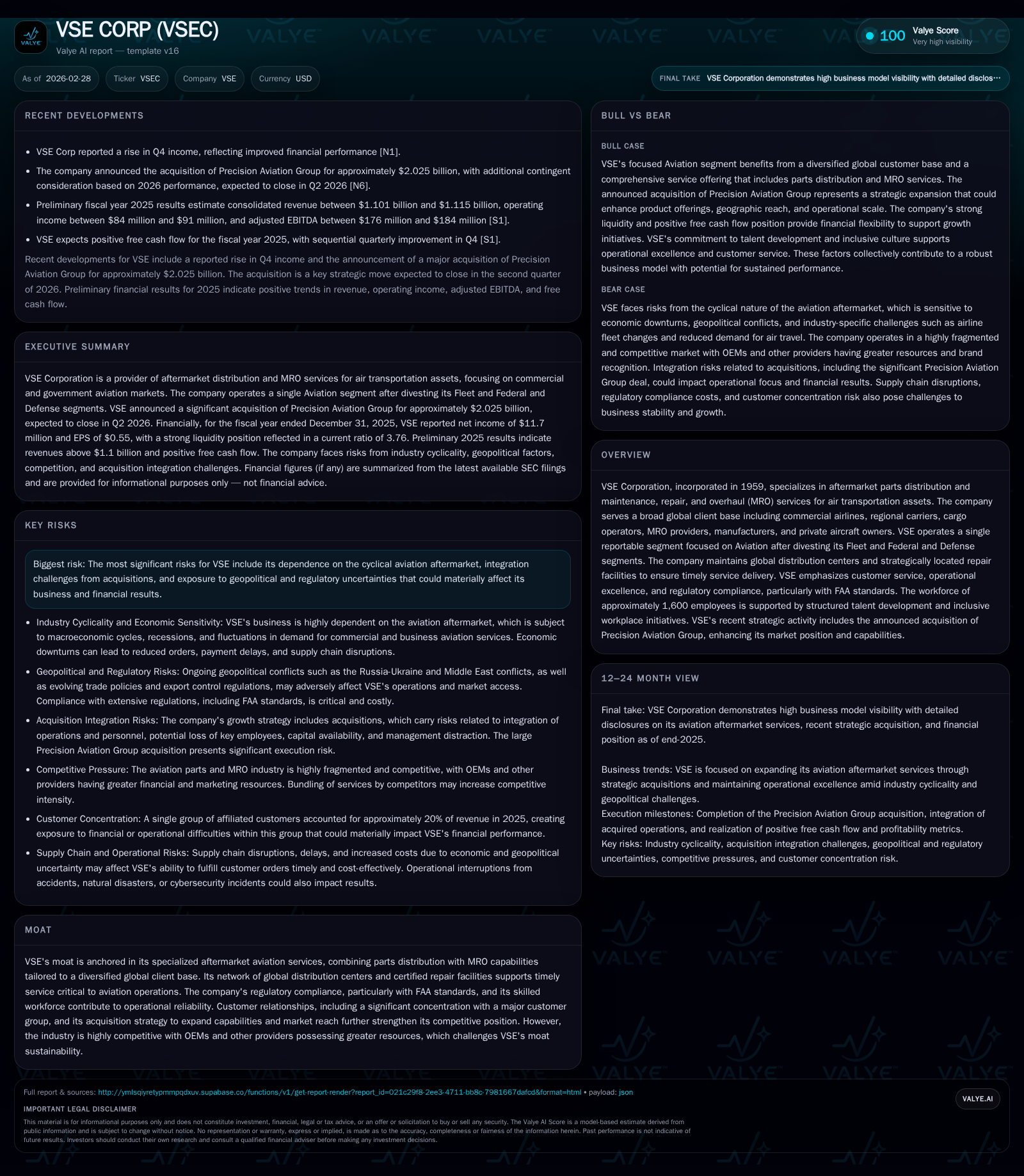
VSE Corporation has sharply refocused its business by divesting non-aviation segments and consolidating its market position as a specialized provider of aftermarket parts distribution and MRO services in aviation. The recent acquisition of Precision Aviation Group (PAG) for approximately $2.025 billion significantly expands scale and capabilities but introduces execution risks amidst sector cyclicality. Historical growth showed steady operating income gains alongside volatile net margins impacted by restructuring; future prospects hinge on successful integration, customer concentration management, and navigating geopolitical and regulatory factors inherent in the aerospace aftermarket industry.
Aviation-Focused Transformation: Background and Evolution
Since its incorporation in 1959, VSE Corporation has evolved from a diversified industrial entity into a focused player specializing exclusively in the aviation aftermarket sector. Historically operating three reportable segments—Aviation, Fleet, and Federal and Defense—VSE undertook strategic divestitures completing sales of its Fleet segment in April 2025 and Federal and Defense segment assets earlier. This repositioning leaves VSE operating solely within one reportable Aviation segment dedicated to aftermarket parts distribution and maintenance, repair, and overhaul (MRO) services tailored to air transportation assets [S1][S4].
This narrowing of focus aligns with VSE's stated purpose: enhancing productivity and extending the life cycles of high-value aerospace equipment through superior service delivery compliant with rigorous FAA regulations. The company's operational pillars include global distribution centers providing just-in-time parts availability coupled with strategically located FAA-certified Part 145 repair facilities performing complex component repairs. Combined with an employee base of approximately 1,600 skilled personnel trained under structured talent development programs emphasizing safety, ethics, and inclusion initiatives, VSE aims to deliver reliability crucial for aviation asset uptime [S12].
Historical Financial Performance and Key Growth Drivers
From FY2017 through FY2025, VSE demonstrated solid top-line expansion alongside operating income growth prior to recent strategic changes. Revenue rose from approximately $760 million in FY2017 to steady growth reaching nearly a 10% year-over-year increase into FY2025 [F1]. Operating income mirrored this trajectory with a compounded annual growth rate approximating 10%, increasing from around $55 million in FY2022 to nearly $90 million by FY2025 [F1]. However, net income exhibited greater volatility: despite higher revenues and operating profits, net income declined notably by over 20% year-over-year entering FY2025, falling to about $11.7 million [F1]. This discrepancy stems partly from non-operational factors including costs related to divestitures, restructuring expenses associated with streamlining toward the aviation-only model, and increasing debt-servicing costs [F1][S1].
Cash flows reveal a consequential turnaround with operating cash flow (CFO) swinging from negative territory in FY2023–2024 back into positive territory at approximately $27 million in FY2025 amidst continued capital expenditures near $21 million annually [F1]. This improvement signals underlying operational cash generation strength despite earnings pressure. Capital investment levels demonstrate a measured approach supporting critical infrastructure maintenance without aggressive expansion [F1].
Historical performance (annual)
| FY | Net ($mm) | CFO ($mm) | OpInc ($mm) | Capex ($mm) | Net YoY |
|---|---|---|---|---|---|
| 2025 | 12 | 27 | 90 | 21 | -23.6% |
| 2024 | 15 | -31 | 81 | 21 | -60.8% |
| 2023 | 39 | -22 | 88 | 19 | +39.5% |
| 2022 | 28 | 8 | 55 | 11 |
Source: SEC companyfacts cache [F1].
Capital returns and efficiency (annual)
| FY | Div ($mm) | FCF ($mm) | ROE% |
|---|---|---|---|
| 2025 | 8 | 6 | 0.8 |
| 2024 | 7 | -52 | 1.6 |
| 2023 | 5 | -40 | 6.3 |
| 2022 | 5 | -3 | 6.2 |
Source: SEC companyfacts cache [F1].
Note: Revenues are only available explicitly up to FY2017; other years detail profitability metrics per available data [F1].
Precision Aviation Group Acquisition: Strategic Rationale and Deal Structure
A pivotal moment defining VSE’s forward journey is the announced acquisition of Precision Aviation Group (PAG) on January 29, 2026, transcending the company’s earlier profile. The purchase agreement commands a roughly $2.025 billion cash-and-equity transaction supplemented with up to $125 million contingent earn-outs based on PAG's adjusted EBITDA in fiscal year 2026 [N1][S1]. Funding strategies include equity offerings launched in February 2026 alongside bridging loans facilitating closure targeted for Q2 2026.
PAG brings expansive capabilities across complementary aftermarket MRO niches reinforcing VSE’s portfolio after shedding unrelated fleet and federal segments [S1][N1]. This transaction catapults VSE from a midsized player into a substantial integrator within commercial aviation's repair ecosystem renowned for precision overhaul services critical for tier-1 MRO integrators globally.
However, the sheer scale coupled with operational complexity amplifies integration risks demanding sophisticated alignment of management practices, technology systems—including Sarbanes-Oxley compliance adjustments—and sensitive workforce retention efforts instrumental for sustaining technical excellence [S13][S22].
Operational Synergies and Integration Risks Ahead
Post-acquisition integration represents both opportunity and peril for VSE's expanded enterprise.
The merger targets cost efficiencies through consolidated procurement channels, optimized logistics leveraging existing global distribution centers aligned with PAG’s footprint, enhanced service platform breadth generating cross-selling potential among commercial airline customers, regional carriers, cargo operators, and fixed-base operators (FBOs). Such operational synergies are essential given intense competition from vertically integrated OEMs bundling products with proprietary service contracts.
Nonetheless, execution hazards loom large—the risk of key talent attrition threatens knowledge continuity essential for FAA Part-145 certified repairs adherence; disparate IT infrastructure synchronization is nontrivial given regulatory recordkeeping requirements; customer retention may falter if service disruptions occur during transition phases [S13][S6][S22]. Moreover, near-term cost outlays related to integration impact profitability even as long-term gains are anticipated.
With roughly one customer group accounting collectively for about 20% of revenue concentration reflecting multiple affiliated entities ([S4]), any contract renegotiation or loss intensifies vulnerability necessitating vigilant relationship management within an intensely competitive supplier market.
Future Growth Outlook: Market Position and Industry Tailwinds
VSE is well-positioned to capitalize on tailwinds underpinning aerospace aftermarket growth drivers due to several structural factors:
- Aging commercial aircraft fleets demand increasing replacement part volumes coupled with comprehensive MRO engagements extending asset lifespans.
- Increasing regulatory scrutiny worldwide compels airlines towards certified third-party MRO providers like VSE ensuring adherence to evolving FAA standards.
- Expansion of regional jets and cargo conversion trends necessitate versatile aftersales solutions embedded within global distribution networks ensuring rapid turn-around times.
Nevertheless, growth is subject to cyclical fluctuations common in commercial air travel influenced by macroeconomic conditions including recessions that suppress passenger demand impacting fleet operator order books thus reducing aftermarket spend intensity [S14][N1]. Geopolitical uncertainties such as Russia-Ukraine conflict or Middle East tensions impose supply chain delays or limit market access through restrictive export control regimes further complicating forecast visibility [S14][S19].
Continued investments will likely be necessary to maintain technological edge—digitalization initiatives involving AI-based predictive maintenance tools increasingly becoming baseline expectations among tier-1 aerospace clients could pressure VSE’s innovation capabilities if undercapitalized [S26].
Customer Concentration and Market Dynamics in Aviation Aftermarket
Approximately one customer group constituting an aggregate revenue share near or above one-fifth illustrates pronounced client concentration risk at VSE [S4]. Though it reflects deep-rooted contracting relationships often instrumental in securing sizable volume agreements within aerospace aftermarket ecosystems; it simultaneously exposes downside risk if this grouping experiences distress or pivots procurement strategies elsewhere.
Market dynamics are further complicated by OEM competitors offering bundled components-plus-MRO solutions leveraging brand equity that challenges independent distributors/integrators like VSE requiring differentiation via niche specialization or superior service responsiveness [S4][S19]. Contract renewal leverage is crucial against backdrop where leasing companies or large airlines negotiate aggressively seeking price concessions or exclusive rights within multi-vendor supply chain architectures.
Capital Allocation, Profitability Trends, and Shareholder Returns
VSE demonstrates conservative capital stewardship amidst transformative repositioning:
- Return on equity remains modest near approximately 0.8% as net income lags equity build-up partly attributable to increased balance sheet leverage post-PAG deal financing preparations [F1].
- Operating cash flow rebounded strongly into positive territory reaching ~$27 million in FY2025 after two years negative primarily linked to restructuring activities while capex remained consistent at ~$21 million illustrating steady reinvestment into critical infrastructure supporting FAA-regulated repair stations [F1].
- Free cash flow emerged near $5.7 million suggesting limited but positive internal funding capacity enabling ongoing dividend disbursements without dependency on external capital raising [F1][N8][S24].
- Dividend policy persists prudently with quarterly dividends declared at $0.10 per share reinforcing shareholder return continuity though subject to board discretion amid evolving capital requirements tied to integration costs [N8][S24].
Given substantial acquisition-related expenses detailed by SEC filings highlighting advisory fees, bridge loan costs plus potential goodwill/intangible impairments there remains a need for rigorous post-merger financial discipline preserving liquidity lines while balancing debt servicing obligations raised to support growth strategy [S16][S20][S26].
Regulatory Compliance, Risk Factors, and Cybersecurity Considerations
Strict regulatory frameworks govern all facets of VSE’s operations:
- FAA regulations mandate that all aircraft component repairs occur within licensed Part-145 repair environments staffed by certificated technicians ensuring airworthiness standards are met before parts installation—an operational foundation deeply embedded within VSE's business model requiring continuous audit preparedness and certifications management [S17][S18].
- Exposure to environmental liabilities via chemical solvents handling introduces pollution risk demanding robust compliance with federal/state/local laws imposing costly cleanup obligations if breaches occur [S15].
- Cybersecurity emerges as an intensifying threat vector; VSE relies heavily on third-party cloud-based services hosting both internal systems data plus critical customer information where breach incident impacts range from operational disruption through reputational harm necessitating enhanced threat monitoring programs complemented by insurance coverage though residual risk remains significant given evolving attack sophistication including AI-driven malware deployment attempts [S21].
- Export control laws complicated by ongoing geopolitical conflicts influence cross-border transaction capabilities thus risking shipment delays or fines impacting international contract fulfilment responsibilities fundamental to global distribution logistics integrity [S14][S19].
What to Watch: Milestones, Integration Progress, and Industry Cycles
Key events shaping near-term narrative include:
- Expected closing of PAG acquisition during Q2 2026 sets immediate integration focus encompassing technology harmonization timelines alongside workforce realignment ensuring minimal disruption across FAA-certified repair operations [N1][N8].
- Earn-out contingencies tied to PAG's adjusted EBITDA performance metrics reflecting management confidence but necessitating close monitoring as deviations may impact total consideration paid aligning incentives with operational performance post-close [N1][S9].
- Progress metrics such as retention rates of technical specialists critical for maintaining service levels; achievement of projected cost synergies; timely IT system convergence; and key customer contract renewals especially concerning largest single customer group at roughly one-fifth revenue concentration remain focal points signaling integration success or stress points meriting attention.
- Broader industry cyclical trajectories governed by airline capital expenditures on fleet replacement activity will materially influence parts demand volumes critical for forecasting organic volume increases beyond acquisition-induced growth drivers.
This analysis synthesizes publicly available SEC filings filed February 27, 2026,[N#] disclosures on acquisitions,[F1] company history,, risk factors,[S#] regulatory environment considerations,[S17][S21] along with sector knowledge about aviation aftermarket operational nuances without providing investment advice or recommendations.
Disclaimer: This is research-only, informational analysis and not investment advice. It may include AI-generated interpretation and general industry context. Always verify important details using primary sources.

Comments