
Wilson Bank's Real Estate Lending Expansion and Risk Management Profile
Wilson Bank has grown earnings through regional real estate lending while managing credit and interest rate risks amid concentrated local market exposure.
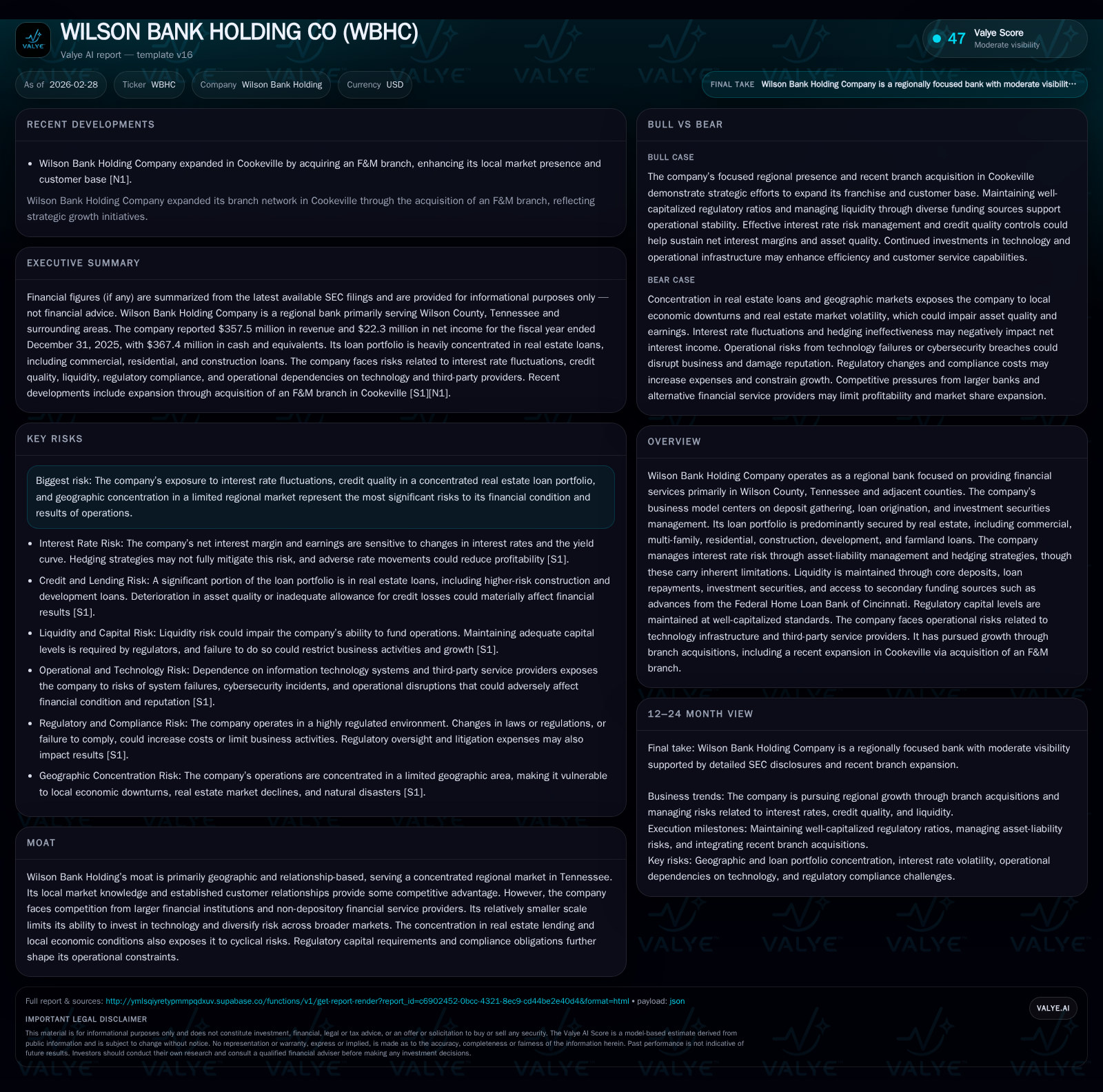
Wilson Bank Holding Company demonstrated robust financial growth in fiscal 2025, with a 14.2% revenue increase and nearly 50% rise in net income driven by its focus on real estate lending and disciplined capital management. Its concentrated loan portfolio in commercial and residential real estate underpins growth but also concentrates credit risk, necessitating vigilant asset quality monitoring and risk mitigation strategies. The company maintains a well-capitalized position, supported by strong operating cash flows and liquidity frameworks, while expanding its regional footprint via the recent F&M branch acquisition in Cookeville. However, inherent risks from interest rate volatility, local economic cycles, regulatory compliance costs, and technology investment challenges remain key considerations.
Financial Performance Trajectory: Revenue and Earnings Momentum
Wilson Bank Holding Company’s financial progression over the past four years underscores a trajectory of solid revenue and profitability expansion anchored by consistent operating cash flow generation. Fiscal year 2025 revenue reached $357.5 million, marking a 14.2% year-over-year increase from $313.1 million in 2024 [F1]. This top-line growth coincided with an impressive net income advance of 49.4%, rising to $22.3 million from $14.9 million in the prior year. Operating cash flow (CFO) exhibited notable strength as well, increasing by approximately 45% year-over-year to nearly $90 million in 2025 from $62 million in 2024 [F1]. Capital expenditures remained modest around $3.7 million with slight upward movement compared to prior periods.
The coherence between growing revenue streams and healthy CFO demonstrates Wilson Bank’s effective conversion of earned income into liquidity supporting both operational needs and strategic initiatives underpinned by a conservative capital discipline framework.
Historical performance (annual)
| FY | Rev ($mm) | Net ($mm) | CFO ($mm) | Capex ($mm) | Rev YoY | Net YoY |
|---|---|---|---|---|---|---|
| 2025 | 357 | 22 | 90 | 4 | +14.2% | +49.4% |
| 2024 | 313 | 15 | 62 | 3 | +33.1% | |
| 2023 | 11 | 86 | 5 | -9.1% | ||
| 2022 | 12 | 73 | 5 |
Source: SEC companyfacts cache [F1].
Capital returns and efficiency (annual)
| FY | Div ($mm) | Buybacks ($mm) | FCF ($mm) |
|---|---|---|---|
| 2025 | 8 | 0 | 86 |
| 2024 | 21 | 2 | 58 |
| 2023 | 17 | 81 | |
| 2022 | 21 | 68 |
Source: SEC companyfacts cache [F1].
Table reflects four years ending December each year; dollar figures rounded.
Core Real Estate Lending: The Growth Driver with Embedded Risks
At the heart of Wilson Bank’s business model lies its concentrated real estate loan portfolio, which principally comprises commercial real estate loans, multi-family residential loans, construction and development loans, farmland loans, as well as traditional residential mortgage products [S1][S11][S13][S19]. This deliberate portfolio focus has fueled recent revenue gains but simultaneously embeds heightened credit concentration risks.
Notably, construction and development lending segments carry elevated risk profiles due to their dependence on successful project completion for repayment—a dynamic accentuated by elevated loan-to-value ratios inherent in these projects [S19]. At year-end 2025, these loan types constituted approximately 22% of non-performing loans balances indicating susceptibility to collateral valuation swings amid local market fluctuations.
The bank's emphasis on extending credit to homebuilders and land developers adds another layer of cyclical sensitivity given these borrowers' vulnerability to real estate pricing dynamics affected by interest rate shifts and market demand [S16]. Additionally, small business commercial lending within the portfolio introduces further volatility potential owing to such borrowers’ higher sensitivity to economic downturns or operational disruptions.
Wilson Bank employs established credit provisioning methodologies alongside asset-liability management techniques to monitor exposure concentrations embedded within this specialized portfolio mix; nevertheless inherent cyclicality remains a key constraint affecting growth durability.
Geographic Moat and Regional Market Concentration
Wilson Bank’s competitive differentiation is rooted fundamentally in its regionally concentrated presence across Wilson County and adjacent Tennessee counties including DeKalb, Trousdale, Smith, Rutherford among others [S12][S27]. This geographic moat facilitates deep customer relationships cultivated over decades yielding sticky core deposits while enabling tailored local market underwriting expertise.
However, this geographic concentration is double-edged: it exposes Wilson Bank materially to localized economic downturns or structural real estate market corrections unique to its served counties [S13]. Shifts such as declining population growth rates or weakened employment conditions within this tapestry of counties can swiftly affect deposit levels, loan demand, asset quality metrics—and ultimately profitability.
Competition also remains vigorous amid this landscape as Wilson faces not only larger super-regional banks benefitting from scale economies but also nimble community banks and credit unions offering locally attractive rates or terms unconstrained by some regulatory obligations [S12]. While Wilson’s entrenched regional relationships provide some insulation versus transient competitors offering aggressive product pricing tactics, ongoing investments are needed to maintain relative positioning.
Operational Challenges: Technology Investments and Risk Management
Wilson Bank acknowledges operational headwinds linked primarily to legacy technology infrastructure that constrains efficiency improvements relative to larger financial institutions with more substantial IT budgets [S6][S8]. Despite significant prior investments in data processing systems and internet banking enhancements, further modernization efforts are warranted to meet evolving customer expectations for digital services as well as realize cost efficiencies.
Moreover, the bank operates under increasingly rigorous cybersecurity demands requiring continuous upgrades to protective measures—a costly imperative given escalating threat sophistication [S15]. Failure to effectively implement new technological capabilities could impair Wilson’s competitive profile by limiting product innovation speed or regulatory compliance agility.
Furthermore, the efficacy of Wilson’s risk management framework faces scrutiny due both to exposure concentrations within its specialized loan portfolio as well as operational complexities attached to technological transitions that may affect control environments if improperly managed [S29].
Liquidity and Capital Framework: Maintaining Well-Capitalized Status
Liquidity management remains integral to Wilson Bank’s capacity to fund loan origination pipelines sustainably while meeting depositor withdrawal demands or other contingent liabilities [S4][S5][S7]. Core deposit growth complemented by stable repayment inflows from its loan book alongside investment securities cash flows constitute primary funding pillars augmented occasionally by advances from the Federal Home Loan Bank of Cincinnati.
At December 31, 2025, regulatory capital ratios signaled ‘well-capitalized’ status affirming adherence to stringent supervisory thresholds despite organic asset growth trends challenging capital levels without proportional retained earnings accumulation [S4]. This status provides flexibility critical for both maintaining depositor confidence and pursuing expansion initiatives including branch acquisitions.
Still, should asset quality deteriorate precipitously or capital markets dislocate abruptly thus diminishing equity funding avenues, Wilson could face restrictive measures affecting dividend payments or new branch openings per regulatory mandates [S10]. The company must vigilantly balance capital deployment strategies with preservation imperatives incorporating contingency funding plans aligned with prudent asset-liability management practices.
Dividend Policy and Capital Return Dynamics
Dividends paid have exhibited variability over recent years evidencing managerial caution balancing shareholder returns alongside retention for internal growth funding requirements [F1]. Dividend payouts decreased notably in fiscal year ending December 2025 compared with prior periods while no share repurchases occurred during this period reflecting conservative capital allocation stance amidst expansion efforts.
This approach aligns with regulatory dividend restrictions tied explicitly to current plus prior retained earnings of the bank subsidiary before remitting dividends upstream; thus cash available for distribution remains sensitive to earnings volatility stemming from credit losses or operating expenses linked with technology investments or compliance costs [S4].
Wilson’s measured capital return philosophy prioritizes building equity buffers that support lending capacity increases rather than aggressive payout policies common among larger institutions with diversified revenue bases.
Growth Prospects Post F&M Branch Acquisition in Cookeville
A pivotal strategic development emerged recently with Wilson Bank’s acquisition of an F&M branch location expanding its geographic footprint into Cookeville—a move expected to synergistically enhance deposit gathering capacity while potentially diversifying the loan portfolio modulation beyond existing counties served [N1].
This incremental regional presence could catalyze cross-selling opportunities fostering new customer relationships aligned with Wilson’s community banking ethos while potentially mitigating some geographic concentration risks through broader market penetration.
However integration success will depend heavily on operational assimilation efficiencies including technology system compatibility as well as cultural alignment ensuring retention of acquired customers long-term while preventing attrition amid competitive Cookeville banking landscapes.
Key Risks: Interest Rate Volatility, Credit Exposure, and Regulatory Pressures
Wilson Bank faces several primary risk vectors:
- Interest Rate Risk: Its net interest margin sensitivity places profitability at risk if rate movements are unfavorable; imperfect hedging strategies may further amplify earnings volatility given unpredictable rate curve shifts [S1][S25][S28].
- Credit Concentration Risk: Heavy portfolio weighting toward real estate loans—especially construction/development—can precipitate sharp downturns in collateral valuations adversely impacting non-performing asset levels requiring heightened provisioning reserves affecting retained earnings and regulatory capital adequacy [S13][S19][S21].
- Operational Risks: Legacy technology limitations pose challenges implementing requisite cybersecurity controls alongside efficiency drives crucial for sustaining competitive positioning versus larger institutions with scale advantages [S6][S8][S29].
- Regulatory Compliance: Increasing complexity of banking regulations including capital rules tightening alongside fair lending obligations impose ongoing cost pressures potentially constraining net income margins; failure or delays in compliance expose the company to sanctions or reputational damage jeopardizing customer trust [S24][S26][S27].
- Geographic Concentration: The economic health of Tennessee counties directly influences deposit stability and loan demand patterns amplifying cyclicality risks in localized downturn scenarios with few alternate markets currently present to disperse such risk fully.
- Litigation Exposure: While currently no material pending lawsuits exist at this time [S18], lender liability claims related to commercial loan servicing create latent contingent liabilities requiring continuous risk mitigation vigilance.[S21]
What to Watch: Future Milestones and Capital Market Considerations
Although explicit forward-looking guidance is sparse at present some indicators warrant attention:
- Tracking changes in capital ratios relative to accelerated organic loan growth will reveal whether retained earnings keep pace sufficiently or if external capital raises might become necessary impacting dilution or leverage metrics.
- The effectiveness of ongoing technology investments is crucial—successful modernization programs may unlock efficiency gains buffered against wage inflation pressures afflicting regional banks broadly across this space.
- Progress integrating the newly acquired Cookeville branch into systems architecture without diluting service quality will signal operational capability crucial for assuming further regional expansions intact.
- Monitoring macroeconomic signals within Tennessee—such as housing starts data or unemployment rates—for signs of prolonged weakness could preemptively raise red flags regarding asset quality trajectory prompting more conservative provisioning stances ahead of realization events.
- Changes in federal or state regulatory regimes especially around consumer protection laws or capital adequacy may reshape Wilson’s operating model cumulatively increasing compliance headwinds necessitating strategic responses.
In sum, Wilson Bank Holding stands at an inflection balancing accelerated growth driven primarily through regional real estate lending against inherent sectoral risks intensified by geographic concentration alongside operational modernization demands typical for mid-sized community banks seeking sustainable competitiveness beyond core markets.
This report is intended solely for informational purposes highlighting historical performance trends and known factors affecting Wilson Bank Holding Company as documented through SEC filings and public disclosures up to February 28th, 2026. It does not constitute investment advice.
Disclaimer: This is research-only, informational analysis and not investment advice. It may include AI-generated interpretation and general industry context. Always verify important details using primary sources.

Comments