
WEN Acquisition Corp: SPAC Execution Hinges on Fintech Target Selection and Market Timing
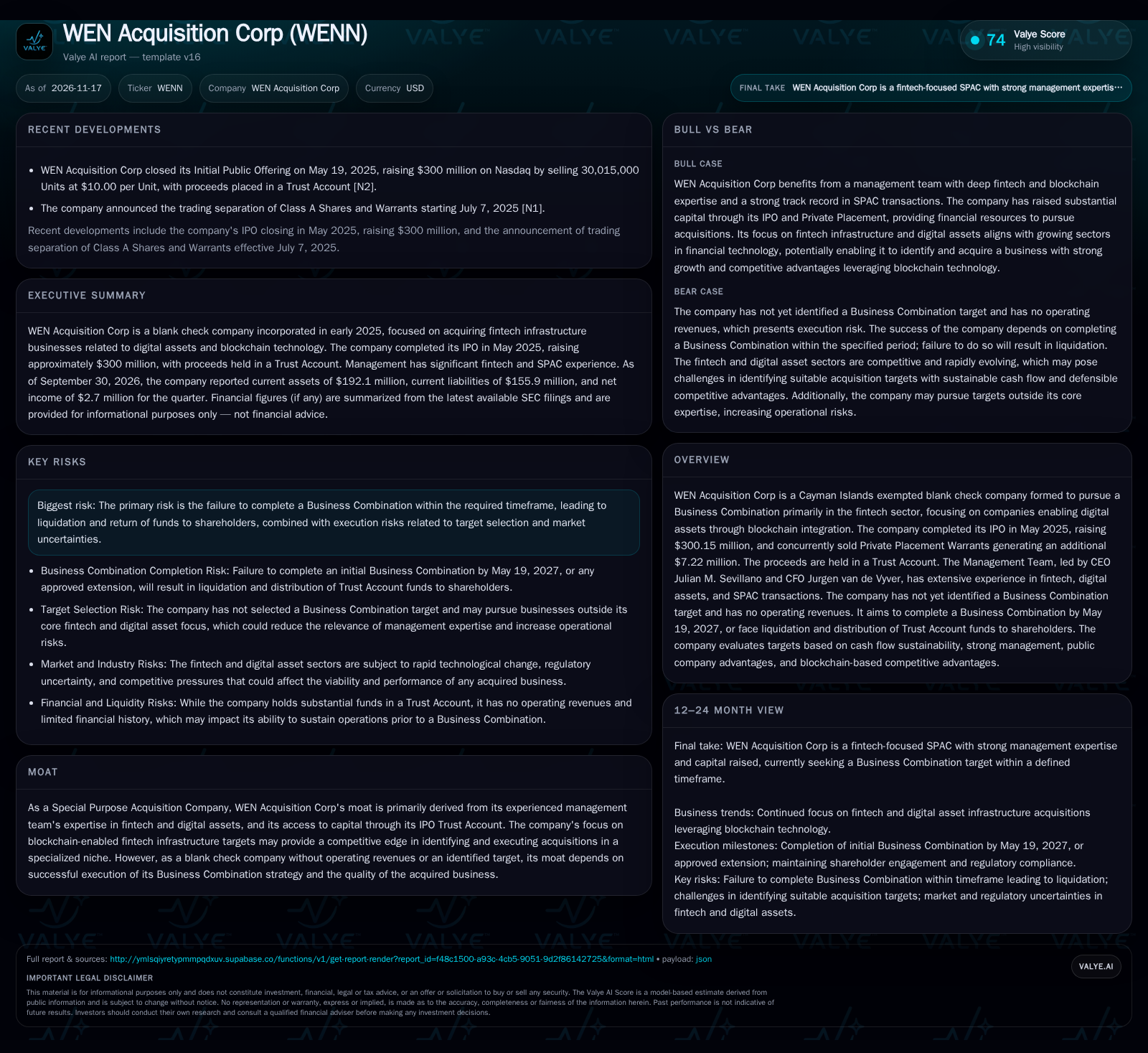
WEN Acquisition Corp enters a critical phase as it seeks a fintech or digital asset infrastructure acquisition before its SPAC deadline. With $192 million in current assets and a management team steeped in fintech and blockchain, the company's ability to identify, negotiate, and complete a business combination will determine whether it transforms into an operating entity or returns capital to shareholders.
WEN Acquisition Corp, a fintech-focused SPAC backed by experienced management, holds $192 million in current assets but has not yet identified a business combination target. Success depends on selecting and closing an acquisition—preferably in blockchain-enabled digital asset infrastructure—before its SPAC deadline, amid sector volatility and intense competition for quality targets. Execution risk remains high.
WEN Acquisition Corp sits at a strategic crossroads typical of late-stage SPACs: flush with IPO proceeds and led by a fintech-focused management team, the company must now identify, negotiate, and consummate a business combination—ideally in the blockchain-enabled digital asset infrastructure space it targets. With $192 million in current assets but no operating revenue or announced target, the company’s fate hinges on its ability to secure a deal before its SPAC deadline amid fierce competition for quality fintech assets and shifting regulatory headwinds.
IPO Proceeds and Deadline Pressure Define WEN’s Near-Term Reality
As of September 30, 2026, WEN Acquisition Corp reported $192.1 million in current assets against $155.9 million in current liabilities, resulting in a current ratio of 1.23 [S2]. The company generated net income of $2.7 million for the quarter but has not produced any operating revenues to date, as is typical for a pre-combination SPAC [S2]. The proceeds from its May 2025 IPO, which raised approximately $300 million, remain largely held in trust pending an acquisition [N2]. Critically, WEN has yet to identify a business combination target. Under SPAC rules and Nasdaq listing requirements, failure to close a deal within the specified period (typically 24-36 months from IPO) would require WEN to liquidate and return funds to shareholders. This looming deadline intensifies the pressure to execute a successful acquisition.
How Value Could Be Created: Acquisition Economics and Post-Merger Leverage
WEN’s business model is fundamentally transactional: it exists to identify and merge with a promising company, thereby taking it public and providing capital, financial discipline, and market access. The economics hinge on two phases. First, deploying the trust proceeds—minus redemptions and transaction costs—to acquire a company with durable cash flows, scalable operations, and a compelling growth narrative. Second, after the merger, value creation must come from the target’s operating leverage, market share gains, and the ability to command premium multiples as a public entity.
For fintech infrastructure and digital asset platforms, revenue streams may include transaction fees, SaaS subscriptions, or network usage charges. Fixed costs (platform development, regulatory compliance) can be high, but successful platforms often exhibit strong operating leverage as incremental volume scales with limited marginal cost. Post-merger, WEN’s success will depend on the acquired company’s ability to grow volumes, expand margins, and retain customers amid sector volatility. SPAC sponsors, including WEN’s team, typically retain incentives (founder shares, warrants) that only pay off if the post-merger entity’s value appreciates.
The Fintech SPAC Arena: Target Scarcity and Differentiation Challenges
WEN’s focus on fintech infrastructure and blockchain-enabled digital asset platforms positions it in a highly competitive SPAC segment. Numerous blank-check companies are chasing a finite pool of quality targets, especially in the digital assets sector, where regulatory scrutiny and market cycles can impact valuations and deal readiness. WEN’s management and advisory team bring sector-specific credibility, which may help in sourcing and negotiating with promising targets. However, the lack of an identified target as of late 2026 suggests the market is tight or that WEN is exercising caution amid shifting sector sentiment.
Competitors include other fintech-focused SPACs, private equity, and strategic buyers from within the financial services and technology sectors. These rivals may offer higher valuations, greater certainty, or stronger post-acquisition support. In this context, WEN’s edge will depend on its ability to leverage its fintech expertise, offer attractive deal terms, and reassure targets about the benefits of public market access via SPAC merger as opposed to traditional IPO or private capital.
Unlocking Value Through a High-Quality Digital Asset Infrastructure Merger
In the most favorable scenario, WEN identifies and successfully acquires a fintech infrastructure company with proven product-market fit, recurring revenue, and scalable operations in digital asset enablement (e.g., stablecoin settlement, blockchain integration for banks). Such a deal would deploy trust capital efficiently, minimize redemptions, and provide a clear path to post-merger growth. If the target demonstrates strong operating leverage and market adoption, the combined entity could command premium public market multiples, especially if regulatory clarity around digital assets improves.
Confirmation of this scenario would come from a deal announcement with a credible, high-growth target, low redemption rates at merger vote, and investor enthusiasm reflected in post-merger trading. Evidence would also include robust revenue and margin projections, sticky customer relationships, and a management team with a record of scaling fintech businesses.
Most Likely Outcome: Acquisition of a Mid-Tier Fintech Platform With Moderate Public Market Reception
The most plausible path is that WEN ultimately secures a business combination with a fintech or digital asset infrastructure company that meets minimum sustainability and growth criteria but does not stand out as a sector leader. The acquisition could involve a company with some recurring revenues, addressable market growth, but also competitive or regulatory challenges. Shareholder redemptions may be elevated but not overwhelming, and the merged entity trades at modest multiples reflecting sector uncertainty.
Evidence confirming this scenario would include a deal announcement with a credible but not top-tier target, moderate redemption rates, and post-merger trading in line with SPAC averages. Any guidance or projections would likely show steady but unspectacular growth, and investor enthusiasm would be tempered by continued sector volatility or regulatory ambiguity.
Deal Failure or Liquidation: Risks of Missing the SPAC Window
Adverse outcomes center on execution failure: WEN may be unable to identify or close an acceptable business combination before its SPAC deadline, forcing liquidation and the return of trust capital to shareholders. This outcome could be triggered by a persistent lack of attractive targets, regulatory shocks that dampen fintech valuations, or excessive shareholder redemptions that erode the capital base for a viable merger.
Signs pointing to this scenario would include repeated extensions or delays, lack of concrete deal progress, regulatory actions affecting digital assets, or market turmoil that makes public market access unattractive for potential targets. Liquidation would result in minimal value creation for sponsors and public shareholders beyond the return of trust assets.
Milestones and External Developments That Will Determine WEN’s Trajectory
Announcement of a definitive business combination agreement, including industry, target profile, and deal terms.
Shareholder redemption rates at the time of merger vote—if disclosed, a low redemption rate would suggest investor confidence.
Projected and actual financial performance of the acquired business, especially revenue growth, margin expansion, and retention metrics (if disclosed).
Developments in digital asset and fintech regulation, particularly any guidance that could affect the economics or viability of the target business.
Any extensions to the SPAC’s merger deadline or amendments to trust agreement terms.
Post-announcement PIPE (private investment in public equity) financing or strategic investment, which could signal market validation or fill capital gaps.
Management commentary on target selection criteria, sector focus, and post-merger operating strategy—would help test the alignment with stated fintech/blockchain ambitions.
Market and peer SPAC deal activity, which could signal shifts in competitive dynamics or target availability.
Disclaimer: This is research-only, informational analysis and not investment advice. It may include AI-generated interpretation and general industry context. Always verify important details using primary sources.

Comments