
NEXGEL: Financial Pressures and Strategic Realignment Following Celularity Biomaterials Acquisition
NEXGEL’s acquisition of Celularity’s biomaterials assets in April 2026 positions it for potential product commercialization, yet the company now confronts severe liquidity shortfalls, high-interest convertible debt, and legal uncertainties.
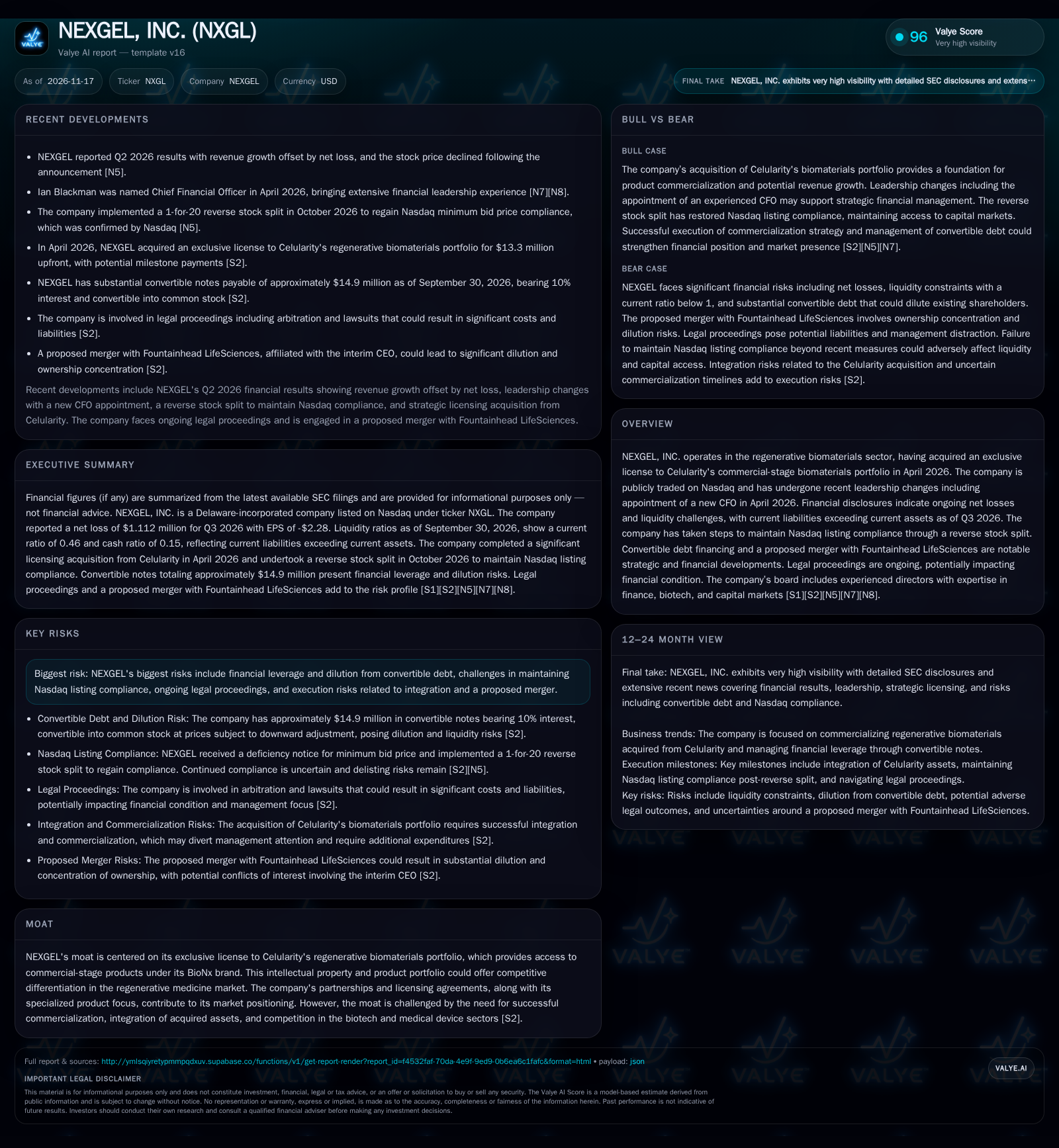
NEXGEL’s acquisition of Celularity’s biomaterials assets in April 2026 positions it for potential product commercialization, yet the company now confronts severe liquidity shortfalls, high-interest convertible debt, and legal uncertainties. A pending merger with Fountainhead LifeSciences could reshape the capital structure but brings significant dilution and governance risks. Execution on integration, commercialization, and financial restructuring will determine whether NEXGEL can convert its intellectual property into sustainable value or remains mired in financial distress. [S2] [N5] [N7] [N8]
NEXGEL, INC. faces a pivotal moment following its April 2026 acquisition of Celularity’s commercial-stage regenerative biomaterials portfolio. While this move provides the company with a differentiated asset base and potential new revenue streams, it has also introduced acute financial pressures, evidenced by a negative current ratio, mounting convertible debt, and persistent net losses. The company’s strategy now hinges on its ability to integrate and commercialize its new assets, manage legal and financial overhangs, and navigate the risks of a potentially transformative—yet highly dilutive—merger with Fountainhead LifeSciences. The next several quarters will be critical in determining whether NEXGEL can secure a sustainable business model or faces further instability.
Liquidity Strain and Strategic Moves Define NEXGEL’s Present
NEXGEL’s current facts center on three developments: the acquisition of Celularity’s regenerative biomaterials portfolio, a pronounced liquidity crunch, and a proposed merger that could fundamentally reshape its capital structure. The $13.3 million upfront outlay for the Celularity license, with up to $20 million in contingent payments, has added a valuable commercial-stage asset but also intensified funding needs [S2]. As of September 30, 2026, NEXGEL reported cash and equivalents of $938,000, current assets of $4.936 million, and current liabilities of $10.626 million—translating to a current ratio of 0.46 and a cash ratio of just 0.15 [S2]. The company’s $14.9 million in convertible notes bearing 10% interest, which are convertible at potentially downward-adjusted prices, introduce both balance-sheet risk and significant dilution potential [S2]. NEXGEL’s 1-for-20 reverse stock split in October 2026 restored Nasdaq compliance but underscores persistent market and regulatory pressures [N5]. A merger proposal with Fountainhead LifeSciences, linked to the interim CEO, further complicates the near-term outlook due to potential for extreme dilution and governance concentration [S2].
Commercialization Requires Scale, But Capital Structure Is a Major Constraint
NEXGEL’s underlying business model is now predicated on monetizing its exclusive access to Celularity’s regenerative biomaterials—products with applications in wound care, regenerative medicine, and possibly aesthetic or drug delivery markets. The company must convert this intellectual property into recurring product revenues, either through direct sales, licensing, contract manufacturing, or white-label partnerships. Successful commercialization would likely require significant up-front investment in regulatory, manufacturing, and marketing capabilities. Fixed costs could be high in the initial years as the company integrates the new assets and builds distribution, but variable costs may scale favorably if production volumes rise.
However, the company’s capital structure is acutely stressed. The $14.9 million in convertible debt at a 10% interest rate imposes a heavy cash burden, while conversion at lower stock prices could result in massive shareholder dilution. The sub-1.0 current ratio and reported cash balance constrain operational flexibility, making it difficult to fund working capital or invest in growth without additional financing or asset sales. The economics of the business are therefore highly sensitive to near-term revenue ramp, cost discipline, and the terms of any recapitalization or merger. If the Celularity portfolio can be commercialized rapidly and at healthy gross margins, NEXGEL could potentially move toward operating leverage; otherwise, it faces the risk of insolvency or value-destructive dilution.
Portfolio Differentiation vs. Execution and Industry Rivalry
NEXGEL’s moat is based on the exclusivity of its Celularity-licensed biomaterials, which theoretically provide a differentiated product portfolio in the regenerative medicine and wound care sectors [S2]. In these markets, intellectual property and regulatory clearances can create barriers to entry, but the ultimate defensibility depends on clinical efficacy, cost-effectiveness, and physician/payer adoption. The company competes against established medical device firms, specialized biotech companies, and contract manufacturers with broader commercial footprints.
Switching costs for customers (e.g., hospitals, clinics, or distributors) are typically moderate unless the biomaterials demonstrate superior clinical outcomes or cost advantages. If NEXGEL can establish robust partnerships or distribution agreements, it may be able to embed its products more deeply into customer workflows. However, the company’s precarious financial position and uncertain commercialization timeline create vulnerability: competitors with stronger balance sheets or existing distribution channels could outpace NEXGEL in bringing similar regenerative products to market. The risk of technology substitution or regulatory setbacks also looms, especially if the acquired portfolio does not offer clear and demonstrable advantages.
Rapid Commercial Uptake and Successful Recapitalization Could Unlock Value
The favorable scenario for NEXGEL would involve swift integration and commercialization of the Celularity biomaterials, yielding recurring revenues that outpace operating costs and debt service. Early adoption by key hospital systems or medical distributors—potentially validated through clinical studies or favorable reimbursement—could catalyze a virtuous cycle of volume growth and margin expansion. If the company can simultaneously restructure its balance sheet—either by renegotiating convertible debt terms, securing non-dilutive financing, or executing a merger that injects new equity without excessive dilution—then the business could regain financial stability.
Evidence that would confirm this scenario includes: sequential revenue growth from the new portfolio (ideally at high gross margins), successful regulatory or payer milestones, positive cash flow trends, and recapitalization on terms that limit dilution. Conversely, lagging revenue, continued liquidity strain, or a highly dilutive merger would falsify the bull case.
Challenging Transition: Asset Integration Amid Persistent Financial Overhang
The most plausible outcome is a prolonged transition period during which NEXGEL struggles to integrate the Celularity assets and ramp up commercialization while continuing to operate under severe liquidity and capital-structure constraints. Revenues may grow incrementally, but not rapidly enough to offset net losses, interest expense, or the need for additional funding. Legal proceedings and the risk of adverse judgments could further complicate cash management.
The proposed merger with Fountainhead LifeSciences may eventually close, but with substantial dilution and a shift in control, leaving legacy shareholders with only a small stake in the combined entity. Confirmation of this scenario would come from continued net losses, repeated capital raises or debt conversions, and delayed or modest revenue contributions from the acquired portfolio. Evidence to the contrary would include rapid revenue scaling or a less dilutive, more value-accretive financial restructuring.
Liquidity Exhaustion and Value Destruction from Forced Dilution or Delisting
In the adverse scenario, NEXGEL’s reported cash balance and negative working capital lead to a liquidity crisis before commercialization gains traction. The company may be forced to raise capital on punitive terms, triggering extreme dilution via convertible note conversions or emergency equity issuance. If the stock price falls further, downward adjustment clauses in the notes could accelerate dilution and erode shareholder value. Failure to maintain Nasdaq compliance could result in delisting, further constraining access to capital and reducing the attractiveness of the company’s IP assets.
Legal liabilities and merger-related conflicts could compound uncertainty, distracting management and deterring potential partners or acquirers. Confirmation of this downside would include missed payroll or vendor payments, default on debt covenants, delisting notices, or large-scale emergency financings at deep discounts.
Milestones That Will Shape NEXGEL’s Commercial and Financial Trajectory
Quarterly revenue growth attributable to the Celularity biomaterials portfolio—if disclosed—would help indicate commercialization progress and validate the integration thesis.
Updates on gross margin trends and manufacturing scalability, which would clarify whether the business can achieve operating leverage as volumes ramp.
Resolution and cost impact of ongoing legal proceedings, since material adverse outcomes could further impair liquidity or distract management focus.
Disclosure of conversion activity or renegotiation of the $14.9 million in convertible notes, as large-scale conversions or amendments would signal dilution risk or changing creditor confidence.
Progress or terms of the proposed merger with Fountainhead LifeSciences, especially regarding ownership structure, governance, and dilution magnitude.
Maintenance of Nasdaq listing compliance, as any renewed deficiency notices or delisting proceedings would directly impact capital access and investor confidence.
Cash burn rate and updatedreported liquidity position disclosures—if provided—would help assess the risk of forced financing or insolvency.
Disclaimer: This is research-only, informational analysis and not investment advice. It may include AI-generated interpretation and general industry context. Always verify important details using primary sources.

Comments