
Calisa Acquisition Corp: SPAC Merger with GoodVision AI Reshapes Risk and Opportunity Profile
Calisa Acquisition Corp’s pending merger with GoodVision AI marks a strategic pivot from blank-check uncertainty toward exposure in AI infrastructure, bringing new upside potential and execution risks. The deal’s success will hinge on integration, partnership leverage, and the evolving competitive landscape for AI hardware and inference platforms.
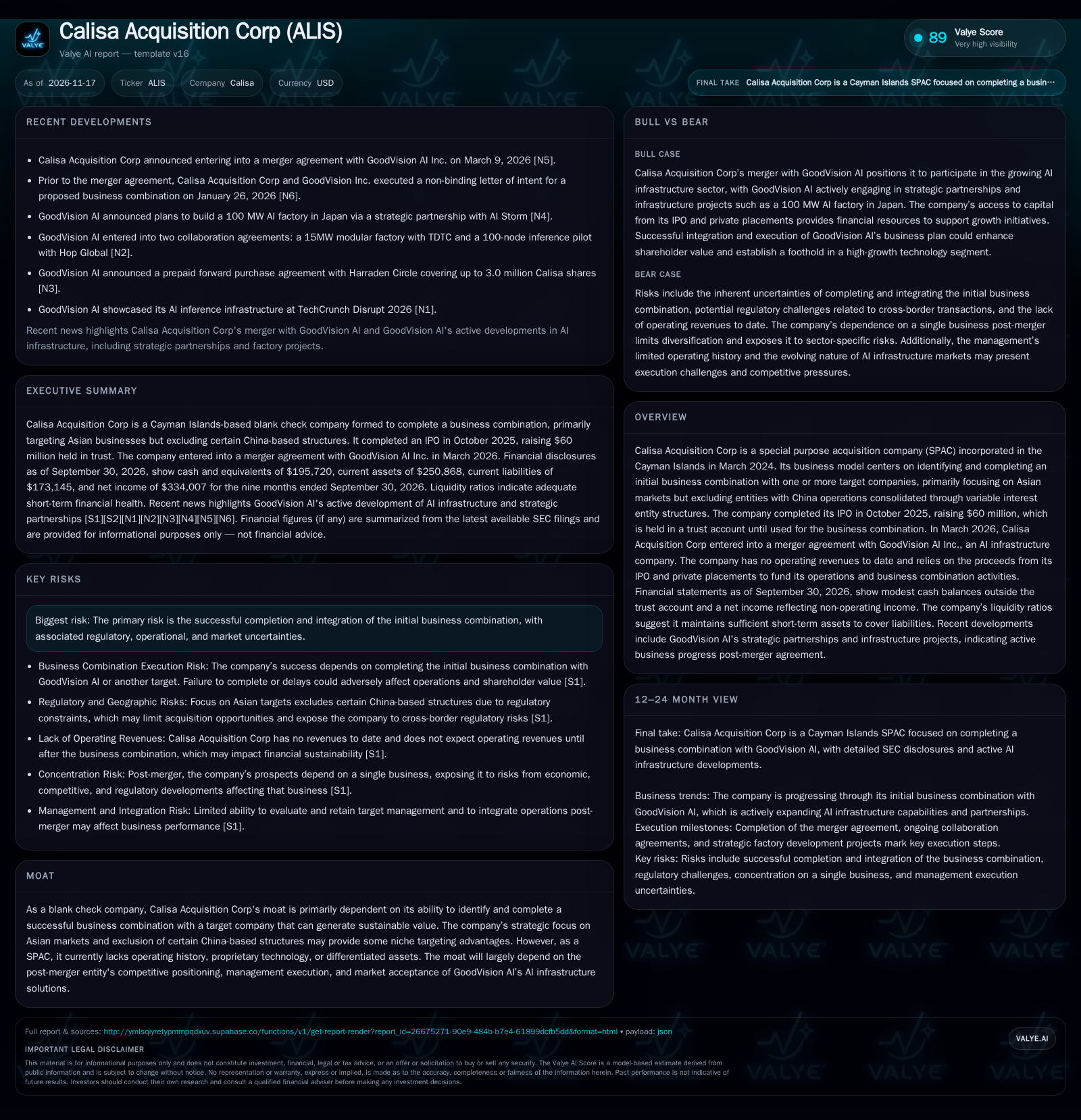
Calisa Acquisition Corp, a Cayman Islands-based SPAC, raised $60 million in its October 2025 IPO and is now progressing toward a business combination with GoodVision AI, a company focused on AI inference infrastructure. As of September 30, 2026, Calisa showed a reported cash balance outside its trust, with $62 million still held in trust and no operating revenues to date. GoodVision AI has announced notable partnerships and a forward purchase agreement, but the post-merger success will depend on integration, the scalability of GoodVision’s technology, and its ability to navigate the dynamic AI market.
Calisa Acquisition Corp’s transition from a cash-rich SPAC to a vehicle for AI infrastructure exposure is now defined by its pending merger with GoodVision AI. The transaction promises entry into a high-growth, highly competitive market, but it also concentrates Calisa’s future on a single, execution-dependent venture. Recent partnerships and capital agreements suggest GoodVision AI is building operational momentum, yet the combined entity’s fate will depend on its ability to scale, differentiate, and monetize AI inference technologies amid intensifying market competition. Investors face an asymmetrical risk/reward profile shaped by the quality of post-merger integration and the unpredictable trajectory of AI infrastructure demand.
Merger Milestone and Financial Position Define Calisa’s Present
Calisa Acquisition Corp’s most material recent development is its entry into a definitive merger agreement with GoodVision AI Inc. in March 2026, a move that will see GoodVision become a wholly-owned subsidiary if the deal closes [S1] [N5]. Calisa, as of September 30, 2026, continues to operate as a pre-revenue SPAC, with $62 million in trust and a modest $195,720 in cash and equivalents outside the trust [S2]. The company reported net income of $334,007 for the first nine months of 2026, but this figure reflects non-operating sources, as Calisa has no operating revenues to date [S2].
GoodVision AI, the proposed merger target, recently announced a prepaid forward purchase agreement with Harraden Circle for up to 3 million Calisa shares, providing a potential mechanism for post-combination capital infusion [N3]. Meanwhile, GoodVision has secured two notable commercial partnerships: a 15MW modular factory with TDTC and a 100-node inference pilot with Hop Global. These partnerships signal early operational momentum for the target business, but their scale and revenue impact remain to be tested. Collectively, these facts mark a pivot point for Calisa, transitioning from a capital pool to an operating company with significant concentration risk and execution dependence on the GoodVision AI platform.
SPAC Economics Give Way to AI Infrastructure Risk-Reward Dynamics
Pre-merger, Calisa’s economics are typical of a SPAC: capital from its $60 million IPO and $2.525 million private placement is held in trust, generating minimal net income from interest or investment returns [S1] [S2]. The actual business model and economics will be defined by GoodVision AI post-merger. AI infrastructure businesses, particularly those focused on inference hardware and integrated platforms, depend on the ability to scale deployments rapidly, capture high-value enterprise contracts, and achieve a mix of upfront hardware sales and recurring software or service fees.
Fixed costs in this segment tend to be high, with significant R&D, capital outlays for factory buildouts, and ongoing costs associated with maintaining cutting-edge technology. The 15MW modular factory partnership suggests an ambition to vertically integrate or secure manufacturing capacity, which could enable higher gross margins if utilization is strong but exposes the company to under-absorption risk if volume lags. The 100-node inference pilot points to an early customer validation, but the conversion rate from pilot to scaled deployment will be crucial for sustained revenue and margin expansion.
Post-merger, the combined entity’s economics will likely hinge on the mix of capital-intensive infrastructure projects versus higher-margin, recurring software or inference-as-a-service revenues. Operating leverage could be significant if GoodVision achieves scale, but initial phases may be cash-intensive, with negative free cash flow until a critical mass of customers is reached. The prepaid forward purchase agreement could provide a buffer for working capital or growth initiatives, but dilution or share overhang risk also rises.
Entering an Intensifying AI Infrastructure Race
GoodVision AI, as Calisa’s intended operating business, enters a fiercely competitive landscape. The market for AI inference infrastructure is shaped by large, entrenched players (such as global cloud providers and traditional semiconductor giants), as well as specialized startups targeting modular hardware and edge inference niches. Key competitive factors include performance per watt, total cost of ownership, integration flexibility, and the ability to serve both hyperscale and vertical-specific enterprise customers.
The announced partnerships—a modular factory and a pilot with Hop Global—suggest GoodVision is attempting to carve out a differentiated position with modular, scalable deployments. However, the durability of any competitive advantage will depend on proprietary technology, ecosystem integration, and the speed of customer adoption. The exclusion of China-based VIE structures may limit addressable market size but also reduces regulatory complexity and geopolitical risk for Western-aligned customers.
Network effects and switching costs in AI infrastructure are possible if GoodVision can tie customers to its platform through proprietary APIs, data pipelines, or managed services. However, in the absence of disclosed recurring revenue contracts or deep integrations, the risk remains that customers may trial but not commit at scale. The company’s ability to convert pilots into long-term, recurring relationships will ultimately determine its competitive staying power.
If GoodVision Scales Deployments, Calisa’s Platform Could Become a Core AI Infrastructure Player
The favorable scenario hinges on GoodVision’s successful transition from pilot projects to scaled, multi-year commercial contracts. If the 100-node inference pilot with Hop Global leads to broader enterprise adoption, and the modular factory partnership enables cost-effective, high-volume hardware production, the business could achieve rapid revenue growth and operating leverage. Early validation from recognized enterprise partners would support both customer acquisition and investor confidence.
Confirmation of this scenario would require evidence of pilot-to-contract conversion, public announcements of scaled deployments, and disclosure of recurring revenue streams or backlog. Accelerating top-line growth, improving gross margin, and positive operating cash flow would further validate the thesis. If the prepaid forward purchase agreement is exercised under favorable terms and used for strategic expansion, it could amplify growth rather than merely offsetting cash burn.
Integration Uncertainties and Pilot Risk Temper Growth Ambitions
The most plausible outcome reflects a period of post-merger integration, with GoodVision moving from pilots to initial commercial deployments but facing lumpy, unpredictable revenue and margin progression. The company may secure some follow-on contracts from its pilots, but widespread adoption could be slower than hoped given the competitive market and the capital requirements of scaling hardware infrastructure.
In this scenario, Calisa’s financials transition from trust-based interest income to a mix of modest operating revenue and continued cash outflows for R&D, sales, and manufacturing scale-up. The prepaid forward purchase agreement may be tapped to support working capital, but dilution risk rises if share prices do not appreciate. Confirmation would come from steady but not explosive revenue growth, persistent negative free cash flow, and incremental partnership or customer announcements rather than transformative wins. Falsification would involve evidence that pilots are not converting or that integration challenges are causing operational delays and cost overruns.
Failure to Convert Pilots or Integrate Operations Could Erode Shareholder Value
The adverse scenario is driven by an inability to convert pilot deployments into material commercial contracts, operational missteps in scaling manufacturing, or integration failures post-merger. Competitive pressure from larger, better-capitalized incumbents could squeeze margins, while the lack of recurring revenue or customer stickiness could lead to high churn and weak visibility.
In this outcome, cash burn accelerates, the trust proceeds are depleted without offsetting revenue, and the company is forced to seek additional dilutive capital or downsize ambitions. Redemptions of Calisa shares could further reduce the public float and limit liquidity. Confirmation of this scenario would be the absence of new contract wins, disclosure of pilot failures, or guidance of higher-than-expected costs and delays. Falsification would require unambiguous signs of successful commercial scaling and improving financial health.
Milestones That Will Shape Calisa-GoodVision’s Post-Merger Trajectory
Disclosure of conversion rates from pilot projects (such as the 100-node Hop Global pilot) to full-scale commercial contracts would help test the scalability of GoodVision’s business model.
Updates on the progress, utilization, and economics of the 15MW modular factory partnership with TDTC—particularly any transition from pilot to volume production.
Revelation of contract terms, duration, and revenue recognition mechanics for any announced customer wins, if disclosed.
Evidence of recurring revenue streams, backlog, or multi-year commitments from enterprise customers would clarify revenue visibility.
Operating cash flow trends and capital expenditure requirements post-merger, especially as the company ramps infrastructure.
The pace and scale of redemptions by Calisa shareholders in connection with the business combination, which could affect post-merger liquidity and public float.
Material updates or changes to the prepaid forward purchase agreement with Harraden Circle, including how proceeds are deployed and their impact on dilution.
Disclaimer: This is research-only, informational analysis and not investment advice. It may include AI-generated interpretation and general industry context. Always verify important details using primary sources.

Comments