
Westlake Corp's 2025 Earnings Decline and Strategic Shifts Highlight Integration Challenges and Capital Structure Focus
Westlake Corporation’s vertical integration and global footprint provide resilience but recent operational shutdowns and goodwill impairment weigh on near-term results.
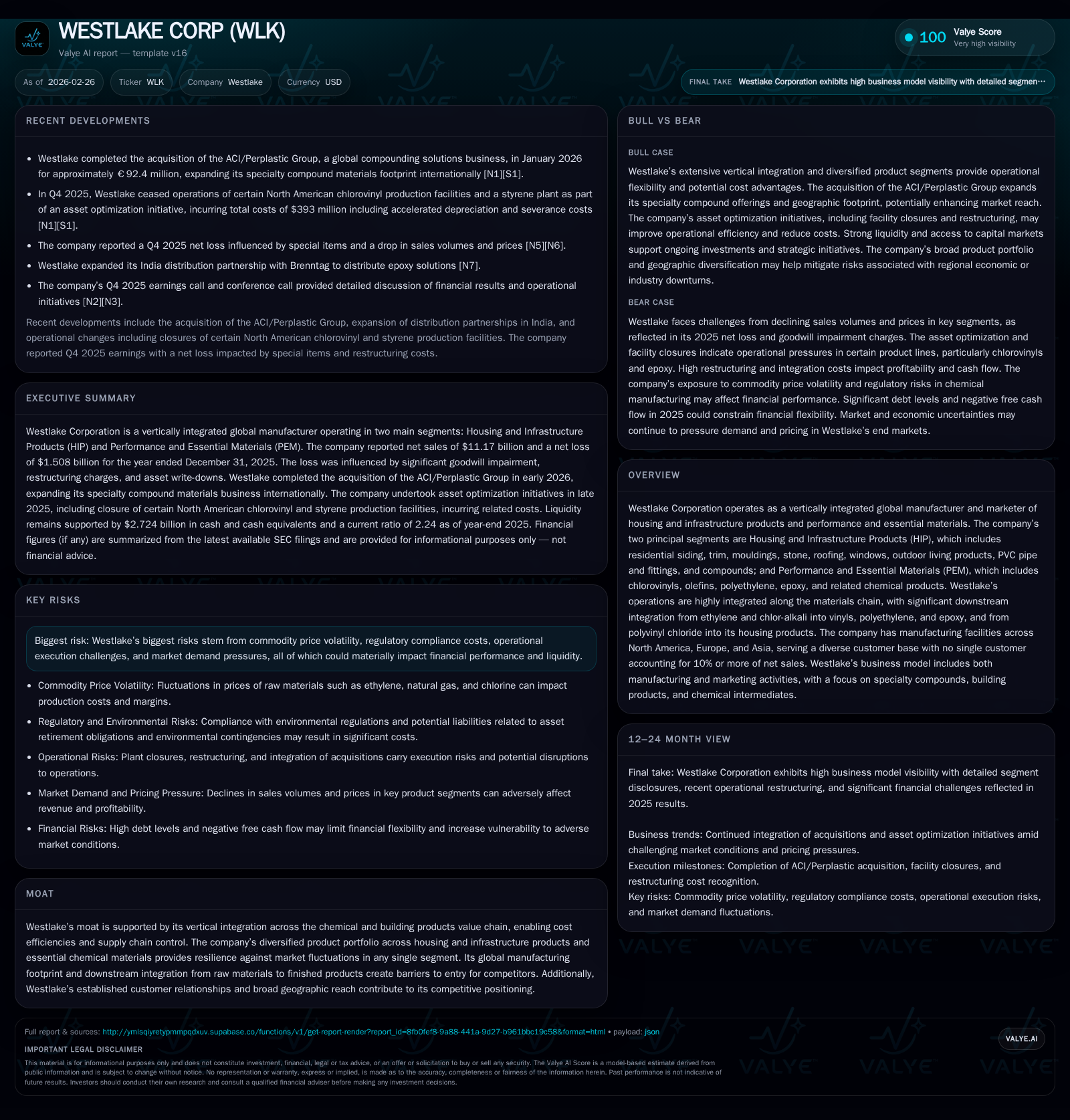
Westlake Corporation, a vertically integrated producer in housing products and specialty chemicals, reported a sharp fall in 2025 earnings driven primarily by restructuring charges and softer market conditions. The company’s strategy centers on strong downstream integration from raw materials through to finished products, giving it cost advantages but exposing it to cyclical commodity price volatility. Recent asset optimization initiatives included plant closures that triggered a sizeable goodwill impairment, marking a clear turning point in its Performance and Essential Materials segment. Despite near-term headwinds, Westlake’s balance sheet remains solid with ample liquidity and access to capital markets, supporting ongoing dividend payments and share repurchases. Future growth hinges on successful integration of recent acquisitions and operating efficiency gains amid challenging demand dynamics.
Business Overview
Westlake Corporation operates two principal segments: Housing and Infrastructure Products (HIP), which includes residential building materials such as siding, trim, PVC pipe & fittings; and Performance and Essential Materials (PEM), encompassing chlorovinyls, olefins, polyethylene, epoxy resins among others [S1]. The company leverages vertical integration along the chemical value chain—from feedstocks like ethylene and chlorine through intermediates such as vinyl chloride monomer (VCM) to polymers used internally for building products as well as external sales. This integration supports cost optimization and supply chain control across North America, Europe, and Asia [S1].
Historical Performance
Westlake experienced notable volatility reflecting commodity cycles and restructuring efforts. Revenue declined from approximately $15.79 billion in 2022 to $11.17 billion in 2025—a decrease driven primarily by pressures in the PEM segment affected by plant shutdowns [F1]. Operating income plunged from positive $3.05 billion in 2022 to a loss of $1.58 billion in 2025 due largely to a $727 million goodwill impairment charge related to the North American Chlorovinyls reporting unit alongside $393 million restructuring costs for plant closures plus inventory write-downs amid softer selling prices [F1][S1]. Net income followed this trend with a swing from profit of $2.25 billion in 2022 down to a loss of $1.51 billion in 2025 [F1].
Operating cash flow contracted from over $3.3 billion in 2022 down to approximately $465 million in 2025 while capital expenditures remained steady near $995 million aligned with maintenance needs amid strategic investments [F1].
Historical performance (annual)
| FY | Rev ($bn) | Net ($bn) | CFO ($bn) | OpInc ($bn) | Rev YoY | Net YoY |
|---|---|---|---|---|---|---|
| 2025 | 11.2 | -1.5 | 0.5 | -1.6 | -8.0% | -350.5% |
| 2024 | 12.1 | 0.6 | 1.3 | 0.9 | -3.2% | +25.7% |
| 2023 | 12.5 | 0.5 | 2.3 | 0.7 | -20.6% | -78.7% |
| 2022 | 15.8 | 2.2 | 3.4 | 3.0 |
Source: SEC companyfacts cache [F1].
Capital returns and efficiency (annual)
| FY | Div ($mm) | Buybacks ($mm) | FCF ($bn) |
|---|---|---|---|
| 2025 | 272 | 63 | -0.5 |
| 2024 | 264 | 60 | 0.3 |
| 2023 | 221 | 23 | 1.3 |
| 2022 | 169 | 101 | 2.3 |
Source: SEC companyfacts cache [F1].
Table: Westlake Annual Financial Summary (USD billions where applicable)
Strategic Developments & Recent Events
In January 2026 Westlake completed the acquisition of ACI/Perplastic Group for approximately €92 million (~$100 million), expanding its specialty compounding capabilities primarily serving the wire & cable sector across Portugal, Mexico, Tunisia, and Romania—broadening its global compound product offerings [S1].
Late Q4’25 saw the cessation of operations at several North American chlorovinyl production facilities including the Aberdeen PVC plant (Mississippi), Lake Charles VCM plant (Louisiana), one chlor-alkali diaphragm unit at Lake Charles South site, plus the styrene production plant also at Lake Charles [S1]. This asset optimization initiative reflects structural shifts away from less competitive assets amid market pressures on vinyls/chemicals demand.
Q4 restructuring charges totaled approximately $393 million including accelerated depreciation/amortization ($317 million non-cash), asset retirement obligations ($52 million), severance costs ($17 million), with additional closure costs estimated at around $25 million expected through completion in calendar year ’27 [S1].
A significant non-cash goodwill impairment charge of $727 million was taken against the North American Chlorovinyls reporting unit during Q3’25 following downward revisions of industry outlooks due to operating losses combined with macroeconomic headwinds [S1].
Future Growth Prospects
Growth opportunities include leveraging vertical integration advantages especially if commodity markets stabilize or improve enabling margin recovery upstream feeding into downstream product lines such as HIP’s building material franchises serving resilient housing markets globally.
The ACI acquisition potentially diversifies end-market exposure into specialty compounds beyond commoditized chemicals [S1]. Ongoing operational efficiency improvements are targeted through continued manufacturing footprint rationalization.
Challenges include cyclicality inherent in chemical feedstock pricing influenced by global energy markets; regulatory compliance costs particularly environmental mandates; ongoing litigation risks including antitrust lawsuits involving caustic soda pricing (U.S./Canada settlements pending court approval Q2’26) as well as European Commission investigations into ethylene pricing practices; plus potential indemnity claims linked historically via PPG subsidiary arrangements [S5][S15][S24].
Demand softness observed late ’25 quarter across chemical derivatives alongside price erosion signals constraints absent material stimulus or capacity rationalization success.
Financial Position & Capital Allocation
As of December 31, 2025, Westlake held strong liquidity with cash & equivalents totaling approximately $2.72 billion plus available-for-sale securities valued at about $204 million alongside an undrawn revolving credit facility sized at $1.5 billion maturing June ’27 offering flexible borrowing capacity if needed [F1][S4].
Total long-term debt carrying value stood at approximately $5.58 billion after November ’25 issuance of senior notes totaling $1.2 billion split between notes due ’35 (5.55%) and ’55 (6.375%) used partly for refinancing expiring notes plus funding the ACI acquisition [F1][S9][S10].
Interest expense rose with higher coupon rates though weighted average borrowing cost remained manageable near ~3.9% end ‘25 versus prior years around ~3.4% [F1][S10]. Debt maturities are spread through mid-‘20s into early ‘30s requiring active management.
Capital spending was consistent just below the billion-dollar mark reflecting mostly maintenance-focused investments aligned with sustaining production capabilities rather than large expansions currently [F1].
Dividends paid increased modestly reaching about $272 million during ’25 demonstrating commitment to shareholder returns despite earnings pressure while share repurchases continued under a long-standing program totaling approximately $63 million deployed strategically during the year [F1].
Risks Summary
Commodity price volatility remains a key factor affecting top-line sales realizations as well as margins especially within PEM chemicals exposed directly to feedstock swings.
Regulatory tightening globally on environmental compliance adds cost burdens alongside risk of remediation liabilities.
Ongoing complex litigation involving alleged antitrust practices pose uncertain financial impacts but currently are assessed by management as unlikely to cause material immediate effects pending legal outcomes [S5][S15][S24].
Operational risks persist around integrating acquisitions like ACI while completing planned plant shutdown programs without excessive disruption or unplanned costs.
Market demand pressures tied notably to construction sector cyclicality may suppress HIP volumes though geographic diversification partly mitigates this exposure.
Outlook & What To Watch (Analysis)
Explicit forward guidance remains limited beyond public disclosures up to early ’26 but key indicators include:
- Stabilization or reversal of commodity prices balancing input cost inflation against product pricing power,
- Progress on shutdown completions and related cost control over next two years,
- Margin improvements within PEM driven by operational efficiencies or favorable market shifts,
- Synergy realization from ACI acquisition expanding specialty compounds portfolio,
- Legal developments clarifying contingent liabilities related to antitrust litigations,
- Cash flow trends enabling stronger capital returns or debt reduction easing leverage constraints.
Improvement across these areas could alleviate recent financial stresses whereas prolonged headwinds might extend recovery timelines impacting investment capacity.
This analysis is based solely on publicly available information including SEC filings as of February 26th, 2026 ([F1],[S#]) and referenced news articles ([N#]). No forward-looking statements about future performance beyond documented facts are made herein nor investment advice given.
Disclaimer: This is research-only, informational analysis and not investment advice. It may include AI-generated interpretation and general industry context. Always verify important details using primary sources.

Comments