
Walmart Inc. (WMT) Deep Dive: Omnichannel Strength, Margin Levers, and Capital Intensity in a Competitive Retail Landscape
Walmart’s integrated omnichannel retail model drives revenue and margin expansion amid cost pressures, with capital investments shaping its midterm trajectory. The key question is whether Walmart can sustain pricing power, operational efficiency, and membership growth to offset inflation and competitive threats.
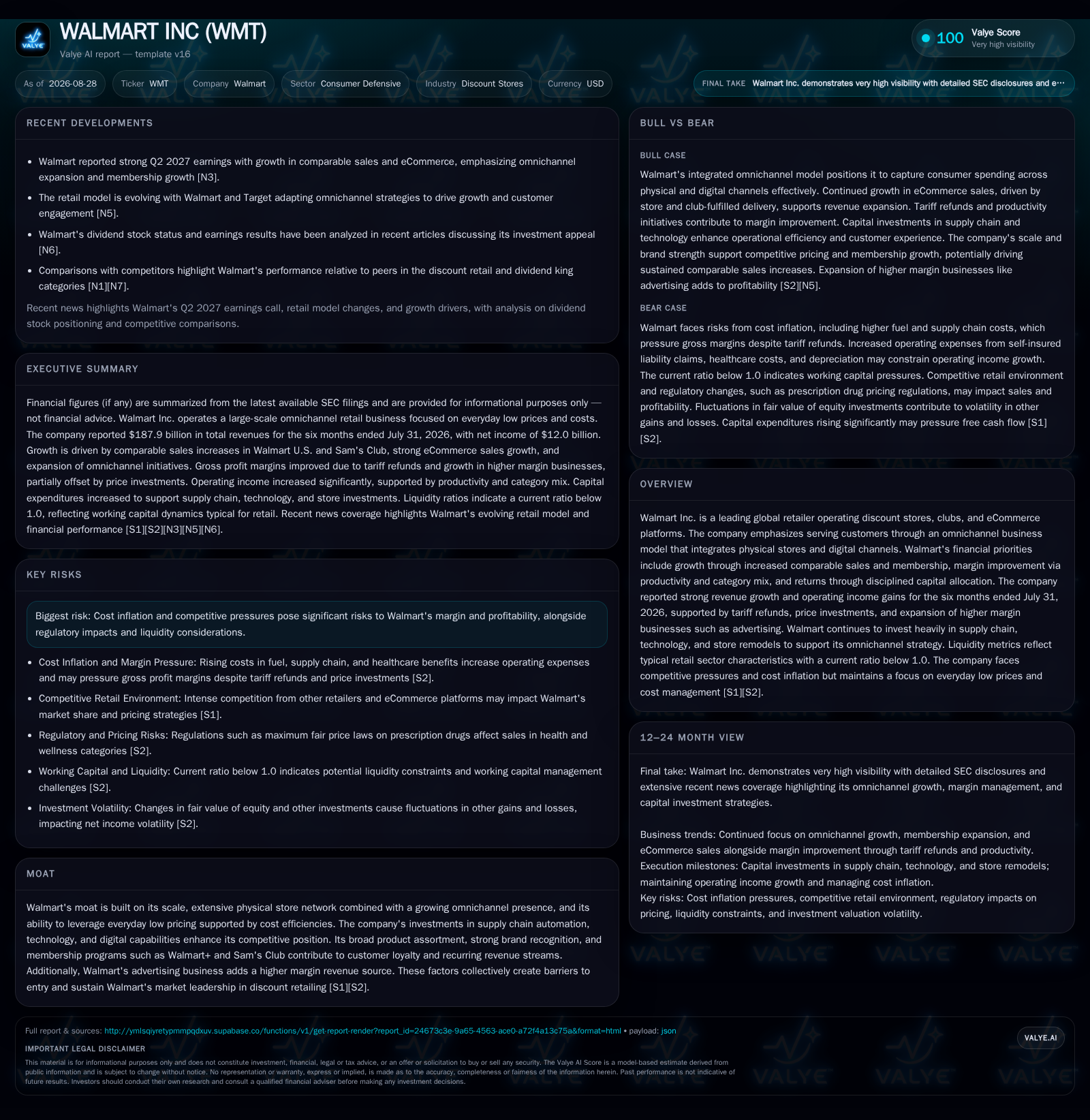
Walmart’s 2026 operating results show solid revenue growth fueled by omnichannel expansion, membership gains, and higher-margin ad sales, supported by tariff refunds and productivity. However, rising operating expenses and working capital constraints pose challenges. The company’s moat hinges on scale, supply chain investments, and customer loyalty via Walmart+ and Sam’s Club. The bull case envisions continued eCommerce acceleration and margin improvement, while the bear case highlights cost inflation, competitive pressure, and liquidity risks. Key near-term milestones include sales trends, margin stability, membership growth, and capital deployment effectiveness.
Walmart Inc. reported robust growth in the first half of fiscal 2026 driven by its omnichannel retail strategy, which integrates physical stores, eCommerce, and membership clubs like Sam’s Club. The company posted a 6.5% increase in net sales and a 24% surge in eCommerce revenue, supported by store- and club-fulfilled delivery. Margin improvement was aided by tariff refunds and productivity gains, though partially offset by inflationary costs and price investments. Despite rising operating expenses and capital expenditures dampening free cash flow, Walmart’s scale, evolving digital capabilities, and membership growth underpin its competitive positioning. The key questions revolve around Walmart’s ability to sustain expansion and profitability amid intense retail competition and cost pressures.
Latest Operating Snapshot
Walmart’s latest financial disclosures for the six months ended July 31, 2026, reveal a continuation of solid top-line momentum with net sales increasing 6.5% year-over-year to $361.8 billion [S2]. Comparable sales growth in Walmart U.S. at 3.8% and an even stronger 7.3% at Sam’s Club underscore underlying consumer demand across grocery, general merchandise, and fuel categories. Notably, eCommerce sales surged 24%, largely powered by store- and club-fulfilled delivery, highlighting the success of Walmart’s omnichannel expansion strategy [S2].
Margin dynamics improved with gross profit margin rising 53 basis points to 24.9%, primarily because of $2.9 billion tariff refunds and growth in higher-margin segments like advertising, though price investments and rising fuel costs partially offset these gains [S2]. Operating income climbed 17% to $16.9 billion with margin expansion to 4.7%, despite a slight increase in operating expenses driven by elevated self-insured liability claims, healthcare costs, and depreciation from capital investments [S2]. Capital expenditures were significant at $14.2 billion, targeting supply chain, technology, and store remodels, reflecting Walmart’s continued commitment to omnichannel capabilities [S2].
Business Model and Unit Economics
Walmart operates a large-scale discount retail business with a multi-format approach encompassing Walmart stores, Sam’s Club membership clubs, and a growing eCommerce platform. The company generates revenue primarily through merchandise sales, supplemented by membership fees and an expanding advertising business. Pricing strategies emphasize everyday low prices (EDLP) supported by rigorous cost discipline, enabling Walmart to attract high transaction volumes and maintain customer loyalty. Volume growth is a key driver, enhanced by rising membership counts in Walmart+ and Sam’s Club, which create recurring revenue streams and promote higher basket sizes.
Economically, Walmart’s business combines high fixed costs—such as store real estate, supply chain infrastructure, and technology platforms—with variable costs tied to inventory and logistics. Operating leverage can emerge as revenue scales, especially through eCommerce and advertising, which have lower incremental costs per dollar of sales compared to physical retail. However, capital intensity remains high, with $14.2 billion in recent capital expenditures reflecting investments in supply chain automation, digital capabilities, and store remodeling. These investments aim to improve operational efficiencies and customer experience, though they temporarily pressure free cash flow. Effective cost control and productivity gains are critical to sustaining margin improvements amid inflationary pressures.
Moat, Competition and Counterforces
Walmart’s moat is anchored in its unparalleled scale, extensive physical store footprint, and integrated omnichannel platform. The company leverages a vast supply chain network and cost efficiencies to offer everyday low prices that are difficult for competitors to match sustainably. Membership programs like Walmart+ and Sam’s Club deepen customer engagement, creating switching frictions through benefits such as discounted fuel and exclusive offerings. The growing advertising business adds a differentiated, higher-margin revenue stream that capitalizes on Walmart’s vast consumer data and product assortment.
Counterforces to Walmart’s moat include intensifying competition from both traditional discount retailers and digitally native eCommerce players. Competitors like Target and Costco challenge Walmart’s market share through differentiated product assortments and customer experiences. Additionally, cost inflation in fuel, supply chain, and healthcare benefits erodes margin advantages. Regulatory risks, such as prescription drug pricing controls, and working capital constraints reflected by a current ratio below 1.0 could also limit operational flexibility. Walmart must continuously innovate its omnichannel capabilities and manage costs to sustain its competitive edge.
Bull Case
In a bullish scenario, Walmart successfully leverages its omnichannel model to capture increasing consumer spending, with eCommerce and store-fulfilled deliveries becoming dominant growth engines. Membership growth at Walmart+ and Sam’s Club accelerates, driving recurring revenues and higher customer lifetime value. The company’s investments in supply chain automation and technology yield significant productivity improvements, enabling margin expansion despite inflationary pressures. Tariff refunds and strategic price investments support competitive pricing power, while the advertising business scales rapidly as marketers seek Walmart’s unique consumer reach and data insights.
Confirming evidence would include sustained double-digit eCommerce growth, accelerating comparable sales, improving gross and operating margins, and robust membership sign-ups. Capital expenditure efficiency would be demonstrated by rising return on invested capital (ROIC) and stable or increasing free cash flow margins despite elevated investment levels. Conversely, failure to maintain these trends, such as stagnant membership, margin compression, or weak advertising revenue growth, would falsify this optimistic outlook.
Base Case
The base case envisions Walmart maintaining steady revenue growth driven by moderate comparable sales increases and continued eCommerce expansion, albeit at a decelerated pace relative to prior years. Margin improvement is modest, supported by tariff refunds and some productivity gains but tempered by persistent cost inflation in fuel and healthcare. Membership growth continues at a stable rate, contributing incremental but not transformative recurring revenue. Capital expenditures remain elevated to sustain omnichannel capabilities, limiting free cash flow growth but preserving investment in future growth drivers.
Operating expenses as a percentage of sales may creep upward due to inflation and increased depreciation, but Walmart manages these costs through efficiency initiatives. Competitive pressures persist but do not materially erode Walmart’s market position. The company’s liquidity remains adequate despite a current ratio below 1.0, reflecting normal retail working capital cycles rather than distress. Key metrics such as operating income margin and return on assets hold near recent levels, signaling resilient but unspectacular financial performance.
Bear Case
Under a downside scenario, Walmart faces sustained cost inflation that outpaces tariff refunds and productivity gains, leading to margin erosion. Rising fuel, supply chain, and healthcare costs increase operating expenses disproportionately. Competitive pressures intensify as rivals innovate faster or leverage differentiated strategies, resulting in market share losses and pricing concessions. Regulatory actions, especially around drug pricing, depress sales in health-related categories. Working capital challenges exacerbate liquidity pressures, reflected in a persistently low current ratio and constrained potential financial flexibility.
Capital expenditures, while necessary, strain free cash flow amid worsening operating profitability. Volatility in investment valuations adds to earnings unpredictability, undermining investor confidence. Confirming evidence for this bear case would include declining comparable sales, shrinking margins, faltering membership growth, and deteriorating liquidity ratios. Signs of weakening supply chain efficiency or lost share to competitors would further validate this negative outlook. Conversely, stabilization or improvement in these metrics would mitigate downside risks.
What Matters Next
Investors should closely monitor Walmart’s comparable sales trends in both Walmart U.S. and Sam’s Club segments, particularly the balance between transaction growth and average ticket size, as these reflect underlying consumer demand and pricing power. Tracking the pace and quality of eCommerce sales growth, especially the contribution of store- and club-fulfilled delivery, will indicate the success of omnichannel initiatives. Membership metrics for Walmart+ and Sam’s Club, including growth rates and retention, are key indicators of recurring revenue sustainability.
Margin dynamics warrant careful attention: gross profit rate trends will reveal the net impact of tariff refunds, price investments, and cost inflation. Operating expense ratios must be watched for inflationary pressures, particularly healthcare and liability claim costs. Capital expenditure efficiency metrics like ROIC and free cash flow generation will signal whether investments in supply chain and technology are translating into operational improvements. Finally, liquidity ratios and cash flow trends provide insight into Walmart’s potential financial flexibility and ability to navigate macroeconomic challenges.
Disclaimer: This is research-only, informational analysis and not investment advice. It may include AI-generated interpretation and general industry context. Always verify important details using primary sources.

Comments