
WeRide Extends Leadership in Autonomous Robotaxi Deployment with Strategic Board Appointment
New board member appointment underscores WeRide's commitment to global expansion amid intensifying competition in autonomous vehicle services.
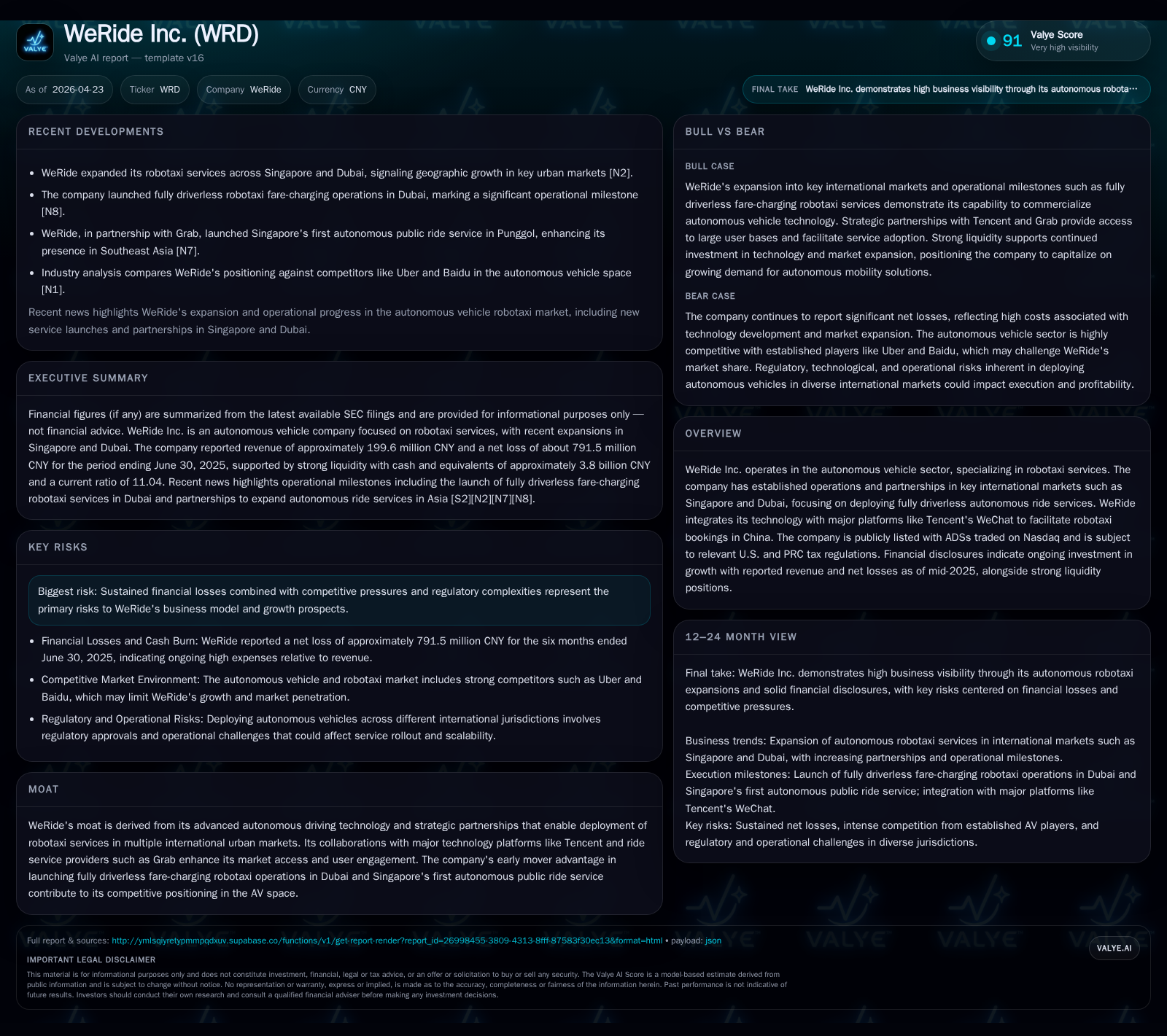
WeRide Inc. continues to solidify its position in the autonomous vehicle ecosystem, notably launching fully driverless robotaxi services in Dubai and Singapore. The appointment of Ichijo Futakawa, a seasoned automotive executive with direct autonomous taxi experience, reflects a strategic emphasis on international growth and industry collaboration. While substantial ongoing investments strain profitability, WeRide leverages strategic partnerships and advanced technology to differentiate within a rapidly evolving robotaxi market. Future milestones will hinge on scaling service deployments and maintaining financial discipline amid competitive and regulatory challenges.
Recent Operating Update
WeRide Inc.'s latest SEC filing dated April 21, 2026 ([S2]) confirms appointment of Mr. Ichijo Futakawa as a non-executive director, effective immediately. Mr. Futakawa brings extensive experience from key roles at Nissan Motor Co., including leadership of Nissan's autonomous taxi business in Suzhou, China — positioning him as a valuable asset for guiding WeRide's global robotaxi strategy. This governance update signals an enhanced focus on industrial collaboration and market expertise poised to support WeRide's international ambitions.
No further material operational changes were disclosed in the two most recent 6-K interim filings ([S2], [S3]), indicating steady operational execution without immediate pivots. However, recent market developments external to SEC filings demonstrate aggressive expansion: WeRide and Grab launched Singapore’s first autonomous public ride service in April 2026 ([N1]), while fully driverless fare-charging robotaxi operations began in Dubai earlier in March ([N2]). These launches mark important commercial milestones and differentiate WeRide as an early mover delivering scalable services beyond pilot programs.
Business Model Analysis
WeRide operates as a holding company headquartered in the Cayman Islands but executes its primary business through subsidiaries located mainly in mainland China ([S1]). Its core offering is robotaxi services based on proprietary autonomous driving technology. The company monetizes by providing fare-based ride-hailing through fully driverless vehicles integrated into local mobility ecosystems.
A notable aspect is WeRide’s integration with major platforms such as Tencent’s WeChat for service bookings in China, providing embedded access to a vast user base. This enhances customer convenience and retention potential through existing digital habits. Internationally, collaborations extend to Southeast Asian partners like Grab, allowing localized market adaptation and leveraging regional ride-hailing infrastructure ([N1]). The commercial operation of fully driverless taxis in Dubai marks one of the few worldwide instances of fare-charging robotaxis operating without safety drivers, underscoring technological maturity.
Nonetheless, the business remains capital intensive given the need for continuous R&D investment, fleet procurement, regulatory compliance costs, and infrastructure setups such as vehicle garages and sensor stocking ([S12], [S17]). Revenue generation depends heavily on scaling urban deployment and achieving sufficient trip volumes to leverage operating leverage.
Industry Structure and Competitive Position
The autonomous vehicle sector is characterized by multifaceted competition involving legacy automakers (e.g., Ford-Motional), technology giants (e.g., Waymo), and new entrants focusing on robotaxi services ([N3], [N14]). Regulatory environments vary markedly across jurisdictions causing segmentation.
WeRide’s moat hinges primarily on:
- Advanced autonomous software validated through live commercial operations.
- Strategic regional alliances that facilitate route-to-market penetration.
- First-mover status launching fully driverless fare-charging services especially in Dubai and Singapore.
Their approach contrasts with many peers still operating under safety-driver supervision or limited pilot zones. By entering multiple global urban centers early with commercial operations, WeRide positions itself ahead of competitors that are still refining technology or negotiating regulatory green lights.
However, sustained competitive advantage will depend on maintaining technological lead amid well-funded competitors increasingly focusing on similar markets. Additionally, expanding into geographies beyond China-Southeast Asia-Middle East mix exposes the company to complex regulatory environments requiring tailored approaches.
Growth Drivers and Constraints
Key growth drivers include:
- Rapid adoption of shared mobility solutions accelerating demand for autonomous ride services.
- Strengthening partnerships enabling quicker market entry and brand recognition.
- Scalability of WeRide’s software stack supporting diverse fleets outside of proprietary vehicle hardware.
- Expansion into new cities aggressively adopting AV frameworks (e.g., Dubai’s government initiatives).
Growth constraints comprise:
- Regulatory complexity surrounding safety certifications, data privacy, and street testing varying by jurisdiction ([S22]).
- High fixed costs related to fleet procurement and infrastructure investments limiting margin expansion initially.
- Cash burn associated with developmental R&D and technology enhancements required to maintain competitiveness ([S12],[F1]).
- Market risk linked to customer acceptance rates and willingness to transition from human-driven taxis.
WeRide has begun executing share repurchase plans approved in March 2026 but had not conducted any buybacks as of end-2025 ([S9]), opting currently to deploy available capital towards scaling operations rather than capital return initiatives.
What to Watch Next
Investors and industry watchers should monitor:
- Expansion cadence of robotaxi fleets in Singapore and Dubai beyond initial service areas indicating successful scaling.
- Regulatory developments especially approvals or setbacks impacting new market entries.
- Partnership announcements potentially extending ecosystem reach or incorporating new technology vendors.
- Customer usage metrics such as trip volume growth reflecting adoption trends.
- Financial releases for signs of margin improvement or cash flow stabilization as scale effects materialize.
- Potential moves into additional international regions following initial successes.
The appointment of Ichijo Futakawa is also notable for how it may translate into deeper cooperation with leading auto OEMs given his Nissan background — this could open pathways for joint ventures or enhanced vehicle supply agreements crucial for fleet expansion.
Financial Profile (Supporting Context)
Data from mid-2025 indicates WeRide had approximately RMB3.8 billion (US$570 million) in cash equivalents with current assets vastly exceeding short-term liabilities by a factor over 11 ([F1]). Such liquidity supports ongoing capital-heavy investment phases intrinsic to scaling autonomous mobility operations.
Revenue stood at roughly RMB361 million as of year-end 2024 but net losses were substantial — exceeding RMB2.5 billion for 2024 alone — reflecting continued upfront spending on R&D, fleet deployment, personnel costs including significant share-based compensation expenses ([F1], [S1], [S18]). Capital expenditures rose sharply from RMB37 million in 2023 to RMB248 million (US$35 million) in 2025 indicating intensified asset build-out ([S12]).
Operating cash flows remain negative due largely to investment cycles but financing activities show robust equity issuance proceeds fueling growth ambitions ([S10], [S18]). Overall financial dynamics embody typical emerging tech enterprise patterns where scale economies are yet nascent but poised given market traction if execution risks are managed effectively.
Disclaimer
This analysis is based solely on publicly available information including recent SEC filings up to April 23, 2026, company disclosures, and relevant industry commentary without reliance on non-public data. It should not be construed as any form of investment advice or recommendation.
Disclaimer: This is research-only, informational analysis and not investment advice. It may include AI-generated interpretation and general industry context. Always verify important details using primary sources.

Comments