
Woodward’s Strategic Refocus and Financial Fortitude Set Stage for Selective Growth
Woodward’s recent earnings strength and strategic wind-down of a key segment position it to navigate sector volatility with operational clarity.
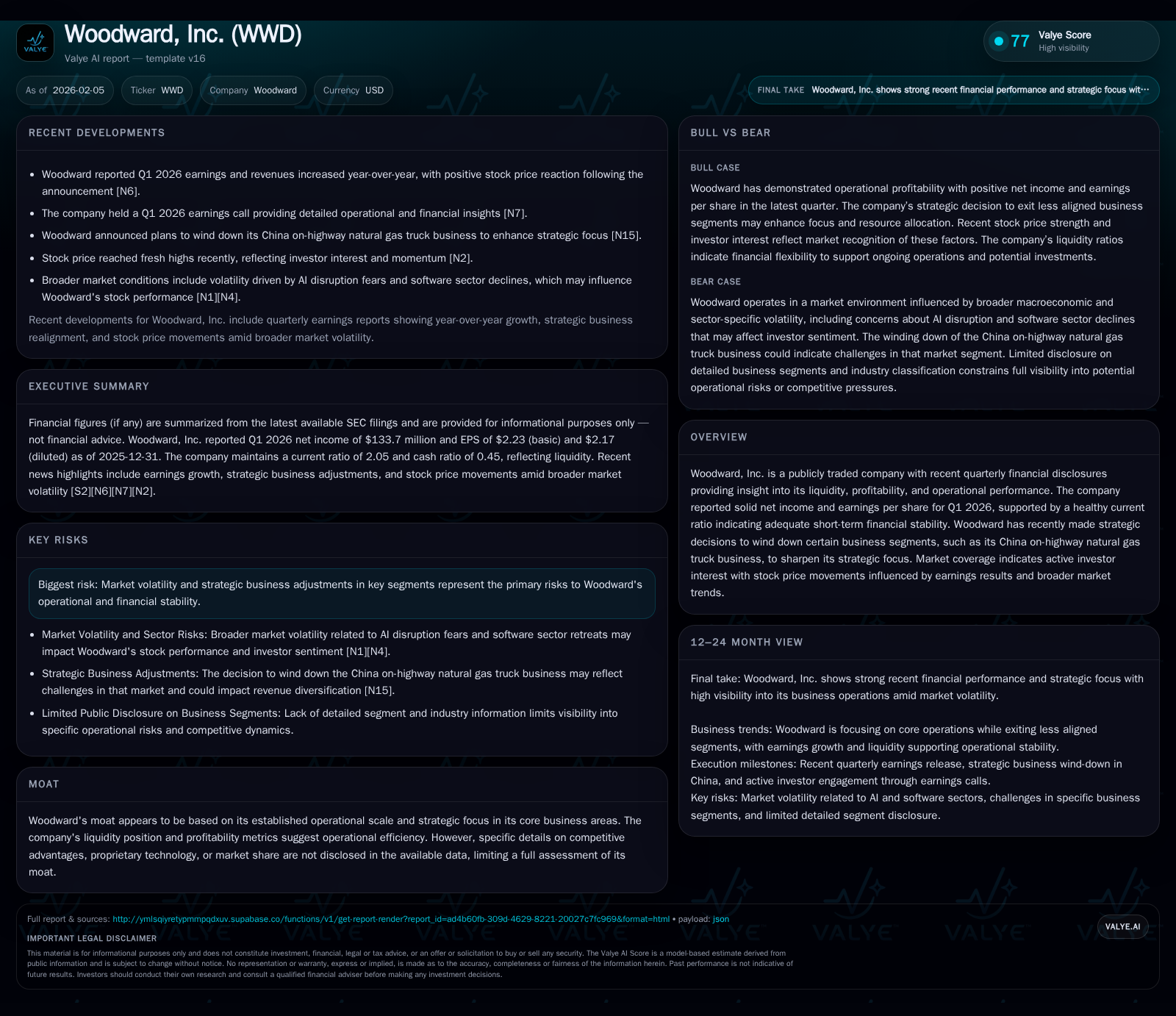
Woodward, Inc. delivered a better-than-expected Q1 2026 earnings performance alongside solid liquidity metrics, underscoring a healthy financial foundation. The decision to exit its China on-highway natural gas truck business reflects a deliberate tightening of strategic priorities aimed at reinforcing core operations. While the company exhibits operational efficiency and prudent balance sheet management, limited disclosure on proprietary advantages tempers assessments of its sustainable moat. Going forward, Woodward faces a complex risk environment marked by market volatility and industry realignment, demanding agile execution and investor discipline.
Sharp Focus: The Impact of Exiting China’s On-Highway Natural Gas Truck Market
In mid-January 2026, Woodward declared it would wind down its China on-highway natural gas truck business, marking a pivotal step toward refining its portfolio. The official announcement cited the move as enhancing "strategic focus," implying an evaluation that maintaining this segment did not align with the company’s long-term profitability or competitive positioning [N6]. This decision cuts away what could be perceived as a high-growth but possibly capital-intensive area within the natural gas vehicle segment in China—a market often characterized by regulatory shifts and rising competition.
From a strategic standpoint, this divestiture streamlines Woodward's efforts toward its established aerospace and industrial controls franchises. While relinquishing an avenue with potential for expansion may raise questions about growth trade-offs, it also reduces operational complexity and reallocates management focus. The choice signals management's preference for consolidating strengths rather than stretching resources across diverse geographies or sectors without clear marginal advantage.
Such portfolio pruning aligns with contemporary corporate best practices centered on maximizing return on invested capital. Yet, given the sparse public details about financial contribution of the exited business or customer dynamics, investors must interpret this move cautiously—a refinement but not necessarily an acceleration of growth trajectories [valye_report_excerpt].
Q1 2026 Earnings Beat: Strength in Numbers and Market Response
Woodward’s Q1 2026 earnings report revealed robust performance metrics that outpaced consensus expectations. Net income reached $133.7 million—a figure underpinning recurring profitability—and was accompanied by margin lift signaling operational leverage amidst sales increases [F1,N1,N3,N4,N12]. Revenue gains were consistent year-over-year, reflecting resilient demand in core segments despite macroeconomic softness affecting some industrial end markets.
Multiple Nasdaq coverage articles emphasized how these results supported a notable uplift in share price post-release. Specifically, Woodward stock rose sharply following earnings due to both beat surprises and forward commentary underscoring disciplined cost management [N1,N9]. Analysts highlighted that beyond headline financials, the company's ability to sustain margin expansion while absorbing inflationary pressures was indicative of sound execution.
Operational commentary from the earnings call transcript supplemented numeric disclosures by elucidating streamlined processes and targeted investments in aftermarket services—areas contributing to durable profit pools [N2]. Collectively, these findings position Woodward as outperforming peers amid challenging sector dynamics.
Liquidity and Balance Sheet Health: Analyzing Woodward’s Financial Stability
A defining pillar during this phase is Woodward’s liquidity profile. As of December 31, 2025, cash and cash equivalents stood at approximately $454 million against current liabilities close to $999 million, supporting an enviable current ratio of 2.05—well above typical benchmark thresholds for industrial firms [F1,valye_report_excerpt,S2]. This metric provides confidence that Woodward can comfortably meet near-term obligations while funding ongoing operations without excessive reliance on external financing.
Furthermore, current assets totaling over $2 billion reveal ample buffers that hedge against unforeseen disruptions or investment opportunities requiring rapid capital deployment. The balance sheet's conservative structure underscores prudent financial stewardship amid broader economic uncertainty.
Management commentary within the Q1 filing reiterates commitment to sustaining this financial flexibility as a core component of risk mitigation strategy. The company appears well-positioned to absorb potential shocks from volatile commodity costs or supply chain instability while maintaining investment-grade credit metrics [S2].
Strategic Moat Unpacked: What Drives Woodward’s Competitive Edge?
Woodward's moat rests primarily on operational scale combined with effective focus following recent rationalization moves. According to Valye's analysis excerpt, profitability ratios suggest efficiency but specifics such as proprietary technologies or dominant market share remain less transparent from available data [valye_report_excerpt]. The latest 10-K (S1) similarly provides limited explicit discussion around intellectual property protections or unique barriers to entry.
Nonetheless, the company's historical footprint in aerospace control systems and its diversification into various industrial verticals deliver inherent advantages through established customer relationships and integration expertise [S1,Business section]. It's reasonable to infer that entrenched scale effects coupled with quality certifications constitute tangible competitive moats.
However, lack of disclosed R&D intensity or explicit technological leadership details invites caution in overstating uniqueness relative to aggressive competitors evolving rapidly in automation and sustainability-linked controls. Consequently, while Woodward demonstrates structural strengths supporting resilience, its moat might be better characterized as moderate—dependent heavily on execution consistency rather than breakthrough innovation.
Risks on the Radar: Market Volatility Meets Business Realignment
Market turbulence remains front-and-center among risks facing Woodward. The company itself flags uncertainties tied to fluctuating demand across aerospace cycles and industrial spending patterns within its SEC Risk Factors (Item 1A) [S1]. Additionally, winding down a substantial business segment carries integration and transition risks including revenue gaps or unforeseen costs.
Broader market conditions further complicate outlooks; recent Nasdaq reports highlight investor anxieties over AI-driven disruption spreading unevenly across tech-related sectors resulting in rapid sell-offs impacting even industrial-equipment suppliers indirectly exposed via supply chains or valuation correlations [N7]. Such environment inflates volatility and challenges clear signal extraction regarding underlying fundamentals.
From an operational risk perspective, shifts in regulatory frameworks—particularly environmental policies influencing energy-efficient propulsion technologies—could affect product viability timelines. These combined factors underline the necessity for vigilant risk management balanced against pursuit of strategic opportunities.
Investor Sentiment and Stock Performance Amid Broader Market Trends
Post-earnings enthusiasm propelled Woodward shares to fresh all-time highs shortly after Q1 results publication as documented by multiple Nasdaq commentaries [N8,N9]. Market participants praised demonstrated earnings strength and effective cost controls underpinning improved margins amid inflationary headwinds.
This positive momentum contrasts with wider market softness predominantly driven by fears surrounding AI adoption disrupting traditional software segments—the proximate cause for corrections seen elsewhere in the Nasdaq composite index during early February 2026 [N7,N10]. Precious metal recoveries cited concurrently further emphasize fragmented investor appetites creating differentiated performance streams [N11].
Woodward's outperformance within this nuanced backdrop suggests selective investor confidence rooted more in solid fundamentals than speculative themes. However, given prevailing macro uncertainties described above, stock trajectory may remain susceptible to periodic bouts of volatility keyed to broader technology-driven sentiment shifts.
Looking Ahead: Does Woodward Have Room to Run?
Synthesizing recent developments reveals a narrative that is cautiously optimistic yet tempered by realistic headwinds. Strong liquidity ($454 million cash reserves) paired with solid profitability ($133.7 million net income) provides Woodward ample runway to reinvest strategically despite shedding lower-margin operations [F1,valye_report_excerpt]. The company's deliberate pruning of non-core businesses echoes intent to prioritize efficient growth paths over unfocused expansion.
Notably absent are clear signs of breakthrough technology dominance or sweeping market share gains that might catapult prospects dramatically higher; instead growth appears likely measured and steady anchored by existing competencies rather than disruptive leaps [valye_report_excerpt,S1]. Meanwhile, external risks ranging from geopolitical trade fluctuations impacting Chinese market access (noted indirectly via exit) through technological disruption fears persist as counterweights.
Recent valuation analyses acknowledge potential upside reflected by recent stock highs but advise prudence due to prevailing macro volatility—underscoring need for investor discipline aligned with fundamental performance rather than extrapolative optimism [N8]. Ultimately, Woodward's future path will hinge considerably on its ability to execute operationally within refined segments while managing risks prudently amidst evolving industry landscapes.
Disclaimer: This analysis is informational only and does not constitute investment advice or recommendations regarding purchasing or selling securities.
Disclaimer: This is research-only, informational analysis and not investment advice. It may include AI-generated interpretation and general industry context. Always verify important details using primary sources.

Comments