
Wynn Resorts' Balancing Act: Luxury Expansion and Rising Capital Intensity Pressure Margins
Wynn Resorts continues to invest heavily in integrated resorts globally while grappling with slowing earnings growth and regulatory challenges.
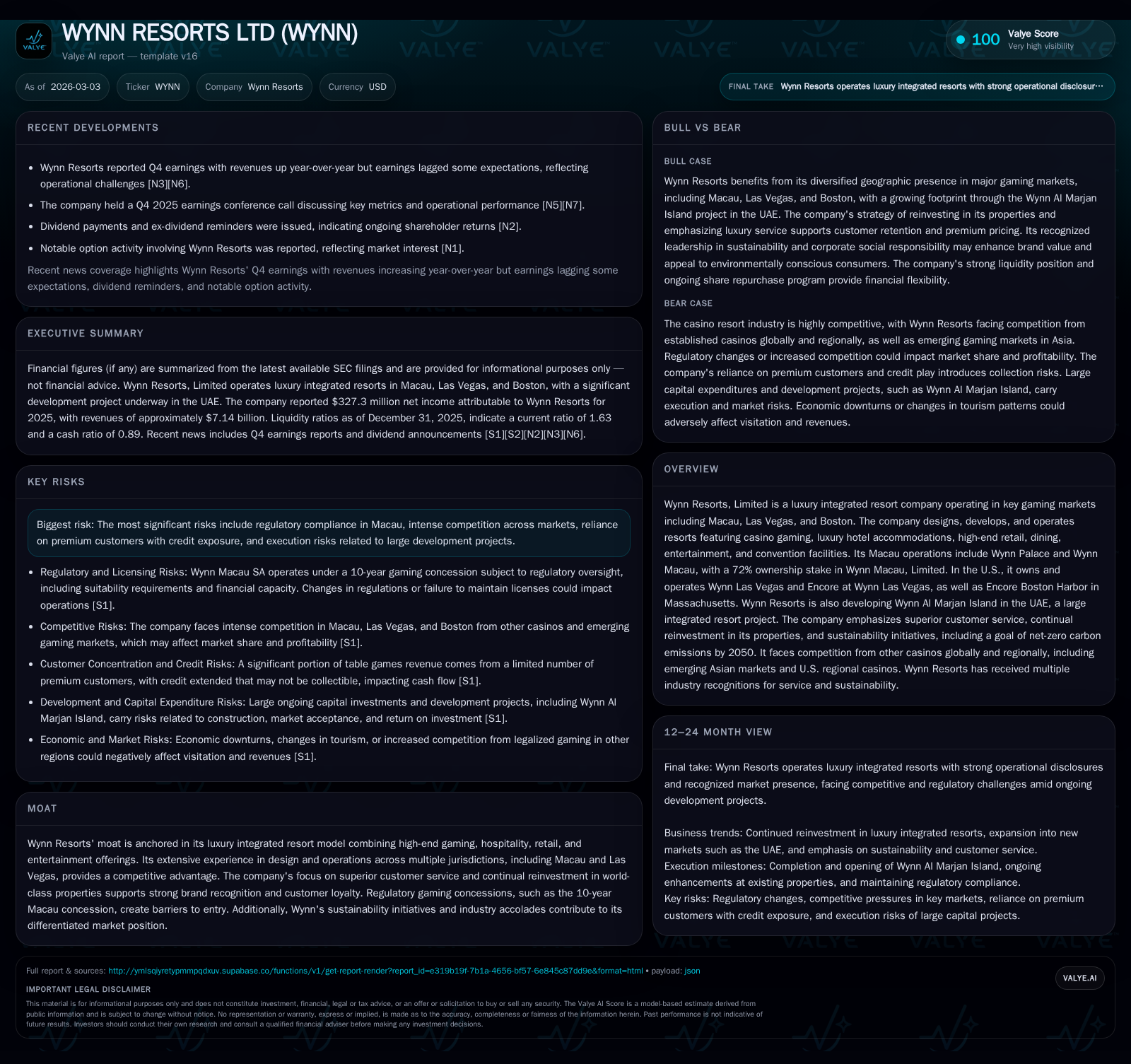
Wynn Resorts operates luxury integrated resorts across Macau, Las Vegas, Boston, and is developing a major project in the UAE. The company has shown robust revenue growth since 2022 following pandemic recoveries but faced a slight decline in operating income and net profit in 2025 despite record revenues. Continued global expansion and reinvestment underpin growth prospects but also increase capital intensity and execution risks. Wynn maintains strong liquidity, a sizeable share repurchase program, and consistent dividends even amid regulatory and regional market uncertainties.
Overview
Wynn Resorts Ltd is a premier designer, developer, and operator of luxury integrated resorts featuring casinos, high-end hotels, retail spaces, dining, entertainment, and convention facilities. The company's portfolio spans two flagship Macau resorts (Wynn Palace and Wynn Macau), the Wynn Las Vegas complex (including Encore), Encore Boston Harbor, and a joint venture-operated retail space. Additionally, an ambitious project in Ras Al Khaimah, UAE—Wynn Al Marjan Island—is under construction with expected opening in 2027 [S1][S5][S6].
Historical Performance
Wynn's financials reflect a steep rebound from pandemic-affected lows in 2022. Revenue increased dramatically as travel resumed globally; however, operating income showed marginal contraction and net income declined significantly in 2025 compared to prior years [F1]. This contrast highlights margin pressure amid higher operating costs including substantial capital investments.
Historical performance (annual)
| FY | Net ($mm) | CFO ($mm) | OpInc ($mm) | Capex ($mm) | Net YoY |
|---|---|---|---|---|---|
| 2025 | 327 | 1353 | 1118 | 660 | -34.7% |
| 2024 | 501 | 1426 | 1133 | 420 | -31.4% |
| 2023 | 730 | 1248 | 840 | 443 | +272.2% |
| 2022 | -424 | -71 | -101 | 300 |
Source: SEC companyfacts cache [F1].
Capital returns and efficiency (annual)
| FY | Div ($mm) | Buybacks ($mm) | FCF ($mm) |
|---|---|---|---|
| 2025 | 175 | 380 | 692 |
| 2024 | 140 | 402 | 1006 |
| 2023 | 85 | 212 | 805 |
| 2022 | 1 | 187 | -371 |
Source: SEC companyfacts cache [F1].
Note: Revenue data for recent years is not explicitly reported but known to have increased significantly post-2022 [F1].
Revenue Drivers
The strong top-line recovery is primarily attributed to rejuvenated demand across key regions:
- Macau operations benefitted from expanded tourism flows following eased travel restrictions.
- Las Vegas facilities saw return-to-travel boosts but face competitive headwinds linked to overall visitor volume declines.
- Encore Boston Harbor adds geographic diversification with local premium clientele.
Gaming remains the dominant revenue segment complemented by growing non-gaming amenities such as retail and hospitality services.
Cost Structure and Margin Pressure
Despite rising revenues, operating income contracted slightly (-1.3%) due to elevated expenses from:
- Aggressive capital expenditure programs focusing on property enhancements across Macau ($70–80 million maintenance capex forecast for 2026), Las Vegas (~$375–400 million project capex planned for '26), Boston, and new developments [S10][S11].
- Ongoing compliance costs necessitated by multi-jurisdictional regulatory regimes.
- Staff training investments aimed at maintaining luxury service standards.
Net profit fell more sharply (-34.7%) reflecting higher finance costs tied to debt refinancing and amortizations [F1].
Growth Outlook
Key growth opportunities include:
- Opening of Wynn Al Marjan Island resort in the UAE by 2027 represents entry into a nascent luxury gaming market with strong tourism ambitions [S5][S22].
- Incremental enhancements at existing resorts aim at elevating guest experience—critical for attracting repeat visitation.
- Macau’s stated goal of becoming a world-class tourism destination supports long-term potential despite growing competition from neighboring Asian jurisdictions like Japan and South Korea [S9].
Risks that could hamper growth comprise regulatory interventions especially in Macau’s tightly governed gaming sector, geopolitical disruptions affecting travel flows, macroeconomic pressures impacting discretionary spending, and execution risks on large-scale developments [S4][S13][S19].
Capital Allocation and Financial Positioning
Wynn maintains robust liquidity with over $1.46 billion in cash/cash equivalents as of end-2025 plus revolver capacity exceeding $2.58 billion [S10][F1]. Despite negative book equity positioning (-$275 million at fiscal year-end), the company generates healthy operating cash flows ($1.35 billion) that comfortably cover large capital investments while funding shareholder returns.
Dividends paid rose to nearly $175 million in FY25 while share repurchases remained active at $380 million amid an authorized repurchase program still offering roughly $455 million capacity [F1][S21].
Debt maturities are managed through refinancing initiatives extending loan tenors through at least 2030 [S7][S8][S12], cushioning near-term liquidity risks.
Competitive Moat & Risks
Wynn's moat derives from its well-established luxury integrated resort model combining premium casino offerings with top-tier hospitality across multiple jurisdictions backed by regulatory concessions holding entry barriers high [S5][S9]. Brand prestige bolstered by consistent reinvestment fosters customer loyalty yet dependencies exist on volatile premium gaming clientele exposed to credit risk.
Regulatory scrutiny continues from past compliance investigations resolved via settlements but remain a reputational risk factor with potential impacts on licensing status if issues re-emerge [S4][S13][S19]. Furthermore, Wynn is subject to geopolitical uncertainties influencing international travel habits critical to its customer base concentrated largely out of Greater China [S23].
What To Watch Ahead (Analysis)
- Execution progress on Wynn Al Marjan Island development including capital deployment pace.
- Operational recovery signals or margin stabilization trends particularly within Macau post-pandemic normalization.
- Regulatory developments around gaming licenses especially in Asia-Pacific jurisdictions.
- Strategic capital allocation choices balancing reinvestment needs versus shareholder return amidst elevated capex demands.
- Macroeconomic conditions globally affecting discretionary spending power of Wynn’s core gaming clientele.
Conclusion
Wynn Resorts stands at an inflection point balancing expansive luxury resort investments against margin pressures amid evolving regulatory landscapes across continents. While recent years have marked significant top-line rebounds driven by pent-up travel demand recovery post-pandemic, profitability faces headwinds due largely to rising capital intensity associated with property enhancements and new developments like Wynn Al Marjan Island nearing completion.
Maintaining competitive differentiation through service excellence alongside vigilant regulatory compliance will be paramount as Wynn strives to deepen its footprint globally while returning value via dividends and buybacks supported by solid cash flows.
Disclaimer: This analysis is based solely on publicly available information including SEC filings dated up to March 3, 2026, company disclosures, and relevant news reports without making investment recommendations or forecasts beyond stated facts.
Disclaimer: This is research-only, informational analysis and not investment advice. It may include AI-generated interpretation and general industry context. Always verify important details using primary sources.

Comments