
Exzeo Group Advances National Expansion While Balancing Increasing Public Company Costs
Exzeo's latest quarterly report highlights steady revenue growth driven by expanded platform usage and geographic reach, offset by rising operational expenses related to its transition to a standalone public company.
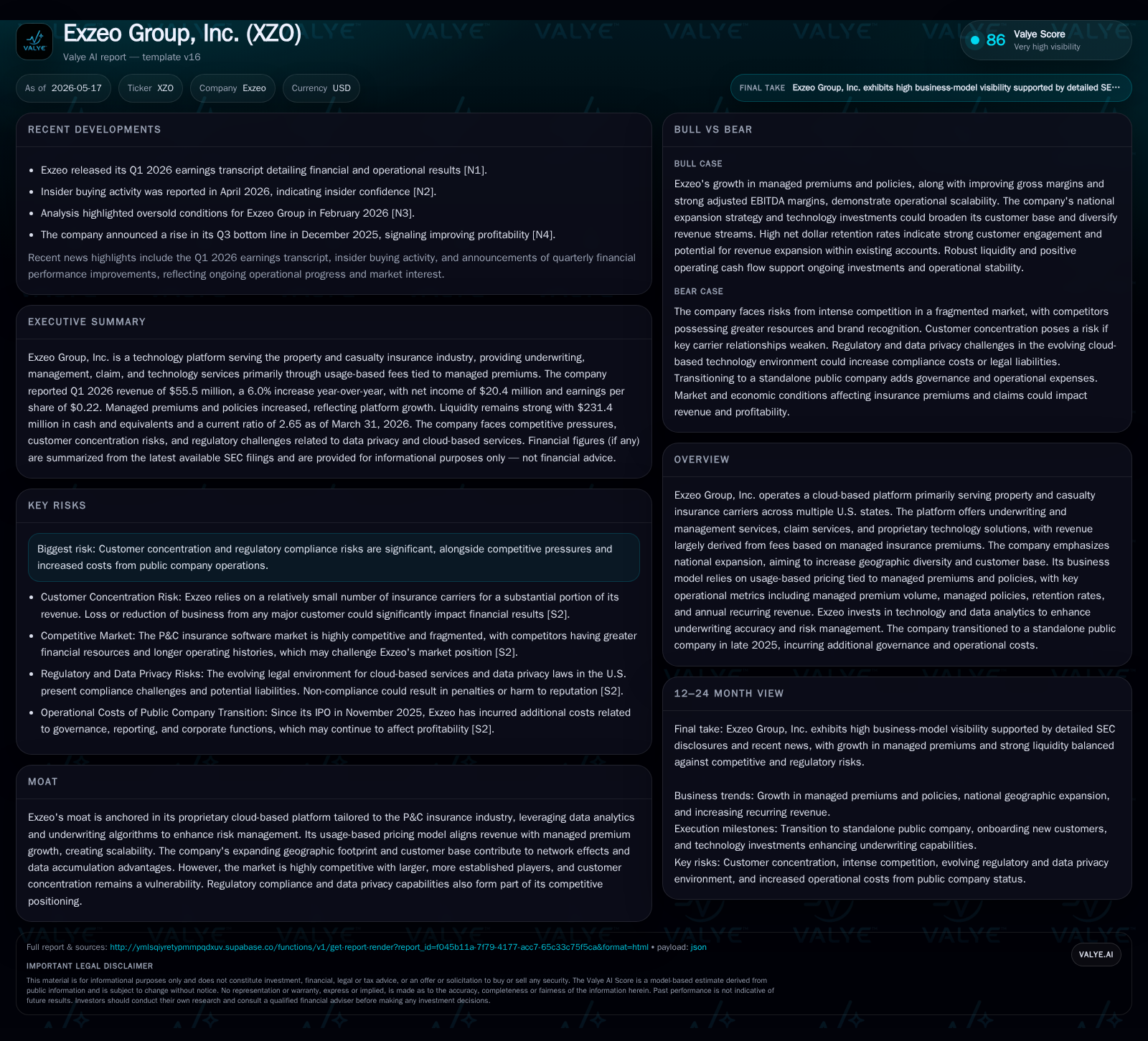
In its Q1 2026 filing, Exzeo Group, Inc. reported a 6% revenue increase supported by growth in underwriting and management services and broader policy volumes across multiple U.S. states. The company's cloud-based platform business model continues to leverage fee-based revenue tied to managed premium volumes, driving strong operating leverage and margin improvement. However, increased selling, general and administrative expenses reflect the cost of compliance and governance as a newly independent public entity. Exzeo’s competitive moat derives from proprietary underwriting algorithms enhancing pricing accuracy and risk management in property and casualty insurance, though customer concentration and regulatory compliance remain material risks. National geographic expansion coupled with diversified partnerships is the key growth driver, with demand scaling as the company extends beyond its initial carrier relationships. Operational efficiencies and retention will be critical as expense pressures persist during this scale-up phase.
Recent Operating Update
Exzeo Group Inc.'s Q1 2026 Form 10-Q [S2] indicates steady operational progress with a total revenue increase of 6%, reaching $55.5 million compared to $52.4 million in the same period last year [S5][S19][S29]. This growth was principally fueled by a 6.2% rise in underwriting and management services revenue which forms the core of Exzeo's cloud-based insurance platform offering [S26]. Claims services and other technology service revenues also contributed incremental gains albeit at lower absolute levels.
The adjusted EBITDA margin expanded modestly to 51.5%, up from 49.7% year-over-year [S5], highlighting continued operating efficiency gains leveraging the platform's scalable pricing model tied primarily to managed premium volumes. Nonetheless, operating expenses were elevated with SG&A nearly doubling (92.8% increase) year-over-year — a reflection of incremental costs associated with maintaining compliance as a newly independent publicly traded company following its late-2025 IPO [S26][S29].
Liquidity metrics remain robust with a current ratio at 2.65 supported by $231 million in cash and equivalents at quarter-end [F1]. Operating cash flow increased by approximately $5.7 million versus Q1 2025, indicating improved underlying business cash generation despite significant outlays for fixed-maturity securities purchases [S4][S6][S7].
Management emphasized national expansion efforts covering services now delivered across thirteen states including key markets such as Florida, New Jersey, Georgia, and Massachusetts [S2]. This geographic diversification complements the drive toward broadening their customer base beyond their foundational carrier relationships.
Business Model
Exzeo operates a proprietary cloud-based platform offering comprehensive underwriting support, claims processing services, and technology-enabled management solutions tailored predominantly to property and casualty (P&C) insurance carriers across multiple U.S. states [S1][N1]. The company’s primary revenue mechanism hinges on variable fees based on 'managed premiums'—the volume of insured premiums administered via their platform—aligning their top-line directly with clients’ insured volume expansion.
Underlying this is an emphasis on data analytics integration where Exzeo utilizes external dynamic data sources feeding proprietary underwriting algorithms designed to enhance risk pricing sophistication over time [S2]. This technology-driven approach aims to reduce loss frequency and improve loss ratios by improving policy selection accuracy — paramount in P&C underwriting where precision correlates directly to profitability.
Customers pay fees tied to premium volumes rather than flat subscriptions or licensing fees; thus revenue scales with volume increases or geographic growth as more policies flow through Exzeo's system. Operational leverage benefits subsequently accrue since marginal servicing costs diminish relative to growing premium bases.
Industry Structure and Competitive Position
The market for core P&C insurance systems is fragmented but intensely competitive featuring both legacy software vendors and emerging insurtech companies [S2]. Key competitive factors include software functionality breadth, integration flexibility with carriers' workflows, total cost of ownership considerations, and demonstrated domain expertise within P&C insurance underwriting.
Exzeo’s differentiator lies in its tailored cloud-native platform married tightly with advanced analytic capabilities derived from continuous data incorporation which enhances pricing precision—an important moat given P&C underwriting complexities [S1]. Their scalable usage-based fee alignment also appeals to carriers seeking more variable-cost structures amidst fluctuating premiums.
However customer concentration risk persists as a notable vulnerability: historically reliant on a limited set of substantial carrier clients for much of its revenue base [S2]. This motivates current strategy toward diversifying partnerships nationally while expanding into complementary service areas beyond traditional underwriting support.
Regulatory compliance demands around data security and privacy compound sector barriers but also require sustained investment in governance infrastructure—now evident in Exzeo's rising operating expenses post-IPO which may pressure near-term margins but build long-term defensibility [S1][S8].
Growth Drivers
The principal growth engine resides in expanding managed premium volumes via both existing customer upsell and onboarding new carriers nationally. As of March 31, 2026, Exzeo serves insurers spanning thirteen states—a trajectory implying considerable runway given the fragmented nature of state-based insurance regulations creating localized market opportunities [S2].
Technological advancements around incorporating novel external data sources underpin improved underwriting accuracy which can catalyze client acquisition by delivering superior risk pricing outcomes compared to legacy systems [S14]. Additionally, increasing policy volumes encourage economies of scale that enhance margin profiles.
Efforts targeting customer success functions aim at retention stabilization amid increasing sales investments for geographic expansion—a crucial lever given revenues depend heavily on recurring annualized premiums under ongoing contracts [S2]. The transition away from affiliates of Health Care Innovators (HCI) toward independent carrier partnerships forms part of de-risking strategies against over-concentration risks.
Risks / Watchpoints / Growth Constraints
Customer concentration remains one of the most palpable risks since losing or downsizing any major partner could materially affect revenues owing to uneven client-weighted fee flows [S2][S8]. Given industry fragmentation but competitor scale advantages held by incumbents like Guidewire or Duck Creek Technologies coupled with deep pockets poses ongoing competitive pressure.
Regulatory environment uncertainty particularly relating to compliance requirements for data handling forces continuous resource allocation potentially constraining funds available for direct growth investments.
Inflationary pressures may erode gross margins if rising costs for personnel or cloud infrastructure cannot be effectively offset through price adjustments borne out within short contract cycles.
Finally, as a recently spun standalone public company financing liquidity needs alongside expanding sales & marketing capabilities will need careful balancing against potential dilution or debt issuance risks absent explicit disclosures of long-term debt obligations presently [F1][S9].
What to Watch Next
- Quarterly updates on managed premium volume trends will be critical to assess whether national expansion translates into material top-line acceleration.
- Customer diversification progress metrics including new carrier contract wins outside legacy affiliates.
- Retention rates indicating stability or erosion within existing relationships signaling platform stickiness.
- Operating expense trajectory particularly SG&A spend related to compliance versus sales growth efficiency measures.
- Development milestones associated with enhanced data analytics or underwriting algorithm sophistication promised as future competitive differentiators.[N1]
- Any guidance commentary provided during forthcoming earnings calls or press releases detailing expectations for reinvestment pace or margin improvements.[S3]
Financial Snapshot (as of Q1 2026)
Latest financial snapshot
| Metric | Value | Period |
|---|---|---|
| Cash & equivalents | $231mm | |
| 2026-03-31 | ||
| Current assets | $261mm | |
| 2026-03-31 | ||
| Current liabilities | $99mm | |
| 2026-03-31 | ||
| Current ratio | 2.65x | |
| 2026-03-31 |
Source: SEC companyfacts cache [F1].
| Metric | Value | Period End |
|---|---|---|
| Cash & Equivalents | $231.4 million | |
| 2026-03-31 | ||
| Current Assets | $260.9 million | |
| 2026-03-31 | ||
| Current Liabilities | $98.6 million | |
| 2026-03-31 | ||
| Current Ratio | 2.65 | |
| 2026-03-31 |
Summary
Exzeo Group exhibits promising traction as it evolves its cloud-enabled insurance platform towards broader national adoption amid competitive headwinds inherent in P&C core system markets. Its fee-aligned business model benefits from growing premium bases driving sustainable recurring revenues while data-fueled underwriting improvements enhance the value proposition vis-à-vis entrenched incumbents.
While near-term profitability bears some compression due to mandatory public company costs and heavier investment cycles essential for scaling operations nationally alongside regulatory robustness requirements; effective execution on customer diversification and technological advancements could underpin meaningful medium-term expansion potential.
Investors should monitor operational KPIs related to managed premium scaling balanced against expense management discipline alongside evolving regulatory contexts governing sensitive insurance data handling.
This analysis is based solely on publicly available information including SEC filings dated through May 7, 2026 ([S1]-[S29]) and supplemental news transcripts ([N1]-[N2]). No projections or investment opinions are offered.
Disclaimer: This is research-only, informational analysis and not investment advice. It may include AI-generated interpretation and general industry context. Always verify important details using primary sources.

Comments