
Yelp’s Profitability Surge and Capital Deployment Amid Local Ad Spending Pressures
Yelp Inc. combines a trusted content platform with advanced AI tools to sustain growth and returns despite macroeconomic challenges in local advertising demand.
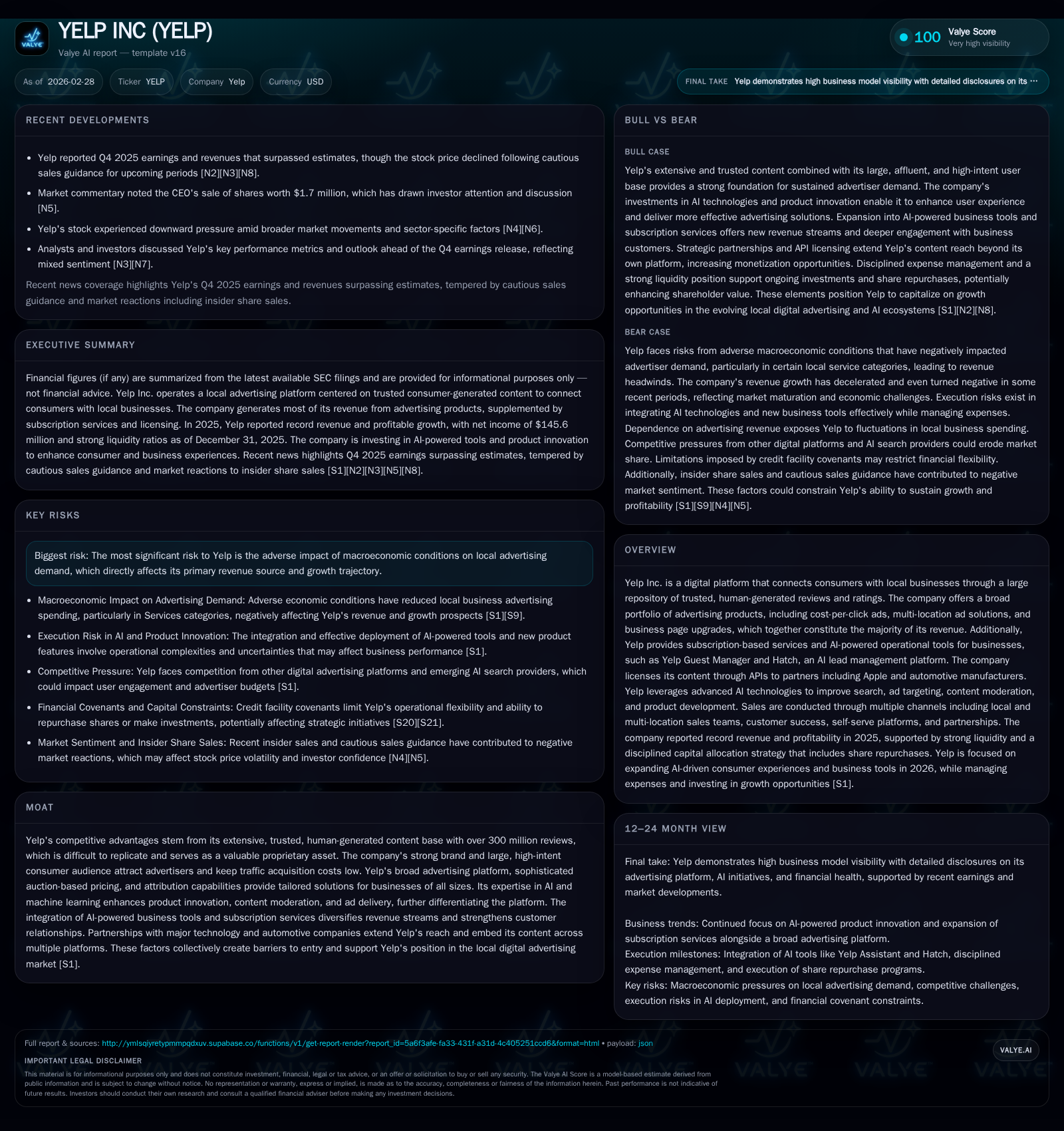
Yelp’s financial results through 2025 reveal robust revenue expansion driven by its broad advertising portfolio and strong brand moat grounded in extensive, trusted content. Although macroeconomic headwinds, especially across Restaurants, Retail & Other categories, continue to suppress advertiser spending and user traffic growth, Yelp actively responds by evolving its product mix with AI-powered offerings and optimizing sales channels. Capital allocation remains disciplined with substantial share repurchases funded by strong free cash flow generation. Near-term outlook balances cautious sales guidance recognition of persistent market pressures against strategic innovations and partnerships underpinning medium-to-long-term growth potential.
Historical Revenue Growth and Profitability Drivers
Yelp has demonstrated consistent revenue expansion over the past decade-plus horizon. Starting with top-line revenue of approximately $377.5 million in FY2014 [F1], the company scaled materially to reach $847 million in FY2017. This foundation supports record annual revenues into the mid-2020s.
In FY2025 specifically, Yelp reported an 18.8% year-over-year revenue increase compared to FY2024 levels [F1]. Growth was primarily driven by expansion within its broad-based local advertising portfolio comprising both small business-focused Local sales as well as growing Multi-location accounts representing larger mid-market advertisers [S4].
Profitability followed: operating income rose 22.2% YoY to $184.5 million while net income grew by 9.6% YoY to $145.6 million for the same period [F1]. These gains reflect operational leverage amidst steady investment spending and competitive pressures. Margin improvement owes partly to increasing contributions from margin-accretive channels such as the Self-serve advertising platform which reduces reliance on labor-intensive Local sales headcount [S4].
Historical performance (annual)
| FY | Net ($mm) | CFO ($mm) | OpInc ($mm) | Capex ($mm) | Net YoY |
|---|---|---|---|---|---|
| 2025 | 146 | 372 | 185 | 48 | +9.6% |
| 2024 | 133 | 286 | 151 | 37 | +34.0% |
| 2023 | 99 | 306 | 79 | 27 | +172.9% |
| 2022 | 36 | 192 | 58 | 32 |
Source: SEC companyfacts cache [F1].
Capital returns and efficiency (annual)
| FY | Buybacks ($mm) | FCF ($mm) | ROE% |
|---|---|---|---|
| 2025 | 291 | 324 | 20.5 |
| 2024 | 251 | 248 | 17.9 |
| 2023 | 200 | 279 | 13.2 |
| 2022 | 200 | 160 | 5.1 |
Source: SEC companyfacts cache [F1].
*Only FY2017 & FY2022-25 data explicitly available from filings at time of analysis [F1]
Advertising Product Mix and Sales Channel Dynamics
Yelp’s advertising ecosystem spans traditional cost-per-click (CPC) ads alongside multi-location solutions tailored for national brands or large franchises [S4]. Their auction-based CPC model prioritizes efficient allocation of advertiser budgets toward high-intent consumer audiences.
The company blends direct Local sales targeting businesses with fewer than ten locations alongside a Multi-location sales force focused on enterprise clients exceeding that threshold — particularly within Services verticals — evidencing strategic resource reallocation toward higher-margin customers [S4]. Supporting these are Customer Success teams managing retention and spend optimization.
Complementing direct sales is a growing Self-serve platform enabling SMBs to autonomously purchase Yelp Ads or business page upgrades via web or mobile apps; this margin-accretive channel reduces reliance on costly headcounts while expanding accessibility [S4]. Partner-driven reseller arrangements through the Yelp Advertising Partner Program further broaden market reach.
Macroeconomic Headwinds Impacting Local Advertising Demand
Persistent economic headwinds notably pressured Yelp’s core advertiser base within Restaurants, Retail & Other sectors throughout 2025 [S1]. Inflationary costs combined with labor shortages and recessionary anxieties constrained discretionary spending among local businesses.
This resulted in a ~6% decline in RR&O-related advertising revenue alongside a ~3% reduction in paying advertiser locations year-over-year — significant contractions for a foundational revenue segment [S1][N9]. Consumer traffic growth stagnated during this period, compounding difficulties convincing advertisers about returns on marketing investments when foot traffic failed to rebound meaningfully [S1].
Services categories suffered growing impacts later into the year due to deferred or canceled projects stemming from consumer budget tightening — revenues softened sequentially in Q4 2025 specifically [S1]. Thus while total revenue increased overall, underlying sectoral pockets faced pronounced softness.
Management acknowledged conservative near-term sales guidance aligned with ongoing fragility within small-local advertiser cohorts while emphasizing longer-term strategic initiatives designed to counterbalance such pressures through innovation [N1][N3].
AI Integration: Innovating Product Offerings and Consumer Experience
Yelp’s product differentiation increasingly hinges on AI capabilities incorporated across search relevance tuning, ad targeting precision, content moderation enhancements, and operational tools like Hatch — an AI-powered lead management platform focused on Services businesses regardless of their advertising status on Yelp itself [S4][S19].
AI expertise extends beyond ad auction algorithms into natural language processing models powering conversational interfaces such as Yelp Assistant Chatbot; these elevate user interaction quality while driving efficient click-through outcomes benefiting advertisers.
AI-driven systems also boost content quality assurance via human-AI moderation hybrids that identify suspicious review patterns or deceptive listings—critical given reputation risks inherent in platforms reliant on user-generated content [S21].
These investments address competitive demands as Google and Meta adopt similar machine learning techniques but often lack Yelp’s proprietary dataset richness derived from decades of authentic human-generated reviews—a vital moat enhancing relevance amid emerging AI-powered search alternatives leveraging local consumer intent signals.
Strategic Partnerships Extending Content Reach
Key alliances expand Yelp’s content distribution footprint notably through licensing its reviews database via APIs integrated into Apple Maps & Siri voice assistant technology as well as automotive dashboards for brands including Audi AG and BMW enabling real-time local business discovery without app-switching friction [S4][S8].
Reseller agency networks broaden penetration especially among SMB customers preferring consolidated vendor relationships for digital marketing spend management [S4]. These integrations augment organic consumer traffic funnel inputs without proportional incremental acquisition expenses while reinforcing Yelp’s standing versus competitors challenged by content depth or syndication agreements.
Key Financial Metrics: Returns, Cash Flow, and Capital Allocation
In FY2025, Yelp generated operating cash flow of approximately $372 million (+30%), while capital expenditures increased nearly +30% to about $48 million supporting technology infrastructure upgrades including AI development efforts [F1][S19].
Free cash flow after capex approximates $324 million annually—supporting ongoing capital return initiatives alongside innovation spending priorities.
Capital deployment included share repurchases totaling nearly $291 million in FY2025 as part of a disciplined strategy balancing shareholder returns with liquidity preservation amid macro uncertainties [F1][S10].
Equity stood around $711 million at year-end yielding an estimated return on equity near 20.5%, reflecting efficient capital use backed by durable profitability shaped by scale economies inherent in its platform architecture.
Outlook: Growth Opportunities Versus Market Constraints
Recent earnings commentary pointed toward cautious sales guidance reflecting ongoing pressures on small-local advertisers alongside modest revenue deceleration within key categories especially Services as consumers restrain discretionary expenditures [N1][N3][S1].
Management highlighted prospects tied closely to accelerating adoption of multi-location accounts commanding higher spend per client along with promising uptake of subscription-based AI tools simplifying operational complexities encountered by service providers.
Monitoring user engagement metrics on both advertiser platforms and consumer interfaces will yield critical insights into sustained monetization capacity amid evolving consumption behaviors where digital touchpoints remain vital yet competition surges from adjacent tech providers.
Further interest centers around scaling partner agency channels including enhanced attribution reporting improving ROI visibility—integral for customer acquisition and retention navigating tighter budgets.
Risks: Economic Conditions and Competitive Pressures
Adverse macroeconomic conditions pose significant risk: prolonged inflationary cycles plus labor-cost escalations curtail advertiser budgets directly impinging on revenues while slower consumer traffic accumulation diminishes click inventory value per session undermining average yield per impression [S1][S23].
Competitive dynamics intensify as major internet companies like Google secure default search placements beyond Yelp's control while Meta leverages vast social ad infrastructures aggressively courting local business dollars bundled within broader marketing ecosystems—pressuring pricing power.[S5][S6]
Regulatory developments encompassing privacy laws alongside evolving legal scrutiny around user-generated content liability—including potential weakening of protections under CDA Section 230—pose compliance cost escalation risks threatening user engagement depending on moderation policies enforced rigorously yet sympathetically [S11][S12][S13][S17].
Intellectual property enforcement challenges persist given limited patent protections vis-à-vis industry peers requiring reliance upon trade secrets strategies potentially vulnerable to imitation eroding unique product features quickly followed by competitors adds complexity.[S26]
These factors warrant close monitoring even amidst solid historical financial performance underscoring importance of adaptive governance paired with technical innovation continuity.
This analysis reflects information available up to February 28, 2026 based on SEC filings including the company's latest annual report (Form 10-K), quarterly disclosures (Form 10-Q), recent press releases, earnings call transcripts ([F1], [S#]) as well as contemporaneous market news reports ([N#]). It is intended solely for informational purposes without offering any specific investment recommendations.
Disclaimer: This is research-only, informational analysis and not investment advice. It may include AI-generated interpretation and general industry context. Always verify important details using primary sources.

Comments