
York Space Systems Advances National Security Aerospace Solutions with Vertical Integration and Software Innovation
York Space Systems leverages acquisitions and ramped manufacturing to deliver cost-effective, autonomous spacecraft critical to evolving U.S. defense demands.
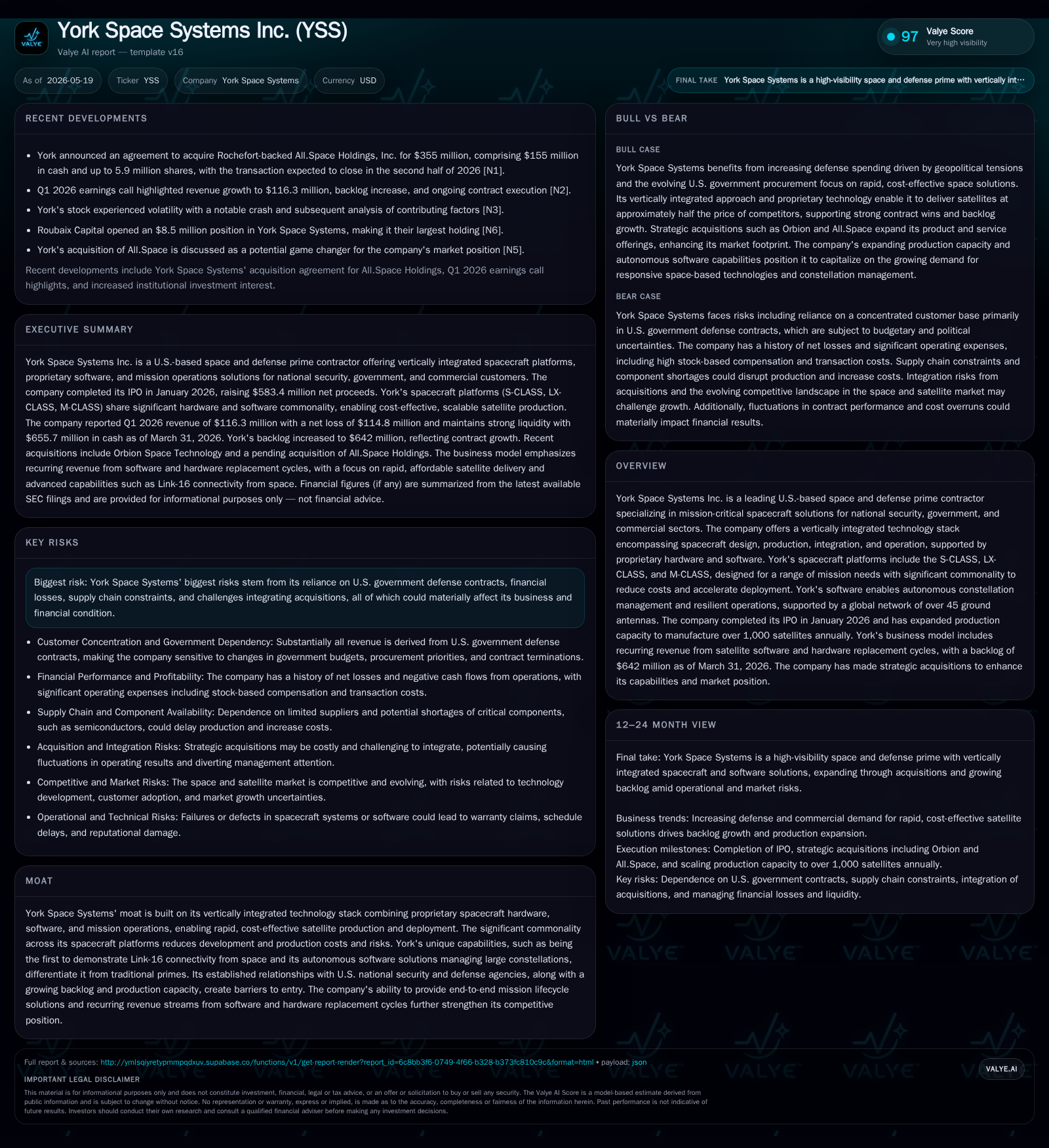
In its latest quarter ended March 31, 2026, York Space Systems executed strategic acquisitions and expanded satellite production capacity, positioning itself as a vertically integrated prime contractor addressing the rapidly evolving national security space sector. The company's proprietary spacecraft platforms and autonomous software solutions enable rapid deployment at roughly half the price of traditional competitors, supported by a $642 million backlog and strong government customer relationships. While growth is propelled by increasing demand for resilient space architectures and recent deal-making, risks persist around customer concentration, supply chain constraints, and sustained operating losses. Ongoing execution on acquisition integration and contract awards will be pivotal in capitalizing on market opportunities.
Latest Operating Highlights: Expansion Fueled by Acquisition and Increased Capacity
York Space Systems recently disclosed key developments in its May 15th quarterly filing (10-Q) that reaffirm its strategy of building a vertically integrated space prime through both organic capacity expansion and targeted acquisitions [S2]. The company is set to acquire All.Space Holdings for $355 million in a mixed cash-and-stock deal scheduled to close in H2 2026 [S8], enhancing its footprint in satellite operations software — a complementary layer to York's existing spacecraft design and mission management stack. Concurrently, York completed an equity investment valued at approximately $3.2 million plus a full acquisition of Orbion Space Technology for just over $11 million in cash and shares earlier this year, infusing flight-proven electric propulsion technology into its portfolio [S8][S21].
Crucially from an operational standpoint, York has expanded its production capacity substantially since its January IPO; the company can now manufacture over 1,000 satellites annually through internally controlled facilities—a scale uncommon among emerging primes and reflective of deep vertical integration extending from hardware fabrication through launch preparation [S2][N2]. This capability supports their low-cost production model where reported per-unit prices are roughly half those of prime competitors for classified DoD contracts including the Proliferated Warfighter Space Architecture (PWSA) programs.
These advances position York not only as a prime contractor but also an innovation engine increasingly embedded within U.S. government satellite workflows due to its broadening technology base.
Business Model & Product Differentiation: Integrated Spacecraft Platforms and Autonomous Operations
York’s business model revolves around offering end-to-end mission lifecycle solutions via proprietary spacecraft platforms—named S-CLASS, LX-CLASS, and M-CLASS—with extensive parts commonality that streamlines development cycles and lowers costs relative to bespoke designs [S1]. Revenue drivers include fixed-price contract wins for hardware manufacture combined with mission operations revenue from software suites that govern spacecraft autonomously once deployed.
The software side is particularly notable: York operates an advanced autonomous constellation management system integrated with a network of over 45 global ground antennas permitting resilient command/control even across large distributed satellite fleets [S1]. This creates recurring revenue streams less sensitive to unit shipment cycles.
Moreover, York’s vertical integration includes custom special test equipment (electrical ground support, automated test benches), boosting first-pass yield and accelerating delivery—advantages typically lacking in traditional defense primes dependent on subcontracted manufacturing [S1]. The firm also monetizes edge computing capabilities onboard spacecraft facilitating low-latency data processing for government intelligence applications.
Financially, these dynamics create switching costs and embedded relationships: customers benefit from accelerated turnaround times paired with unique features such as Link-16 connectivity from space—the only firm demonstrating this capability—which integrates real-time tactical data links vital for NATO-aligned defense operations [S1]. Recurring software/hardware replacement contracts underpin resilience of margin profiles despite the capital intensity.
Competitive Landscape: Peers, Pricing, and Unique Moat in U.S. National Security Space
Within the U.S. national security space sector—an oligopoly dominated by established primes like Lockheed Martin or Northrop Grumman—York stands out as one of few organizations capable of comprehensive vertical integration encompassing design, production, integration, launch support, and autonomous operations [S1],[N1]. Its ability to offer approximately half the per-satellite price compared to incumbents makes it disruptive on cost-efficiency grounds.
York’s demonstrated heritage flying 74 missions alongside developing 17 products with flight heritage consolidates its reputation among Department of Defense (DoD) customers wary of untested providers. The competitive moat is further bolstered by proprietary technologies such as Link-16 from space connectivity and an advanced autonomy platform managing large constellations without constant ground intervention—a rare synthesis across hardware-software dimensions that few competitors replicate currently.
However, governmental budget allocation processes impose challenges; pricing pressures persist especially under fixed-price contracts enforceable by strict compliance regimes. Additionally, reliance on a narrow set of customers—primarily U.S. government agencies like the Space Development Agency (SDA)—both strengthens contractual relationships but simultaneously concentrates revenue risk [S11],[N1].
Growth Drivers: Production Scale, Technical Innovation, and Government Contract Backlog
Growth outlook centers on several pillars:
- Manufacturing scale: Ramp-up beyond 1,000 satellites per annum supports volume contracts with government agencies requiring proliferated architectures enhancing missile defense and space situational awareness capabilities against near-peer threats [N2][S24].
- Product innovation: Integration of All.Space’s satellite operational software assets post-acquisition expands capabilities in constellation management services; Orbion’s electric propulsion enhances payload versatility elevating mission profiles achievable economically [S8][N2].
- Backlog expansion: Growing backlog reached $642 million by Q1 2026 versus $543 million at December-end 2025—a nearly 20% increase signaling robust pipeline health; over half is expected to convert into revenue within twelve months reinforcing sales momentum visibility [S24].
- Evolving Mission Needs: Increasing geopolitical tension drives urgent modernization in missile tracking and counter-space domains fueling procurement of new constellations tailored for persistent monitoring and rapid reconstitution post-contingency scenarios.
Collectively these factors reflect structural demand shifts rather than cyclical noise tied to defense budget fluctuations alone.
Industry Risks: Customer Concentration, Supply Chain Challenges, and Financial Performance
Despite promising fundamentals York contends with notable risks:
- Customer concentration: A handful of government entities—especially SDA—represent significant portions of backlog; cancellation or non-renewal could materially impact revenue realization timelines given multi-year program horizons [S11][S24].
- Supply chain constraints: Inflationary pressures coupled with persistent component shortages common in space-grade electronics can delay deliveries or inflate build costs jeopardizing fixed-price contract margins [S8].[N3]
- Financial losses: Operating income remains negative; Q1 2026 reported operating loss was $110 million amid increased cash burn driven by investments into acquisitions like All.Space/Orbion plus IPO-related expenses; careful liquidity management essential going forward though cash reserves remain strong [$655.7M cash vs $149.1M debt net positive liquidity] [F1][S2][S5].[N3]
- Integration challenges: Successfully blending new acquisitions into York’s vertically integrated tech stack requires substantial engineering effort; execution missteps may delay synergistic cost reductions or new product introductions weakening competitive advantage temporarily.
- Regulatory environment: Defense industry regulations impose compliance costs; potential audits or sanctions could disrupt contract performance or damage reputation if breaches occur unexpectedly [S11],[S14].
Future Watchpoints: Contract Awards, Technology Integration, and Market Penetration
Observers should focus on several key markers:
- Completion of All.Space acquisition expected H2 2026 will reveal how well York absorbs complementary software assets into its portfolio creating richer value propositions around constellation autonomy.
- Progress on contract awards related to PWSA programs particularly renewal or expansion orders will indicate sustainability of core government demand underpinning backlog conversion metrics.
- Demonstration scaling of autonomous mission control software across larger constellations will validate operational robustness essential for broader commercial adoption while enhancing switching costs for government customers.
- Management commentary around backlog progression or order intake replenishment will help assess trajectory beyond current bookings against macroeconomic uncertainty.
Timely execution on these fronts is critical amid intensifying competition among emerging primes seeking government share.
Financial Profile: Balance Sheet Strength and Capital Deployment
At quarter end March 31, 2026 York held $655.7 million in cash & equivalents against total debt outstanding near $149.1 million leaving it with a net cash position exceeding $500 million — ample runway by short-term standards given current operating cash burn trends reflected in Q1 operating losses around $110 million [F1][S2][S5].[N3] The undrawn revolving credit facility ($150 million capacity) adds financial optionality should liquidity needs arise unexpectedly.
Investing activities increased reflecting strategic equity investment in Orbion ($3.2M) plus full acquisition ($10.8M cash consideration), partially offset by note receivable settlements totaling $5 million—demonstrating capital deployment focused on complementary technology infusion alongside organic growth initiatives via expanded manufacturing footprint [S2][F1]
Despite near-term GAAP losses driven by scale-up investments including stock-based compensation charges ($84.7M increase QoQ), non-GAAP contribution margin improved slightly to 34%, indicating operational leverage potential as volumes grow post-acquisition integration [S16]
High current ratio (~5.5x) evidences strong working capital buffer facilitating sustained production ramp above 1000 satellites/year without immediate funding constraint concerns [F1].[N3]
This analysis synthesizes updated regulatory filings alongside recent corporate disclosures to evaluate York Space Systems’ evolving role in national security aerospace markets. The firm’s unique combination of vertical integration—including hardware platforms with extensive parts-commonality—and sophisticated autonomous orbit management software distinctly positions it within a competitive cohort traditionally dominated by older primes focused more narrowly on systems integration or payload engineering alone. However, balancing aggressive growth investments funded primarily through equity raises against persistent operating deficits remains a key challenge requiring close monitoring amid market fluctuations or contract award delays.
This article does not constitute investment advice or research views.
Disclaimer: This is research-only, informational analysis and not investment advice. It may include AI-generated interpretation and general industry context. Always verify important details using primary sources.

Comments