
Yesway's Oklahoma Expansion Amplifies Footprint with Allsup's Recognition Boost
Q1 2026 results show a profitable turnaround driven by aggressive Oklahoma expansion and rising brand acclaim.
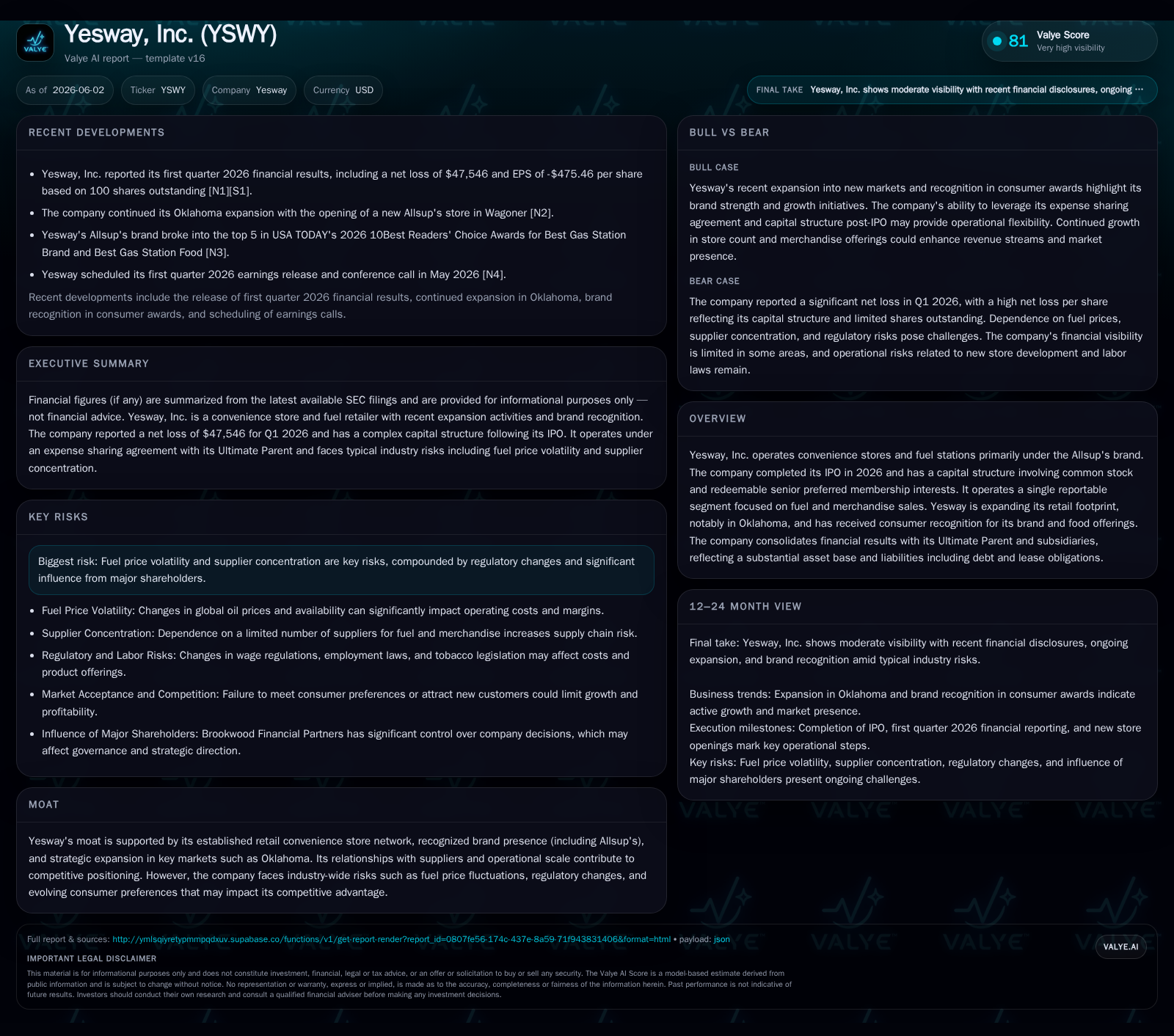
Yesway, Inc. reported a marked net income reversal in Q1 2026 to $30.2 million from a prior loss, driven by operational scaling and strategic retail growth. The company’s expansion of its Allsup's convenience store brand into Oklahoma, including the recent Wagoner store opening, leverages geographic density benefits and enhances market penetration. Simultaneously, Allsup's brand recognition elevated via top-5 rankings in USA TODAY awards underpins customer loyalty and foot traffic. These developments position Yesway as an emerging regional player amidst fuel price volatility and supplier concentration risks.
Quarterly Operational Highlights Drive Positive Earnings Reversal
Yesway’s first quarter of 2026 marked a pivotal earnings inflection point as the company swung from a net loss of $5.6 million in Q1 2025 to a net income of $30.2 million in the latest quarter [S2]. This turnaround was underpinned by robust cash flow generation from operations totaling $48.3 million—more than triple the prior year’s corresponding period—and disciplined capex spending aligned with strategic expansion initiatives [S2]. Notably, Yesway completed its IPO in April 2026, raising over $300 million net proceeds used partly to redeem preferred membership interests and reduce credit facility balances, bolstering financial flexibility at a critical growth juncture [S11][S14]. The combination of operational scaling with capital structure optimization signals evolving execution maturity.
Business Model Dynamics: Fuel and Merchandise Synergy Under Allsup's Banner
Yesway operates through an integrated retail model combining convenience store merchandise with fuel station offerings predominantly under the Allsup’s brand—rooted primarily in Oklahoma but expanding across multiple states [S2]. Revenue flows derive chiefly from retail fuel sales complemented by cross-selling of foodservice, beverages, tobacco, and other consumables inside stores. The Allsup’s brand drives consumer traffic via recognized quality; this was recently validated when Allsup’s secured top-5 rankings in USA TODAY’s 2026 Readers’ Choice Awards for Best Gas Station Brand and Food offerings—an accolade that reinforces the brand's premium positioning relative to typical regional chains [N4]. This consumer recognition signals stickiness that can help mitigate commoditization risks characteristic of regional convenience retail sectors.
Supplier relationships are critical given fuel accounts for a large share of cost of goods sold; Yesway leverages scale aggregation through its fleet of nearly 450 stores to negotiate terms that support competitive pricing while maintaining acceptable margins amid volatile petroleum markets [S10]. Merchandise assortment benefits from curated product mixes tailored to local tastes while driving incremental basket sizes—a key lever to enhance per-transaction economics beyond basic fuel volume dependency.
Competitive Set Overview and Market Positioning in Regional Convenience Retail
As a recently public entity following its April 2026 IPO, Yesway stands as a mid-scale operator focused on regional convenience retail concentrated notably in Oklahoma but extending across nine states with 449 locations reported pre-IPO [S25]. While explicit peer numeric comparisons are limited due to data constraints, Yesway’s competitive moat emerges from an established retail network anchored by the well-regarded Allsup’s brand coupled with strategic supplier leverage that confers some pricing power relative to smaller independent chains.
Nevertheless, Yesway contends with industry-wide headwinds including persistent wholesale fuel cost fluctuations and regulatory dynamics that influence store operating costs and new site developments. The company's single-segment structure simplifies resource allocation but also amplifies exposure to sector cyclicality tied closely to petroleum pricing cycles.
Strategic Expansion and Brand Momentum in Oklahoma Markets
Recent operational disclosures highlight sustained investment in expanding the Oklahoma footprint—the heartland of Yesway’s operations—with the May 2026 opening of an Allsup’s store in Wagoner serving as a notable example [N3]. This deliberate cluster strategy enhances store density which is critical in convenience retailing both for maximizing geographic coverage and optimizing supply chain logistics including fuel delivery routes.
Such geographic consolidation fosters better inventory turns and reduces fulfillment costs per unit served due to shorter replenishment cycles—operationally relevant KPIs within convenience retail economics. Maintaining dense networks in core territories also improves brand visibility and customer recall while deterring encroachment by competitors.
Growth Catalysts: Retail Footprint Scaling and Consumer Loyalty Gains
Yesway’s path to growth hinges on amplifying its retail footprint while deepening customer loyalty through elevated brand experience. The combination of opening new locations—in particular within identified growth corridors like Oklahoma—and leveraging the growing goodwill attached to the Allsup’s banner underpins potential for same-store sales acceleration once sufficient market density is achieved [N3][N4][S2]
Brand-related accolades such as the USA TODAY Readers’ Choice Awards reinforce consumer engagement levels likely to convert into increased visit frequency and higher average ticket sizes driven by cross-category merchandise penetration alongside fuel purchases. Such qualities are vital for mitigating structural risks posed by evolving consumer preferences shifting toward alternative energy transport modes which challenge traditional fuel volume growth assumptions.
Risks: Fuel Price Volatility, Supplier Dependence, and Regulatory Sensitivities
Despite operational momentum, Yesway continues to face pronounced risks endemic to the convenience fuel-retail sector. Wholesale petroleum price volatility remains a key margin pressure factor—as fluctuations can compress retail margins during rapid cost pass-through periods or inventory revaluation timing mismatches [S10]. A heavy reliance on a limited set of suppliers for majority fuel procurement elevates counterparty risk if market disruptions occur.
Regulatory risks also loom: wage law changes can raise operating expenses; zoning or environmental regulations can slow site expansions or add compliance costs; tobacco product regulations create demand uncertainty for popular store merchandise segments; meanwhile broader shifts like electric vehicle adoption pose long-term existential questions about fuel demand trajectories [S20].
Moreover, significant influence exerted by Brookwood Financial Partners over corporate decisions adds governance risk considerations that investors should monitor.
Looking Ahead: Critical Milestones and Execution Watchpoints for Next Quarters
Key indicators will clarify whether Yesway sustains its positive operational trajectory amid ongoing expansion pressures:
- Comparable store sales trends will reveal success in driving organic performance as new stores mature beyond initial opening phase [S2]
- Stability or improvement in gross margins amid ongoing fuel price swings will validate procurement strategies and pricing agility [S2]
- Progress in multi-site development plans especially within core states like Oklahoma where cluster effects matter most [N3]
- Any announcements on diversification of fuel suppliers or modifications in capital structure that may improve liquidity or reduce leverage risk [S14][S19]
Close attention to management commentary around adjusting merchandise mix in response to shifting consumer tastes—particularly toward healthier or alternative food options—will also be important given rising consumer health consciousness impacting convenience food sectors.
This analysis is based strictly on disclosed information as of June 2026 filings without forward-looking investment research views. The company’s performance should be continually contextualized within broader macroeconomic conditions affecting commodity prices and retail consumption patterns.
Disclaimer: This is research-only, informational analysis and not investment advice. It may include AI-generated interpretation and general industry context. Always verify important details using primary sources.

Comments