
Managing Costs and Strategic Pivots in DirectBooking Technology’s Construction Logistics Operations
DirectBooking Technology confronts margin pressures from shrinking project volume while reshaping its strategic focus after an investment deal termination.
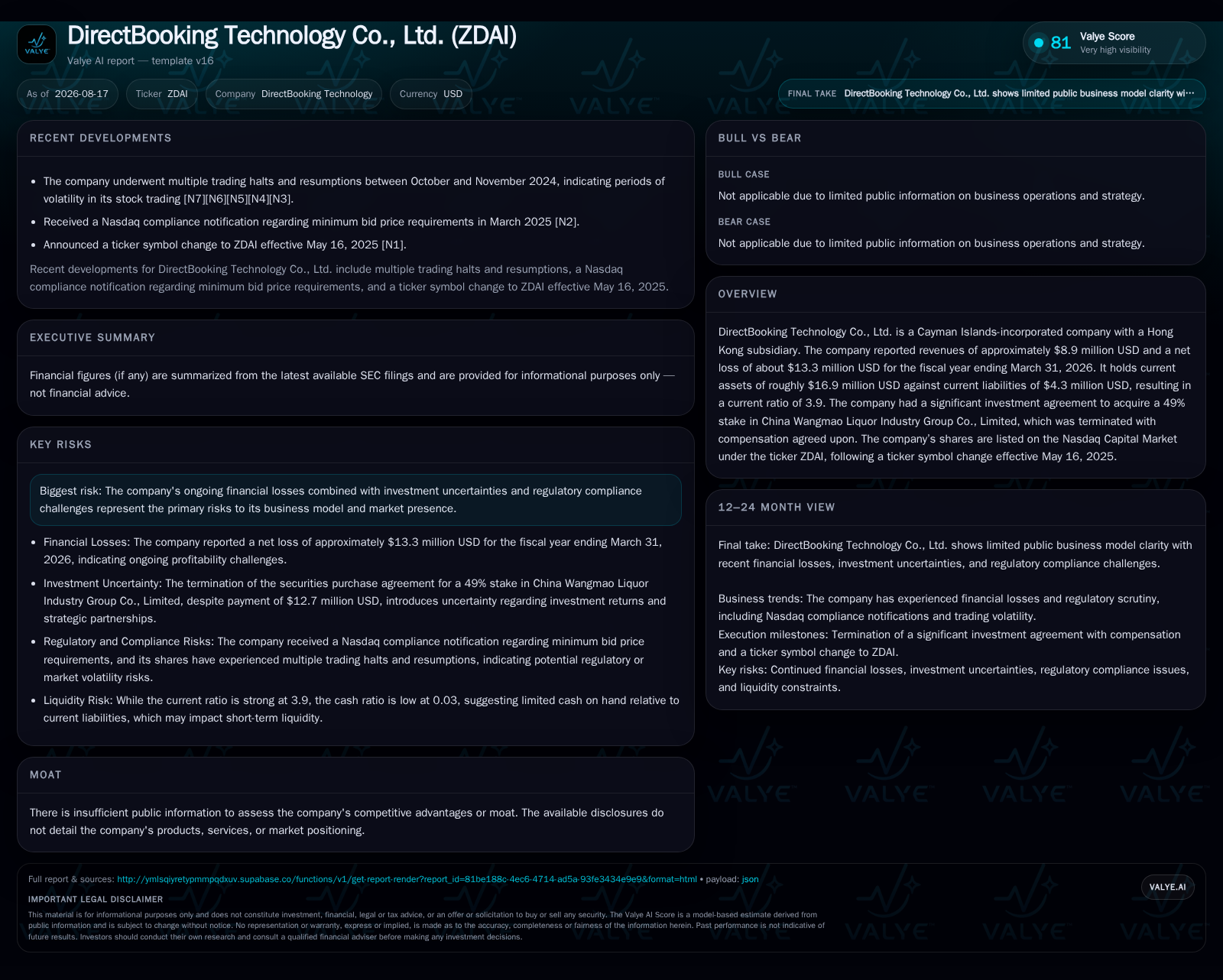
DirectBooking Technology Co., Ltd. reported a significant decline in revenue coupled with a gross loss driven by the completion of major projects and lack of new contracts in its core construction transportation and site services. The company recently terminated a $12.7 million equity investment in China Wangmao Liquor Industry Group, signaling a retreat from diversification efforts. Amid these challenges, it formed a joint venture focusing on AI-enabled travel services, reflecting a strategic pivot outside its traditional business. Operating costs related to fuel, labor, and depreciation remain high relative to declining revenues, pressuring margins and cash flow stability.
Terminated Investment Deal Shifts Capital Deployment Priorities
DirectBooking Technology recently terminated its securities purchase agreement (SPA) to acquire a 49% stake in China Wangmao Liquor Industry Group Co., Limited. Despite paying approximately $12.7 million in late 2025, the expected transfer of shares did not materialize due to unforeseen commercial factors [S2]. After amicable negotiations, the SPA was ended effective August 11, 2026, with China Wangmao agreeing to refund the principal plus interest at an annual rate of 5.25% for the holding period. This termination marks a clear retrenchment from non-core investments into beverage manufacturing and signals renewed focus on core construction transportation and site services businesses
This exit reduces capital lockup risks while enabling management to redeploy cash resources towards stabilizing operational challenges within its main segments.
Project Completion Drives Revenue Decline and Margin Pressure
Transportation revenues recognize upon service completion tied directly to moved material volumes, while construction service revenues follow project progress billing based on contract milestones. The sharp drop in active projects not only reduced billing opportunities but also impaired absorption of fixed overheads, driving gross profit margins deeply negative.
The construction works segment's gross margin fell from a modest profit of 10.6% in FY2025 to a gross loss near -35% in FY2026 due to fixed cost burdens amid lower activity levels [S1][S20]. Similarly, soil and rock transportation margins reversed from +7.2% profit into an -18% loss as fixed labor costs and equipment depreciation remained largely inflexible against declining top-line volumes
This margin deterioration underscores the vulnerability of subcontracting models with fixed labor commitments and leased assets during demand troughs.
Cost Structure Challenges: Fuel Prices, Labor Commitments, Idle Asset Depreciation
DirectBooking employs cost-plus pricing referencing estimated input time and costs including fuel consumption, labor expenses, plant operation, and amortization of right-of-use leased assets. While this approach protects nominal margins under stable or growing demand, it is less effective when project scale unexpectedly contracts preventing proportional cost reductions.
Fuel costs increased materially during FY2026 due to rising diesel prices—a key input for excavation material transport—making operating expenses stickier relative to revenues. Attempts to reduce subcontracting charges face limits given fixed labor contracts and equipment leases generate unavoidable overheads.
Depreciation on machinery and leased assets remains elevated even when utilization drops amid project scarcity; notably some idle machinery depreciation is recorded under general administrative expenses owing to fewer active projects [S1]. These factors cumulatively constrain profitability despite management’s cost control efforts.
Strategic Diversification Through AI-Powered Joint Venture
In July 2026, DirectBooking entered a joint venture with Beijing DeepYou Digital Technology Co., Ltd., targeting AI-driven travel and hospitality solutions distinct from its core construction logistics operations [S3]
This move reflects management’s intent to explore growth outside cyclical infrastructure markets by leveraging emerging digital technologies. However, success depends on navigating unfamiliar industry dynamics divergent from subcontracting-based project billing.
Market Dependency Risks: Infrastructure Spending & Private Developer Activity
DirectBooking’s revenues are tightly linked to Hong Kong government infrastructure budgets alongside private real estate development activity—the primary drivers for excavated materials transportation and specialized site services like earthworks.
The lack of sizable new contract wins following major project completions highlights pipeline weakness consistent with peer reports of muted backlog replenishment across regional urban infrastructure sectors [S1]. Given subcontractors’ reliance on steady project pipelines for revenue visibility, this thin backlog elevates forecasting risk.
Regulatory Compliance Adds Operational Complexity & Timing Risks
Operating within Hong Kong’s regulated construction environment exposes DirectBooking to compliance risks regarding construction waste management practices mandated by local authorities. Such regulations can delay site clearance or complicate logistics scheduling impacting project throughput and cash flow timing [S1]
Additional risks include weather-induced delays or regulatory inspections that may further defer revenue recognition while fixed overheads continue accruing—challenges typical among urban infrastructure subcontractors.
Operational Metrics Reflect Demand Softness but Potential Stabilization Efforts
Though granular KPIs remain undisclosed publicly, available data indicate reduced active projects alongside lower plant/equipment utilization rates aligning with soft demand cycles exerting financial pressure [F1][S1]
Project completion rates slowed as prior contracts phased out faster than new ones commenced during the fiscal period impacting revenue consistency.
Management is actively pursuing new project acquisitions aligned with urbanization trends; any early backlog recovery would improve fixed cost absorption critical for margin improvement.
What Investors Should Monitor Next: Contract Wins, Cost Controls & JV Progress
Key near-term indicators include announcements of new contract awards signaling improving market demand visibility. Execution on cost controls—particularly fuel procurement strategies and labor flexibility—will be essential amid inflationary pressures [S1][S2].
Updates on the AI joint venture's development will clarify whether diversification efforts yield meaningful value or distract focus.
Sequential quarterly gross profit trends alongside operating income will provide insights into the company’s ability to navigate cyclical headwinds toward operational stability.
Financial Profile Discussion: Adequate Liquidity Amid Mounting Losses
While liquidity buffers support solvency over the near term absent sudden cash burn spikes or refinancing issues, persistent losses underscore the urgency for restoring profitable scale or securing additional financing.
Overall balance sheet leverage remains modest but sustainability hinges critically on operational turnaround or capital support.
Disclaimer: This analysis synthesizes information available as of August 17, 2026, integrating regulatory filings with sector knowledge; it does not constitute investment advice.
Disclaimer: This is research-only, informational analysis and not investment advice. It may include AI-generated interpretation and general industry context. Always verify important details using primary sources.

Comments