
Jin Medical International's Manufacturing Expansion and Operational Risks in China's Healthcare Market
Recent facility openings fuel Jin Medical’s growth potential amid inherent structural and market challenges.
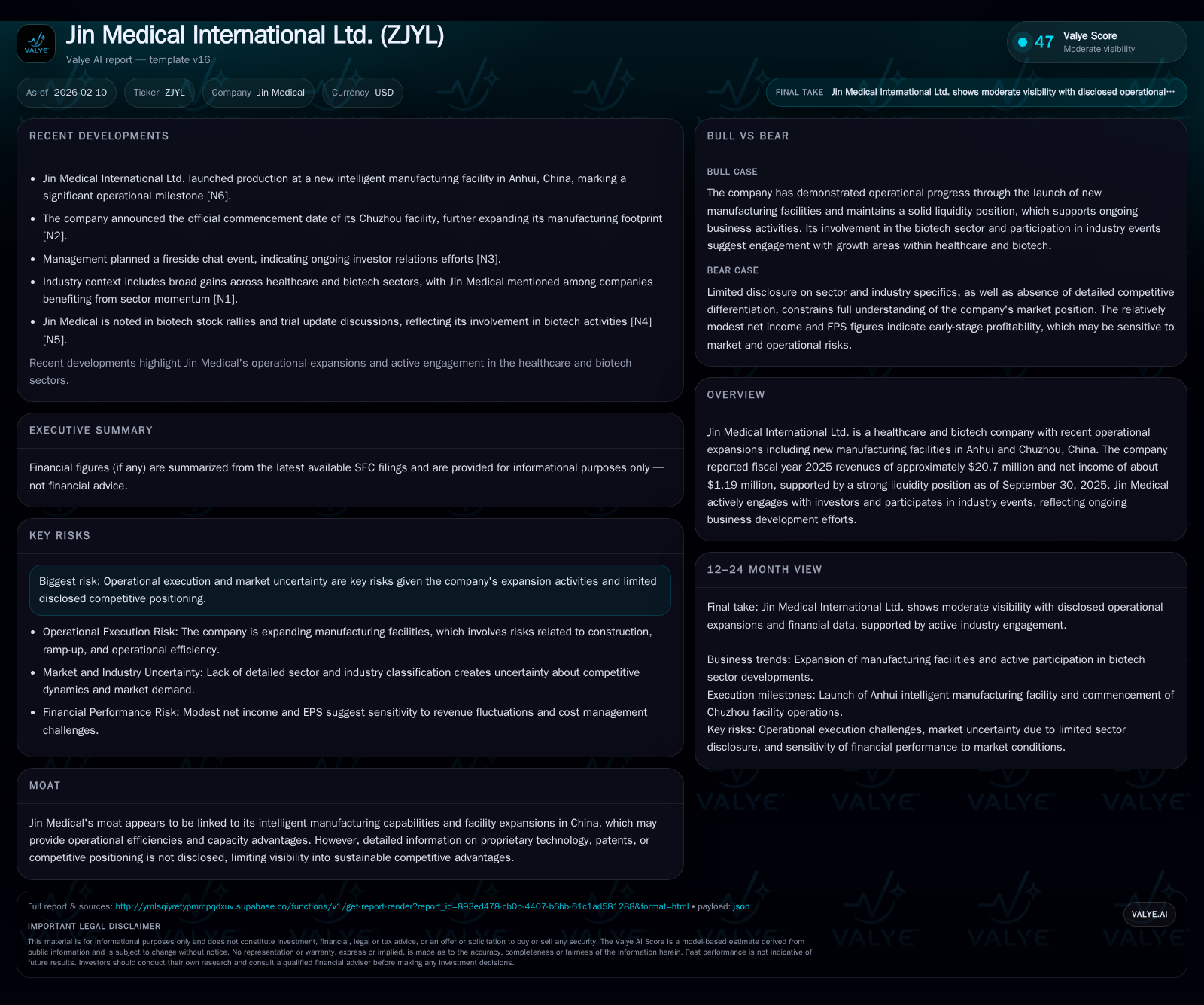
Jin Medical International Ltd. has progressed with significant manufacturing expansions in Anhui and Chuzhou, China, underpinning its operational capacity and growth ambitions. The company reported fiscal year 2025 revenues of roughly $20.7 million and net income near $1.19 million, reflecting ongoing business despite a year-over-year revenue decline and margin pressures. Its reliance on complex VIE structures, limited raw material suppliers, and regulatory uncertainties creates a layered risk environment. Active investor communications and liquidity management demonstrate efforts to navigate these headwinds while scaling production capabilities.
From Expansion to Execution: The New Manufacturing Footprint
Jin Medical International Ltd., through its affiliated entity Changzhou Zhongjin and subsidiaries, has notably advanced its operational footprint by commissioning new production facilities in Anhui and Chuzhou within China. The Chuzhou plant officially commenced operations early in 2026, following announcements in January corroborated by company press releases [N2]. These strategic moves are designed to augment manufacturing throughput for wheelchairs and living aids—the company's core product suite aimed at elderly and disabled populations.
The Anhui facility complements these efforts, potentially providing synergies in processing capacities or application of intelligent manufacturing techniques referenced by management. While these expansions signal positive momentum towards scaling operations efficiently, the transition from construction completion to stable, high-quality mass production is delicate. Historical observations from the company’s risk disclosures underscore that newly established facilities may encounter challenges in maintaining efficiency or ramping up output reliably—a cautionary reminder against assuming seamless execution [S1].
Operationally, these sites could afford Jin Medical enhanced economies of scale as well as technological integration capabilities that support its stated competitive positioning.
Decoding Jin Medical’s Revenue and Profit Trends
In fiscal year 2025 ending September 30, Jin Medical reported approximately $20.7 million in revenues along with net income attributable to shareholders of about $1.19 million [F1][S1]. This performance reflects a contraction compared to the FY2024 revenue figure near $23.5 million alongside a higher profit base of nearly $3.68 million. The downward trend indicates margin compression or volume declines which merit scrutiny given the company's recent investments.
Though still profitable, such shrinkage demands cautious interpretation; it might suggest initial softness as new plants come online or competitive pressures from domestic or international providers. Profit margins may also be impacted by elevated costs linked to onboarding new raw material suppliers or managing quality control during rapid expansion phases.
The consistent net income presence affirms that operational strategies have not yet undermined earnings power but maintaining this trajectory requires navigating emerging cost complexities wisely.
Navigating the Complexities of the VIE Corporate Structure
Central to Jin Medical’s corporate framework is its reliance on a variable interest entity (VIE) structure established through contractual arrangements rather than direct ownership of operating subsidiaries placed within mainland China—specifically Changzhou Zhongjin [S1]. This structure enables foreign-listed entities to circumvent Chinese restrictions on ownership in certain sectors but brings inherent risks including regulatory scrutiny.
The company’s controlling interests over its operating entity flow from agreements granting exclusive consulting rights translating economically into nearly all operating profits assigned back to Jin Medical’s WFOE (wholly foreign-owned enterprise) subsidiary. However, such contractual controls lack the robustness of outright equity ownership.
Consequently, if PRC authorities find any aspect noncompliant with evolving regulations or reinterpretations thereof—as has affected other firms with VIEs—Jin Medical could face severe penalties including loss of effective control which would materially jeopardize investor returns.
Assessing the Operational Moat: Intelligent Manufacturing and Capacity
Jin Medical characterizes its competitive advantage as rooted in intelligent manufacturing capabilities coupled with expanded facility capacity within China’s heartland regions [valye_report_excerpt][S1]. While this suggests a modernization drive leveraging automation or process innovations for wheelchairs and living aids assembly, no specific patents or proprietary technology disclosures are evident in filings or public announcements.
Therefore, the moat appears operationally based: either through cost efficiencies realized by newer production lines or potential scalability versus smaller competitors.
Without clearer insights into unique process technologies or product differentiation protected by intellectual property rights, this position remains vulnerable to imitation or substitution if market competitors adopt similar manufacturing upgrades.
Raw Material Reliance and Supply Chain Fragility
A critical vulnerability disclosed pertains to procurement dependencies on a relatively narrow supplier base for key raw materials essential in wheelchair manufacturing components [S1]. Such concentration risk elevates susceptibility to disruptions stemming from supplier insolvency, quality issues, geopolitical trade interventions, or logistical bottlenecks.
For a firm expanding physical plant capacities simultaneously with geographic dispersion—in Anhui and Chuzhou—any interruption in material inflows could precipitate delays impacting order fulfillment timelines or cost overruns during crucial scaling periods.
This reality underscores the importance of diversified sourcing strategies combined with rigorous supplier audits to mitigate supply chain fragilities threatening operational continuity.
Market Outreach and Investor Engagement: Signs of Business Development
Reflecting an active approach towards stakeholder dialogue and market positioning amidst fiscal tightening was Jin Medical’s announcement regarding leadership engagement through a planned CEO fireside chat in early February 2026 [N3][S2]. Participation in such forums signals transparent communication strategies intended to bolster investor confidence while delineating corporate vision amidst evolving challenges.
Concurrent involvement in industry exhibitions or biotechnology healthcare forums further evidences efforts to refresh partnership channels or brand visibility [N2][valye_report_excerpt].
These interactions serve dual purposes: facilitating capital access discussions critical for funding needs, while reinforcing market relevance against competitors within both domestic Chinese and international healthcare equipment markets.
Intrinsic and Extrinsic Risks: What Investors Must Know
Layered beneath Jin Medical’s surface operational gains lie pronounced risk factors detailed extensively in its SEC filings [S1]:
- Product liability claims pose inherent threats given medical equipment applications involving vulnerable patient populations.
- Quality control lapses—especially during expansion phases—could materially damage reputation and financial standing.
- The necessity for substantial additional financing introduces capital raising uncertainty amidst volatile market conditions.
- Geopolitical factors like shifting trade policies between China and global partners add complexity along with foreign exchange exposure considerations.
- Custodial risks involve potential misuse of critical assets including PRC legal ‘chops’—official seals integral to contract enforceability—which if compromised can affect operational integrity under local law frameworks. Each poses tangible hazards requiring continuous management focus particularly as Jin Medical grows amid an often unpredictable regulatory environment.
Regulatory and Geopolitical Headwinds in China’s Healthcare Sector
Operating primarily through PRC-based entities under foreign ownership constraints places Jin Medical at the confluence of stringent regulatory oversight encompassing:
- Foreign exchange controls influencing repatriation of earnings via dividends subject to withholding taxes (~10%) according to current tax treaties reviewed in multiple jurisdictions including Cayman Islands implications [S1].
- The dynamic nature of PRC healthcare regulations which regularly evolve as domestic policy incentivizes innovation while tightening safety standards imposes compliance burdens relevant especially given product liability exposures noted earlier.
- Risks tied directly to the validity of VIE arrangements themselves subject legal interpretations that remain unsettled within Chinese administrative courts potentially affecting Jin Medical’s authorized control mechanics over Changzhou Zhongjin assets [S1]. Such multi-dimensional regulatory complexity demands vigilant navigation strategies for sustaining business continuity without incurring punitive actions or capital restrictions detrimental to shareholder value preservation.
Liquidity Landscape and Financing Needs Moving Forward
As per latest available data at fiscal year-end September 30, 2025, Jin Medical held current assets approximating $44.14 million against current liabilities near $23.80 million yielding a current ratio close to 1.86—a comfortable short-term liquidity metric indicating ability to meet obligations [F1]. However, cash balances specifically stood at about $2.4 million as per Q2 2025 figures—highlighting restricted liquid reserves relative to working capital needs.
Management openly acknowledged requirements for substantial additional financing resources aimed at supporting ongoing plant commissioning activities plus working capital demands amid operational scale-up programs outlined earlier [S1].
This juxtaposition signals that while balance sheet metrics offer some reassurance about immediate solvency prospects; upcoming capital raises—whether via debt instruments or equity issuances—are likely indispensable ingredients enabling Jin Medical’s ambitions within increasingly competitive healthcare device markets domestically and abroad.
This analysis synthesizes selected recent financial data alongside risk disclosures addressing Jin Medical International Ltd.'s strategic positioning amid facility expansions across China balancing optimistic growth signals against material execution uncertainties characteristic of VIE-dependent healthcare manufacturers operating under evolving PRC regulatory regimes. Readers should consider this report informational only without any investment recommendations.
Disclaimer: This is research-only, informational analysis and not investment advice. It may include AI-generated interpretation and general industry context. Always verify important details using primary sources.

Comments