
zSpace Faces Liquidity Pressures While Expanding AR/VR Education Platform
Latest quarterly results underscore financial strains amid ongoing investments in hardware-software integration for K-12 and CTE sectors.
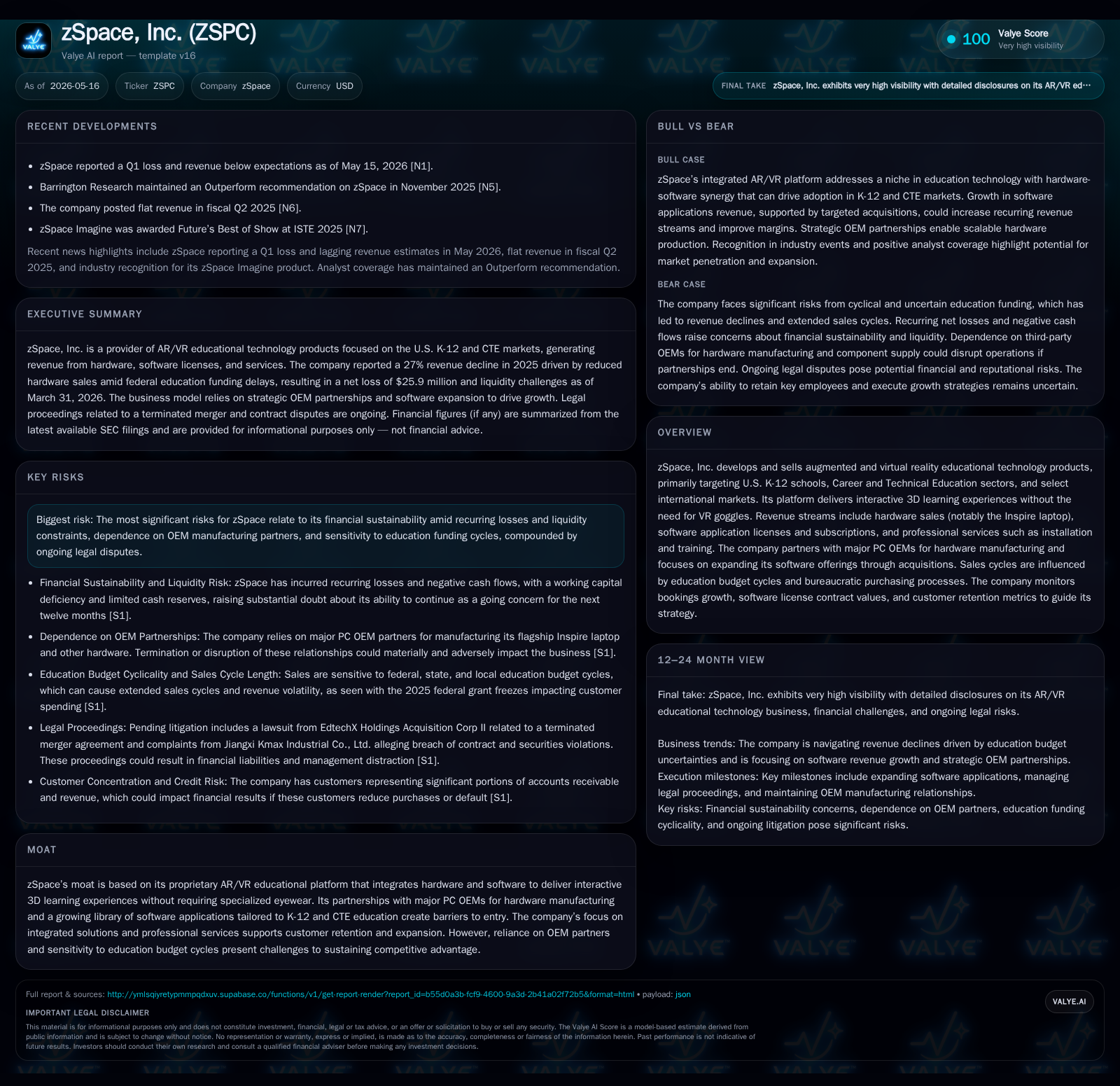
zSpace, Inc. reported a challenging first quarter with losses exceeding prior periods and continued negative cash flows, highlighting ongoing liquidity constraints despite recent preferred stock financings. The company’s business model centers on augmented and virtual reality blended hardware-software educational products primarily sold into U.S. K-12 schools and Career and Technical Education (CTE) programs, supplemented by professional services. Its proprietary technology delivers immersive 3D learning experiences without VR goggles, supported by partnerships with major PC OEMs. However, the business faces structural headwinds from prolonged education budget cycles, dependence on OEM supply chains, competitive pressure in EdTech, and legal disputes that complicate its path to sustainable growth.
Recent Operating Update
In the three months ended March 31, 2026, zSpace highlighted ongoing operating challenges despite efforts to advance its core AR/VR education platform. The first-quarter 10-Q [S2] reveals no material changes to risk factors but confirms continued losses consistent with historical trends. A contemporaneous 8-K filing [S3] details the company’s release of Q1 financial results showing a widening loss position and reiterates efforts to fortify liquidity through issuance of Series P Convertible Preferred Stock earlier in the year.
Operating losses remain substantial; the most recent annual data to December 31, 2025 shows net loss of approximately $25.4 million [F1], reflecting a deterioration relative to prior periods amid rising expenses.
Liquidity metrics indicate pressure: the current ratio at quarter-end was approximately 0.72 [F1], signaling short-term liabilities exceeding readily available assets as accounts payable and accrued expenses remain elevated.
Management has sought incremental capital from institutional investors with $3 million raised via Series P Preferred Stock in January 2026 [S1] but continues facing headwinds on free cash flow generation given persistent negative Operating Cash Flows totaling around $18 million annually [S5].
Business Model
zSpace operates in a niche intersection of augmented reality (AR), virtual reality (VR), and educational technology focused largely on the K-12 sector within the United States as well as Career Technical Education (CTE) programs domestically and select international markets [S1]. The company's revenues accrue mainly from three sources:
- Hardware Sales: Centered around its "Inspire" laptop product line manufactured through partnerships with established PC original equipment manufacturers (OEMs). This hardware uniquely enables stereo holographic projection without goggles or wearables.
- Software Licensing: Includes proprietary educational applications designed to work seamlessly with their hardware platform. These licenses can be perpetual or subscription-based.
- Professional Services: Installation support, training sessions for educators, curriculum integration assistance, and ongoing customer support.
Revenue generation is driven by volume sales of Inspire laptops during school procurement seasons combined with increasing penetration of software licenses aimed at boosting recurring revenue profiles. Pricing dynamics are influenced by contract cycles within education systems that can delay purchase decisions. The bundled solution approach combining certified hardware plus integrated software is positioned to reduce switching costs relative to standalone apps or generic AR platforms.
Margins are constrained by manufacturing costs passed through OEM suppliers alongside significant R&D spend evident from rising annual budgets (~8% increase in R&D costs year-over-year [S17]). The services segment yields lower margins but is crucial for customer retention and upselling.
Industry Structure and Competitive Position
EdTech incorporating AR/VR is a fast-evolving but fragmented segment marked by startups ranging from pure software content providers to device manufacturers selling standalone VR headsets. zSpace situates itself uniquely by offering glasses-free holographic technology partnered with educational content—an integrated model that helps differentiate but also raises capital intensity.
Its key competitive advantages stem from:
- Proprietary technology delivering interactive 3D experiences that do not require specialized eyewear, important for user comfort especially among younger students.
- Strategic alliances with leading PC OEMs that enhance production capacity and distribution capabilities but expose zSpace to supply chain risks.
- A growing digital library of curriculum-aligned software applications tailored to STEM learning mandates increasingly emphasized in U.S. education policies.
However, competition includes emerging entrants focusing on more affordable tablet-based AR apps or competing VR offerings requiring goggles which can command limited attention despite usability barriers.
Customer acquisition remains challenged by protracted sales cycles inherent in public school acquisitions impacted by rigid budgeting processes subject to yearly government allocations.
Growth Drivers
Despite macro headwinds prevailing in education funding environments, several structural growth vectors have been catalyzing opportunities:
- Expansion of Software Licensing: Management expects steady growth in application subscriptions as schools seek to extend device utility beyond initial hardware investment.
- Professional Services Penetration: Customized deployment support enhances renewal rates while embedding zSpace more deeply into institutional workflows.
- International Market Selectivity: Carefully chosen regions where education infrastructure supports new technology offers incremental expansion paths outside saturated U.S. channels.
- Acquisitions: Targeted acquisitions to enlarge software offerings improve product breadth complementing hardware sales potential.
Measurable KPIs include order backlog levels reflecting committed yet unfulfilled purchases typical in education sector seasonality along with contract renewal rates indicative of customer satisfaction.
Risks and Growth Constraints
Several factors impair zSpace’s ability to scale profitably:
- Financial Sustainability Risk: Recurring losses coupled with a working capital deficit point toward potential liquidity shortfalls without additional financing [S15].
- OEM Dependency: Reliance on external manufacturers constrains pricing flexibility and risks disruptions impacting fulfillment timeliness or component availability.
- Education Budget Sensitivity: Prolonged decision timelines due to budgetary constraints limit visibility into future revenue streams negatively affecting working capital management.
- Legal Uncertainties: Notable lawsuits including claims from investor KMax alleging breaches related to historical financings introduce unpredictability that could affect reputation or capital costs if judgment is adverse [S1].
- Competitive Pressures: Increasing innovation velocity in AR/VR combined with competitors offering alternative low-cost solutions may erode zSpace’s market share without sustained product innovation.
What To Watch Next
Critical near-term milestones include:
- Monitoring closure or progress updates on pending litigation against EdtechX Holdings Acquisition Corp II and KMax Industrial Co., which could materially impact financial stability [S1].
- Quarterly bookings trends detailed next filings providing forward-looking insight into demand capture amid school buying cycles.
- Renewal rates for the software subscription base indicating retention efficacy.
- Expansion of professional services contracts signaling successful ecosystem embedding.
- Any strategic announcements regarding new partnerships or acquisitions enhancing technological offerings or geographic footprint.
- Improvements in liquidity ratios post additional capital raises or improvements in cash flow generation will be key indicators of execution progress [S3].
Financial Profile Summary
Latest financial snapshot
| Metric | Value | Period |
|---|---|---|
| Current assets | $9mm | |
| 2026-03-31 | ||
| Current liabilities | $13mm | |
| 2026-03-31 | ||
| Current ratio | 0.72x | |
| 2026-03-31 |
Source: SEC companyfacts cache [F1].
A snapshot of zSpace’s financial health as of March 31, 2026 demonstrates ongoing strain tied largely to operational outflows exceeding inflows:
| Metric | Value (USD) | Period End |
|---|---|---|
| Current Assets | 9,435,000 | |
| 2026-03-31 | ||
| Current Liabilities | 13,101,000 | |
| 2026-03-31 | ||
| Total Debt | 12,989,000 | |
| 2025-03-31 | ||
| Net Income (Trailing) | -25,388,000 | |
| FY ended 2025 | ||
| Operating Income (loss) | -22,141,000 | |
| FY ended 2025 | ||
| Current Ratio | approx. 0.72 | Calculated |
Expenses have grown moderately over prior years fueled by increased headcount-driven costs across R&D (+8%) and general administrative areas (+12%) reflecting investments in product development alongside governance overhead [S17]. Revenue contraction predominately stems from declining hardware sales offset only partially by steadier software licensing receipts highlighting challenges transitioning more heavily toward recurring revenues [S22].
This analysis aims solely at evaluating company performance rooted in publicly available SEC filings through latest quarterly disclosures. It avoids speculative projections or investment advice while clarifying operational context underpinning reported financial trends. Ongoing monitoring of litigation outcomes alongside execution against software growth strategy remains essential for anticipating shifts in fundamental value propositions ahead.
Disclaimer: This is research-only, informational analysis and not investment advice. It may include AI-generated interpretation and general industry context. Always verify important details using primary sources.

Comments