
Zumiez's Q1 2026: Balancing Fast Fashion Trends with Operational Discipline
Zumiez's Q1 2026 results underscore strategic agility in responding to youth apparel trends while maintaining operational efficiencies.
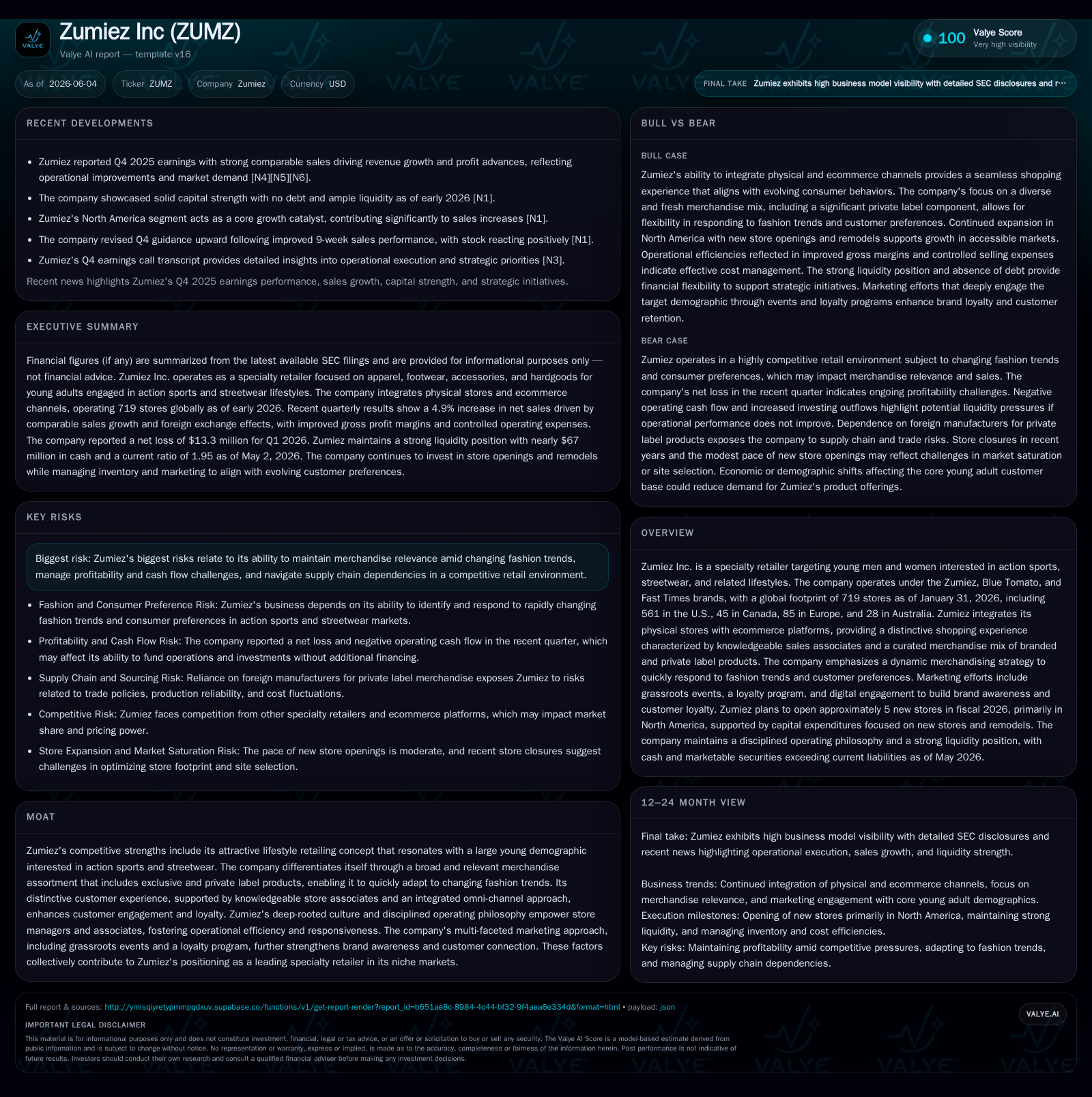
In its Q1 fiscal 2026 report filed June 4, Zumiez Inc. demonstrated solid comparable sales growth of 4.0%, supported by a dynamic merchandise mix and integrated omni-channel sales. The retailer’s ability to leverage product margin improvements and operational cost controls led to a gross profit increase of 10.9% despite enduring a net loss influenced by higher operating expenses and non-cash charges. Zumiez continues to expand its store footprint cautiously, targeting roughly five new openings in fiscal 2026, while advancing localized fulfillment strategies internationally. Challenges remain around maintaining merchandise relevance amid volatile fashion tastes and margin pressures from promotional activities, but stable liquidity and a low-debt balance sheet underpin the company’s strategic flexibility.
Q1 Fiscal 2026 Operating Update: Performance and Key Trends
Zuimez Inc.'s latest quarterly filing dated June 4, 2026 [S2] reveals that the company achieved a noteworthy 4.0% increase in comparable sales for the three months ended May 2, 2026 compared to the prior-year period [S15]. This growth was supported by a balanced performance with a 4.4% lift in North American sales and a resilient 2.2% gain internationally. The increase was largely driven by rising dollars per transaction—a mix of higher average unit retail prices and units per transaction—partially offset by fewer transactions overall.
Gross profit saw a robust increase of 10.9%, reaching $61.3 million from $55.3 million year-over-year [S15]. The gross margin percentage improved by roughly 170 basis points to 31.7%, fueled primarily by product margin enhancements, operating cost leverage particularly in occupancy expenses due to higher sales and store optimization, reductions in web shipping costs through improved fulfillment efficiency, and lower inventory shrinkage.
On the expense front, selling, general and administrative costs increased modestly by only 1.8%, amounting to $76.5 million versus $75.2 million in the prior year quarter [S15]. Expense as a percentage of net sales improved significantly by about 120 basis points due mainly to one-time litigation settlement benefits impacting last year's results favorably and wage efficiencies realized through better labor utilization driven by higher store productivity.
Zumiez sustained net losses in Q1 at $13.3 million reflecting $0.82 loss per diluted share but narrowed the gap compared with the $14.3 million loss last year [S7]. Non-cash charges such as depreciation and amortization represented significant adjustments within these results.
Zumiez’s Specialty Retail Model: A Blend of Products & Experience
Zumiez operates within a specialty retail niche focused on apparel, footwear, accessories, and hardgoods catering predominantly to teenagers and young adults interested in action sports, streetwear culture, music, art, and urban lifestyles [S1]. Its portfolio includes the Zumiez banner alongside Blue Tomato in Europe and Fast Times Skateboarding out of Australia.
A distinctive aspect of Zumiez’s business model lies in its omnichannel integration combining physical stores—719 globally as of January 31, 2026—with e-commerce platforms including zumiez.com [S1]. This integration supports a seamless customer experience where online and offline channels are highly interconnected; customers use them complementarily.
Zumiez's merchandising strategy is distinguished by frequent product replenishments—merchandise arrives up to five times weekly per store—which keeps inventory fresh and aligned with real-time trends [S26][S27]. The assortment is curated to include branded products alongside exclusive private label offerings that bolster differentiation and margin enhancement potential.
Knowledgeable sales associates who embody action sports lifestyle authenticity augment customer engagement inside stores, reinforcing brand credibility [S1]. This experiential retail environment positions store visits as destination shopping trips rather than mere transactions.
Marketing efforts are multifaceted including grassroots events centered on music and sports cultures relevant to their demographic plus their loyalty program "Zumiez STASH," creating stickiness via rewards for purchasing or participating activities that foster community identity around the brand [S26].
Industry Positioning: Distinctive Competitor Differentiators
Within specialty apparel retailing aimed at youth lifestyle segments, Zumiez stands out through its nimble merchandising flow enabling rapid adaptation to changing fashion preferences—a critical structural advantage given fashion's volatility among this cohort [S1]. Competing specialty brands often face challenges maintaining assortment freshness due to slower replenishment frequencies.
Internationally, Zumiez is progressing towards full localized fulfillment across Canada (Delta), Europe (Graz), and Australia (Melbourne) distribution centers which help reduce delivery lead times and improve inventory turns relative to competitors relying heavily on centralized distribution [S26]. This decentralized logistics footprint supports better ecommerce responsiveness—a growing channel alongside physical retail.
Moreover, Zumiez’s deliberate blending of branded merchandise with private label lines reflects an industry trend where exclusives lift gross margins while deepening customer engagement via unique products unavailable elsewhere [S26]. Peer chains that rely heavily on wholesale branded SKUs often lack this degree of assortment flexibility.
Operational discipline empowering store managers with local merchandising discretion enhances execution quality versus peers with rigid corporate-defined assortments [S27]. Combined with competitive marketing rooted organically within target subcultures through event sponsorships and social media presence, this contributes to an effective moat protecting market share.
Growth Catalysts: New Stores, Ecommerce & Merchandise Agility
Zumiez plans a cautious but targeted expansion trajectory—approximately five new domestic store openings planned for fiscal year 2026 alongside remodels or relocations aimed at optimizing existing footprint productivity [S22]. Site selection focuses on high traffic locations near complementary teen-oriented retailers promoting cross-shopping synergies [S27].
Ecommerce momentum complements physical stores; regional fulfillment advancements aim at reducing shipping costs and times internationally enhancing customer satisfaction levels while preserving margins [S26]. Zumiez’s localized fulfillment approach enables better inventory management responsiveness critical for fast-fashion cycles which define streetwear categories.
Rapid merchandise flow underpins growth: newly introduced brands or styles frequently replace older stock limiting markdown exposure while ensuring relevance—a key driver of repeat purchase behavior among style-conscious youth consumers [S26]. KPIs reflective of growth such as sell-through rates or inventory turnover are expected to improve as this strategy matures.
Cross-channel synergy is enhanced by leveraging store associates’ expertise not just for in-person sales but for supporting online order fulfillment through buy-online-pickup-in-store (BOPIS) capabilities adding convenience layers valued by customers.
Risks and Constraints: Fashion Changes, Margin Pressures, Supply Dynamics
Zumiez operates amidst significant risk vectors typical for specialty retailers targeting fickle youth segments whose preferences can swing quickly due to social media influence or cultural shifts [S18]. Maintaining merchandise relevance requires constant assortment refreshment while avoiding overstock risks that induce discounting pressure harming gross margins.
Promotional intensity remains a double-edged sword; competitors engage aggressively on price causing downward pressure on full-price selling percentages challenging Zumiez’s margin stability despite some improvement seen recently [S15][S18]
Supply chain dependencies particularly in international markets remain constraints as localized fulfillment centers are still being fully implemented; delays or cost overruns here could impair service levels or profitability.
Additionally, litigation exposure—including employment-related claims—and regulatory compliance burdens add complexity to cost structures and risk profiles with no assurance that future claims won’t impact financial results materially [S11][S18].
Looking Ahead: Milestones and Metrics to Monitor
Near-term focus should be placed on monitoring consecutive quarterly comparable sales trajectories including ecommerce contribution effectiveness given ongoing investments in fulfillment networks [S2][S22]. Tracking gross margin progression will reveal whether Zumiez can sustain improvements amid continued promotional challenges.
Execution against store expansion targets—opening about five stores in FY26—and successful remodel projects will be key operational milestones influencing revenue ramp potential without overextending capital spending [S22]
KPIs tied to merchandise agility such as inventory turnover rates or sell-through percentages should be observed via subsequent quarterly disclosures indicating whether fresh product flows continue driving consumer demand retention.
Watch also any updates relating to litigation developments or regulatory changes that could affect risk cost outlooks [S11][S18].
Financial Commentary: Capital Structure Solidity Supports Strategy
As of May 2, 2026, Zumiez reports cash and cash equivalents totaling approximately $66.9 million alongside minimal total debt near $1.9 million—reflecting very low leverage levels supportive of financial flexibility [F1]. The current ratio stood solid at roughly 1.95 indicating prudent working capital management amidst operational cash needs [F1].
This balance sheet positioning supports Zumiez’s capacity to fund growth initiatives without undue financial stress or dilution risks especially important within competitive specialty apparel landscape where nimbleness is essential.
This analysis is based solely on publicly available SEC filings dated up to June 4, 2026 as well as related disclosures cited herein. It does not constitute investment advice but aims to provide an informed perspective on Zumiez Inc.’s operating context within specialty retailing focused on action sports streetwear segments.
Disclaimer: This is research-only, informational analysis and not investment advice. It may include AI-generated interpretation and general industry context. Always verify important details using primary sources.

Comments