
Abony Acquisition Corp. I: SPAC Execution Stakes in a Crowded Market for Tech-Driven Deals
Abony Acquisition Corp. I enters the SPAC arena with $230 million in trust, a seasoned management team, and a mandate to target defense technology, advanced computing, software, or media. Its ability to deliver value hinges on sourcing and executing a compelling business combination within a tight 24-month window amid intense competition and shifting market sentiment.
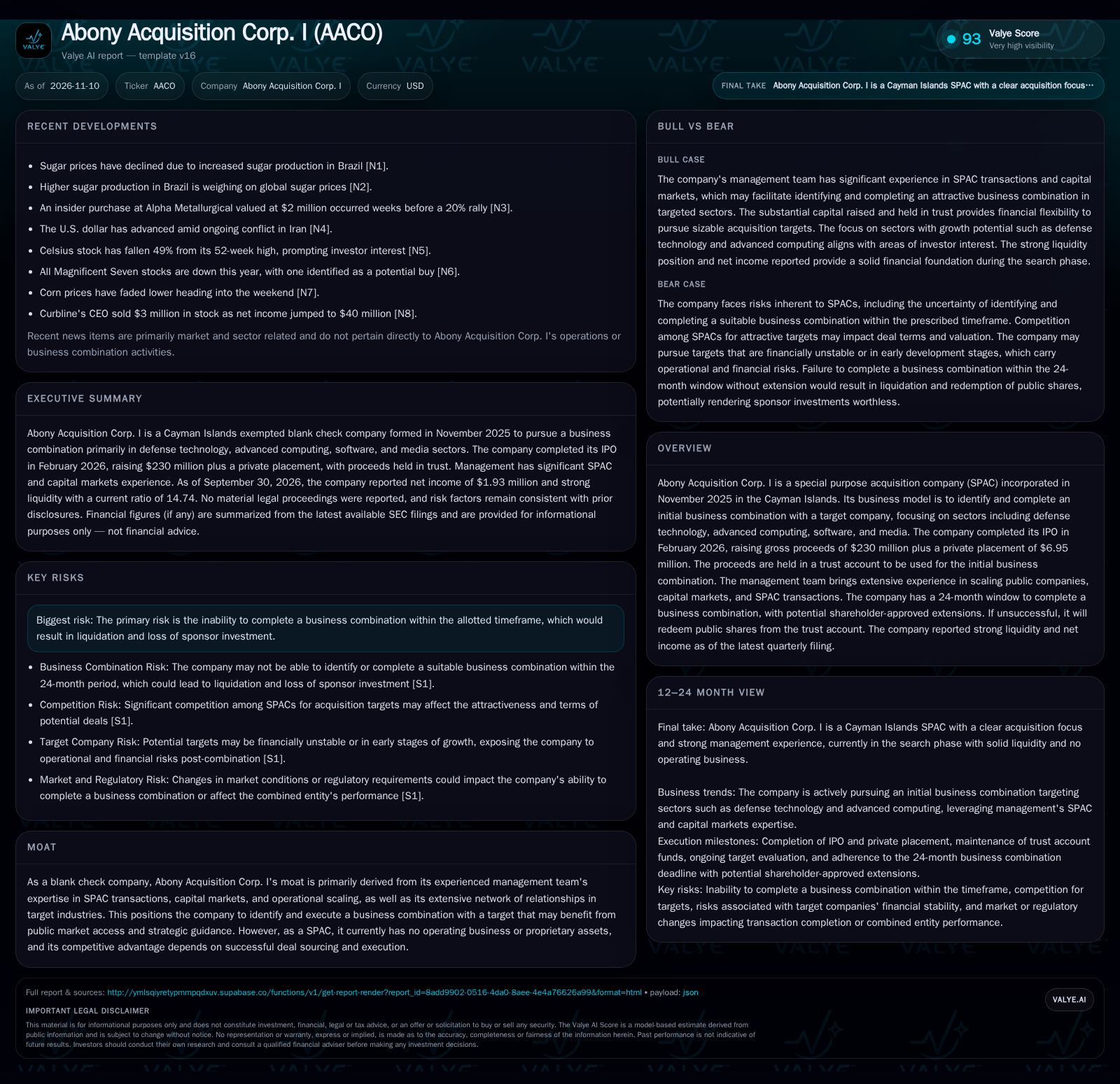
Abony Acquisition Corp. I (AACO) is a Cayman Islands SPAC with $230 million in trust and a leadership team experienced in public markets and SPAC transactions. The company is searching for a business combination in high-growth sectors like defense technology and advanced computing, with a 24-month deadline to close a deal or return capital to public shareholders. The value proposition depends entirely on the quality and execution of the eventual acquisition—there is currently no operating business or recurring revenue.
Abony Acquisition Corp. I (AACO) represents a classic SPAC proposition: a pool of capital, a high-profile management team, and a mandate to hunt for a sizable acquisition in hot sectors like defense technology and advanced computing. With $230 million in trust and a ticking 24-month clock, the company's future is binary—either it sources and closes a compelling deal or returns capital to shareholders. The stakes are amplified by fierce competition among SPACs, evolving market sentiment toward de-SPAC transactions, and the inherent uncertainties of acquiring and integrating a private company into the public market arena.
IPO Proceeds, Search Mandate, and the Countdown to Acquisition
Abony Acquisition Corp. I completed its IPO in February 2026, raising $230 million from public investors and an additional $6.95 million in a private placement, with all proceeds placed in a U.S.-based trust account [S1]. The company is targeting an initial business combination with an enterprise value between $750 million and $1.5 billion, focusing on sectors such as defense technology, advanced computing, software, and media [S1]. Management has a 24-month window (until February 2028) to identify and close a transaction, with potential for shareholder-approved extensions [S1]. If no deal is completed, the company will redeem public shares at approximately $10.00 per share from the trust [S1]. As of September 30, 2026, AACO reported $1.93 million in net income, current assets of $1.1 million, and current liabilities of $75,000, resulting in a current ratio of 14.74 and a cash ratio of 13.6 [S2]. However, these figures reflect the SPAC's pre-acquisition structure—there is no operating business or recurring revenue at present.
SPAC Economics: Fee Structures, Dilution, and Post-Merger Uncertainties
AACO's economics are, for now, those of a typical SPAC: sponsor capital, trust proceeds, and minimal operating costs until a business combination is consummated. The company earns minor interest on the trust account, and reported net income likely reflects this, as well as the impact of low overhead [S2]. The core economic engine will only be defined after a merger closes—in that event, the SPAC structure typically results in significant dilution (from sponsor 'promote' shares, underwriter warrants, and potential PIPE financing) for public shareholders. Post-merger, the combined entity's value will depend on the operating performance, capital needs, and growth profile of the acquired business.
The targeted sectors—defense technology, advanced computing, software, and media—are characterized by high growth potential but also by capital intensity and competitive pressure. If AACO acquires a business with recurring revenue (e.g., SaaS), the merged entity could demonstrate attractive operating leverage and margin expansion potential. Conversely, if the target requires substantial investment or is pre-profit, the combined company could face dilution risk and ongoing capital needs. The SPAC's ability to negotiate favorable terms, minimize redemptions, and structure accretive post-merger economics will be central to long-term value realization.
Deal Sourcing and the Realities of SPAC Competition
AACO's primary edge lies in its management team's capital markets and SPAC experience, as well as its network within the targeted industries [S1]. In theory, this could enable access to higher-quality targets or superior deal terms. However, the SPAC landscape remains saturated, with many blank check companies chasing a finite pool of attractive targets—especially in sectors like defense tech and advanced computing, which are currently in high demand. Competition is not only from other SPACs but also from private equity, strategic buyers, and growth equity funds, all of whom may offer more flexible capital or less public scrutiny.
Unlike an operating company with proprietary technology or established customer relationships, AACO’s competitive position is entirely contingent on its deal process. Its ability to differentiate may depend on management’s credibility, speed of execution, and willingness to accept less favorable economics to close a deal. The absence of a proprietary asset or operating moat means that, until a transaction is completed, the SPAC’s only defensible advantage is its capacity to source, negotiate, and execute a transaction that the market values.
Unlocking Value Through a High-Quality, Accretive Business Combination
The best-case scenario for AACO is the identification and successful acquisition of a fast-growing, profitable company in one of its focus sectors—ideally with sticky revenues, compelling margins, and a defensible market position. If AACO's management leverages its network to secure a proprietary deal (i.e., one not shopped to multiple SPACs or financial sponsors), the resulting merger could be accretive for public shareholders and attract additional institutional capital via a PIPE (private investment in public equity).
Confirmation of this scenario would come from a deal announcement involving a target with robust historical growth, recurring revenue, and positive cash flow, as well as limited redemptions by public shareholders and strong PIPE participation. Additional evidence would include post-merger guidance that supports meaningful revenue and EBITDA expansion and the market rewarding the transaction with an upward re-rating of the combined entity’s shares.
Most Probable Outcome: Competitive Bidding and Market Skepticism
The most likely outcome is that AACO, like many SPACs, faces a competitive process for attractive targets and ultimately negotiates a business combination with a company that is solid but not exceptional. The deal may involve a business with some growth and a credible market narrative, but not the type of breakout profile that drives significant upside for public shareholders. The transaction could be complicated by high public shareholder redemptions, necessitating additional capital raising or a downward valuation adjustment.
Confirmation of this scenario would include a deal announcement with a target that is in line with sector peers but lacks clear differentiation, moderate PIPE support, and a muted market reaction. Falsification would require evidence of a truly proprietary, high-growth target or a transaction that dramatically outperforms peer de-SPAC deals in terms of valuation and post-merger trading.
Deal Failure or Redemption-Driven Liquidation: The SPAC’s Binary Risk
The structural downside risk for AACO is the inability to secure a business combination within the allotted 24-month window, resulting in forced liquidation and return of capital to public shareholders at approximately $10.00 per share [S1]. This outcome would render the sponsor’s investment and any out-of-pocket expenses worthless, and public shareholders would miss out on any upside from a successful de-SPAC transaction.
Alternatively, a poorly executed deal—such as overpaying for a speculative or financially unstable target—could result in severe shareholder redemptions, a lack of PIPE support, and a post-merger collapse in share price. Confirmation of this scenario would include repeated extensions of the SPAC deadline, public filings indicating a lack of target pipeline or failed negotiations, or a merger announcement quickly followed by high redemption rates and negative market reaction.
Milestones and Metrics That Will Define AACO’s Outcome
Any public announcement of a letter of intent (LOI) or definitive agreement with a target business, including sector, size, and financial profile.
Levels of public shareholder redemptions at the time of deal closing—a high redemption rate would indicate limited investor enthusiasm and reduce capital available for the target.
PIPE financing commitments secured alongside a merger announcement, which would signal outside institutional validation of the deal.
Details on the target company’s revenue growth, profitability, and customer concentration, if disclosed.
Sponsor dilution and promote structure—how much of the post-merger entity is allocated to the sponsor team and how that compares to peer SPAC deals.
SEC filings or proxy statements detailing the anticipated use of proceeds, post-merger capital structure, and any earnout or incentive arrangements.
Market reaction to the deal announcement and closing, including share price performance relative to trust value.
Disclaimer: This is research-only, informational analysis and not investment advice. It may include AI-generated interpretation and general industry context. Always verify important details using primary sources.

Comments