
American Airlines Group's Q1 2026 Performance Signals Resilience Amid Industry Headwinds
Strong revenue execution and cost management in Q1 underscore American Airlines’ operational resilience despite sectoral challenges.
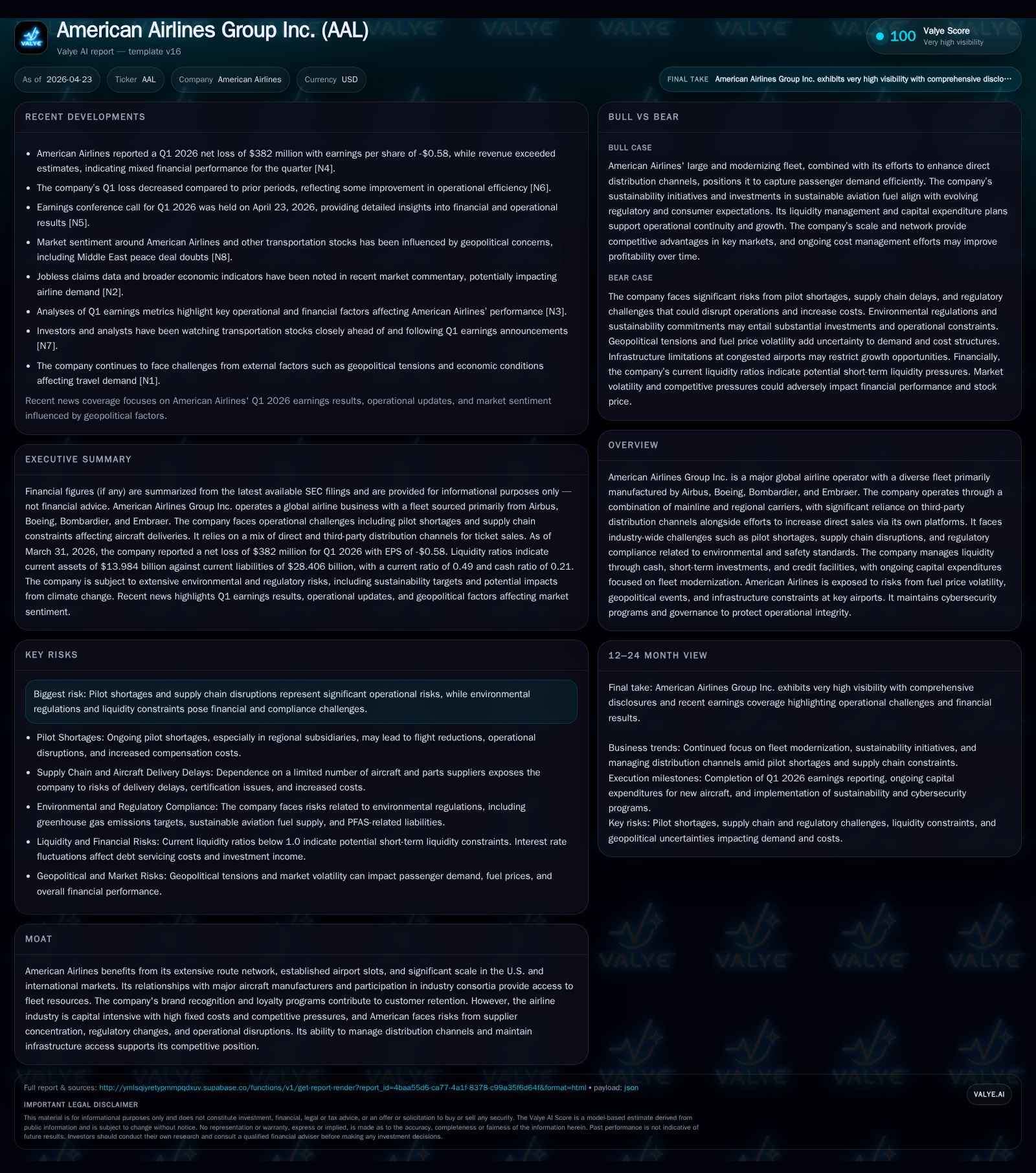
American Airlines Group delivered a narrower-than-expected loss in Q1 2026, fueled by robust revenue growth that outpaced ongoing cost pressures from fuel price volatility and labor inflation. The company continues to navigate industry headwinds such as pilot shortages and regulatory challenges while pursuing fleet modernization and expanding direct distribution channels. Its competitive position rests on extensive network scale, valuable airport slots, and strong supplier relationships, although capital intensity and external constraints limit upside. Monitoring liquidity trends, margin progress, and sustainability initiatives will be critical to assessing near-term operational momentum.
Q1 2026 Operating Update: Revenue Strength and Cost Pressures
American Airlines Group’s first quarter of 2026 delivered encouraging signs of operational resilience with a reported loss narrower than market expectations. According to the April 23, 2026 10-Q filing [S2], revenues exceeded estimates driven by sustained demand on both domestic and international routes despite persistent macroeconomic headwinds. The company attributes this performance to improved load factors combined with strategic pricing during competitive capacity deployment.
However, American’s cost per available seat mile (CASM) continued to face upward pressure primarily due to rising labor expenses following contractual wage increases and pilot-related staffing challenges. Fuel costs showed volatility within the quarter but remained a significant cost driver due to underlying price fluctuations without any active currency hedging program noted [S2]. These dynamics culminated in consolidated loss metrics improving versus prior periods yet highlighting the narrow margin environment.
Market commentary from contemporaneous news sources emphasized American’s ability to navigate these pressures while continuing capacity expansion cautiously [N1][N3]. The lack of a forex hedge exposes earnings sensitivity to foreign currency swings mainly in the Eurozone and Latin America [S2]. Nonetheless, operating initiatives are reportedly offsetting some cost inflations.
Business Model Fundamentals: Revenue Streams, Distribution Strategy, and Product Quality
American Airlines generates the bulk of its revenue through passenger air travel facilitated by its mainline fleet comprising aircraft from manufacturers including Airbus, Boeing, Bombardier, and Embraer. These fleets operate under both mainline services and regional affiliates — the latter often managed through capacity purchase agreements reflecting roughly a tenth of total operations [S1][S6]. Ancillary revenues contribute meaningfully through loyalty programs like AAdvantage which also support customer retention.
On distribution, American operates within a competitive ecosystem where traditional global distribution systems (GDSs)—notably Amadeus, Sabre, Travelport—remain significant ticket sellers alongside conventional travel agents and online travel agencies (OTAs). The firm is actively seeking to migrate booking volumes toward its proprietary digital platforms (e.g., aa.com) to reduce reliance on third-party fees and enable better ancillary product integration [S1][S13]. This transition is complex due to entrenched third-party relationships but remains a priority for better economics and customer experience enhancement.
Product quality relies heavily on network breadth encompassing dense domestic hubs (DFW, ORD) plus international access. Fleet diversity allows tailored route servicing while ongoing modernization targets efficiency gains. Sustainability initiatives aiming at reducing greenhouse gas emissions form a strategic layer of product positioning but face technological viability uncertainties [S1].
Competitive Positioning in a Capital-Intensive Industry
The airline sector’s high capital intensity manifests in large-scale aircraft acquisitions combined with significant fixed operating costs such as airport fees and labor commitments. American Airlines leverages its scale advantage via an extensive U.S. route network controlling valuable airport slots especially at congested hubs like Dallas/Fort Worth (DFW), Chicago O’Hare (ORD), Miami International (MIA), Los Angeles International Airport (LAX) among others [S1][S6]. These slot holdings create substantial barriers for competitors seeking to replicate these routes at scale.
Supplier relationships with leading aircraft manufacturers ensure access to new generations of efficient aircraft crucial for operating cost reduction. American benefits from participating in procurement consortia that enhance bargaining leverage yet remains exposed to global supply chain disruptions including delays related to certification issues for new seat designs [S17].
Operational risks include pilot shortages estimated as significant across the industry due to training pipeline constraints coupled with labor contract negotiations affecting wage inflation . Infrastructure expansion projects at key airports are underway but introduce cost pass-throughs in rents and fees that may constrain margins [S1][S6]. These structural challenges temper the company’s operating leverage despite volume recoveries.
Growth Drivers: Fleet Modernization and Demand Expansion
Capital expenditure plans highlight ongoing investment into fleet renewal targeting newer aircraft such as Boeing 737 MAX variants and Airbus A321XLRs that deliver improved fuel efficiency and passenger comfort [S2][S24]. In FY 2025 alone, capex reached approximately $3.8 billion aimed at procurement plus terminal upgrades — including modernization of LAX Terminals 4 & 5.
Post-pandemic travel demand recovery remains robust albeit facing volatility tied to geopolitical tensions impacting international flows [N10]. Incremental gains are also possible through enhanced direct sales migration providing better margin capture on ancillary products.
Environmental regulation mandates upscaling Sustainable Aviation Fuel (SAF) use — representing both an opportunity for compliance leadership as well as input-cost inflation risk given current SAF pricing premiums relative to fossil jet fuel [S1]. American has secured SAF purchase agreements but production scale is not yet sufficient to materially offset conventional fuel consumption. Continued R&D in digital solutions also supports reengineering efforts aiming at operational productivity enhancements beyond fleet advances.
Constraints on Growth: Pilot Shortages, Fuel Costs, and Regulatory Challenges
Pilot availability remains a critical bottleneck for sustaining capacity growth. Structural labor supply mismatches coupled with increased wage demands put upward pressure on unit costs [S1]. This constraint limits scheduling flexibility particularly in regional operations which are essential feeders into the larger domestic network.
Fuel price volatility continues as a major risk factor; sustained price increases or supply disruptions could depress consumer demand through higher fare elasticity while squeezing liquidity metrics given fuel accounts for a sizable portion of operating expenditure [S15][S2]. Without hedging programs currently deployed for foreign exchange or fuel prices, earnings variability is prone to market shocks.
The environmental regulatory landscape introduces additional compliance costs with potential litigation exposure concerning public sustainability statements (“greenwashing” risks). Moreover, shifts toward alternative transportation modes like high-speed rail on short-haul routes can structurally reduce passenger volumes over time [S1].
Looking Ahead: Key Milestones and Operational Risks to Monitor
Future quarters are likely to reveal whether margin recovery can accelerate benefiting from reengineering programs involving digital process improvements and procurement transformation highlighted for continued investment through 2026 [S1][S2]. Monitoring developments in SAF supply contracts along with any incremental fleet delivery delays will be important execution markers.
Liquidity remains ample at approximately $9.2 billion total as of end-2025 combining cash reserves plus undrawn credit lines providing runway against volatility or unforeseen events [S4][S5]. Attention should focus on working capital management efficacy given fluctuating ticket receivables amid evolving demand patterns.
Geopolitical uncertainties impacting Middle East peace negotiations have already dented investor sentiment broadly within airline ETFs affecting shares including American Airlines [N10][N14], underscoring sensitivities beyond operational controls.
Financial Snapshot: Liquidity, Profitability, and Capital Allocation
Historical performance (annual)
| FY | Net ($mm) | CFO ($bn) | OpInc ($bn) | Capex ($bn) | Net YoY |
|---|---|---|---|---|---|
| 2025 | 111 | 3.1 | 1.5 | 3.8 | -86.9% |
| 2024 | 846 | 4.0 | 2.6 | 2.7 | +2.9% |
| 2023 | 822 | 3.8 | 3.0 | 2.6 | +547.2% |
| 2022 | 127 | 2.2 | 1.6 | 2.5 |
Source: SEC companyfacts cache [F1].
Capital returns and efficiency (annual)
| FY | FCF ($mm) | ROE% |
|---|---|---|
| 2025 | -680 | -3.0 |
| 2024 | 1300 | -21.3 |
| 2023 | 1207 | -15.8 |
| 2022 | -373 | -2.2 |
Source: SEC companyfacts cache [F1].
¹ Source: Latest annual Form 10-K filed February 18, 2026 [F1] ² Liquidity figure as of December 31, 2025 per filings [S4]
Operating income declined notably year-over-year reflecting elevated wage costs (+9.6%) and regional expenses growth (+8.1%), partially offset by lower fuel expense (-6.1% year-over-year) due to lower average fuel prices despite increased consumption volumes for expanded capacity [S24]. Net income suffered an approximate 87% drop compared with prior year evidencing margin compression amid rising operating costs.
Operating cash flow declined around 22% due largely to reduced profitability though remained positive supporting maintenance capex funding alongside debt service obligations [F1]. Capital expenditures jumped over 40%, emphasizing fleet modernization priority essential for meeting efficiency goals in aircraft utilization mix [F1][S24].
The balance sheet reflects significant leverage typical of the airline sector with negative equity attributable largely to amortization of debt issuance costs amid considerable secured financing facilities collateralized by aircraft assets [F1]. Nonetheless, liquidity buffers remain solid with substantial undrawn revolving credit facility capacity providing financial flexibility.
This analysis draws exclusively upon publicly available SEC filings supplemented by contemporaneous market reporting without any projection beyond disclosed information or speculative interpretation. It does not constitute investment advice or recommendations.
Disclaimer: This is research-only, informational analysis and not investment advice. It may include AI-generated interpretation and general industry context. Always verify important details using primary sources.

Comments