
Airbnb’s Agile Innovation and Regulatory Navigation in Post-2025 Global Travel Expansion
Airbnb has transformed from a disruptive home-sharing platform into a comprehensive, AI-driven global travel marketplace while skillfully navigating evolving regulatory challenges.
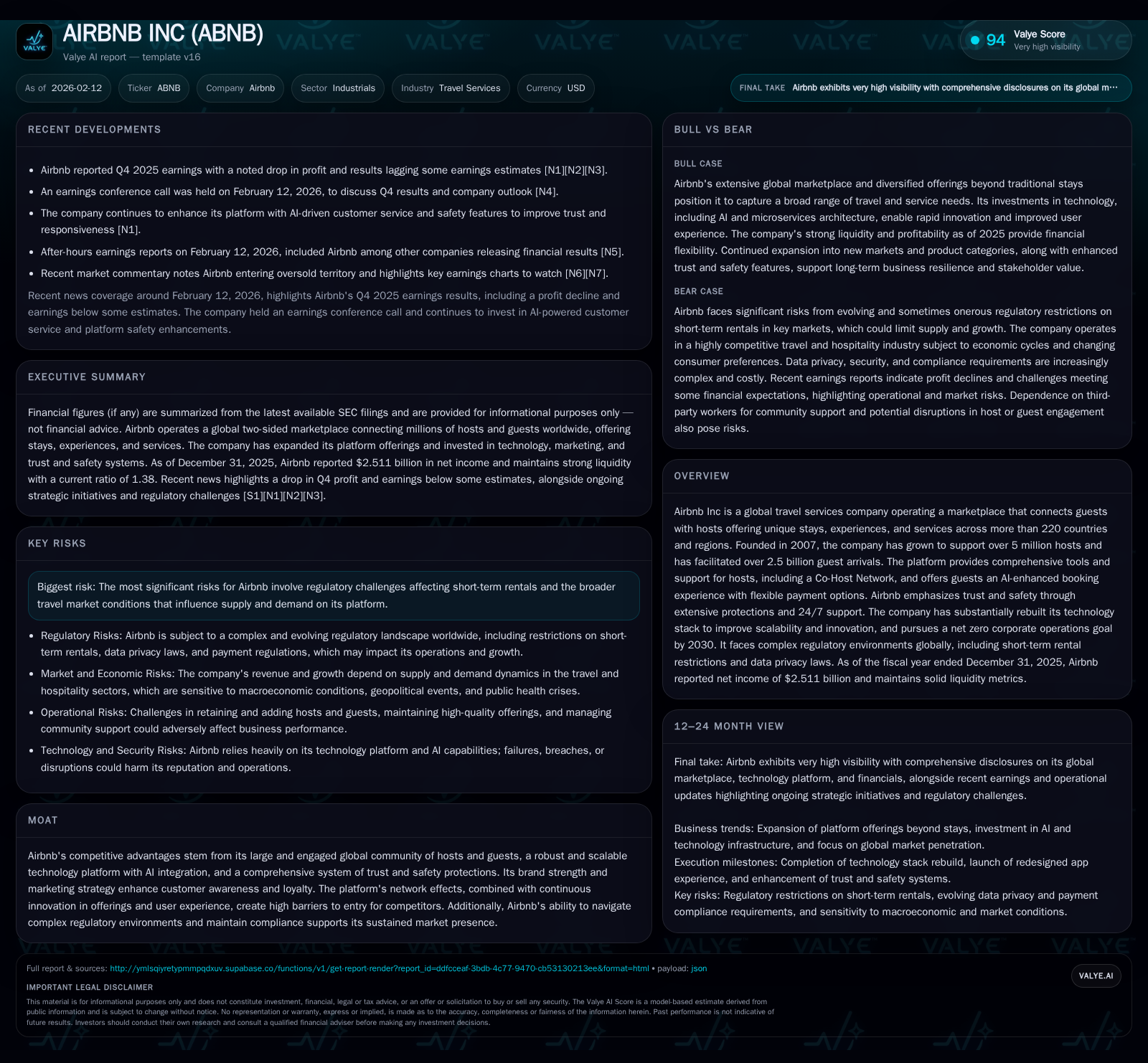
Founded in 2007, Airbnb now connects millions of hosts and billions of guest arrivals worldwide, expanding offerings beyond stays into services and experiences. Despite experiencing a Q4 2025 profit decline amid volatile market conditions, the company’s robust technology upgrades and community-centric platform continue to fuel engagement. Regulatory complexities and host quality management present ongoing risks, but strategic focus on trust infrastructure, AI innovation, and sustainability positions Airbnb for long-term growth. Q4 results reveal resilience underscored by strong liquidity and an ambitious roadmap targeting broader geographic reach and diversified revenue streams.
From Guesthouse to Global Marketplace: Airbnb’s Evolution in Travel Services
Airbnb’s origins evoke the quintessential startup tale: two hosts welcoming three guests into a modest San Francisco apartment in 2007. Since then, it has metamorphosed into a sprawling global community hosting over 5 million listings that have accommodated more than 2.5 billion guest arrivals across over 220 countries and regions [S1]. This trajectory reflects not just scale but strategic broadening — moving from simple home-sharing towards an ecosystem that includes experiences, services, and more recently redesigned offerings launched in May 2025.
The company’s narrative illustrates how Airbnb carved out a distinct identity beyond traditional hospitality paradigms. It leverages the authentic connection between hosts and travelers who seek deeper community immersion rather than generic hotel rooms. This ethos anchors its expansive marketplace where unique stays coexist with curated experiences—an evolution propelled by technology upgrades and deliberate brand positioning.
The Q4 2025 Earnings Beatdown: Reading Between the Lines
Airbnb's Q4 2025 earnings painted a nuanced picture. While the company reported a net income of approximately $2.51 billion for the full fiscal year [F1], headline quarterly results showed profit contraction alongside mixed revenue signals [N14]. The decline in profitability partly stems from elevated investment costs tied to innovation efforts, geopolitical tensions affecting travel patterns, and inflationary pressures impacting consumer budgets.
However, beneath these surface-level setbacks lie sustained engagement metrics: active hosts remained stable while guest bookings preserved momentum [N1][N2]. Revenue growth in diversified segments like experiences revealed early traction despite competitive pressure. Management’s discourse during earnings calls underscored cautious optimism—acknowledging challenges but framing ongoing investments in technology and market expansion as foundations for medium-term upside [N1]. Thus, Q4 serves less as a defeat and more as an inflection point reflecting both macro volatility and the cost of transformative growth.
Breathing Life into Growth: Hosts, Guests, and the Community Engine
At Airbnb’s core is its dual-sided platform dependent on vibrant host participation matched with active guest demand [S1]. In this delicate symbiosis, hosts must continuously offer compelling listings bolstered by competitive pricing and quality standards—factors largely outside Airbnb’s direct control but essential for revenue generation.
To address these complexities, Airbnb has fortified its host support systems through tools such as the Co-Host Network. This innovation connects new or less experienced hosts with seasoned co-hosts who assist with operational tasks from listing management to guest communication. The updated cancellation policies and enhanced pricing recommendations rolled out in 2025 further empower hosts to optimize income streams.
For guests, platform enhancements including flexible payment options (e.g., Reserve Now, Pay Later) and personalized AI-driven search filters augment choice breadth while maintaining booking confidence. Yet risks persist around host variability—if supply quality falters or exclusivity shifts toward competitors happen at scale, it could destabilize platform appeal [S1]. Continuous investments in community support infrastructure remain vital to sustaining this critical network effect.
Innovation with AI and the Power of Technology Ecosystem Rebuild
One of the most striking aspects of Airbnb’s recent evolution is its comprehensive technology stack overhaul geared toward scalability and future innovation [S1]. Central to this revamp is artificial intelligence strategically embedded to enhance both guest experience and operational efficiency.
AI powers personalized booking recommendations tailored to individual preferences gleaned from behavioral data while integrated social features improve communal engagement among co-travelers or event attendees. On the backend, AI-driven customer support functions have been introduced selectively across countries to augment responsiveness without ballooning human resource costs.
This dual application underscores how technology is no longer merely an enabler but a differentiator shaping user interaction dynamics. That said, these advances carry risks inherent in rapid tech adoption—including potential legal issues related to AI outputs plus execution complexity—that Airbnb openly acknowledges [S1]. Nonetheless, successfully managing this digital transition could cement its competitive moat by delivering seamless yet rich user experiences not easily replicated by legacy travel incumbents.
Navigating Regulatory Labyrinths: Short-Term Rental Risks and Responses
Operating as an intermediary for short-term rentals inherently exposes Airbnb to multifaceted regulatory risks spanning jurisdictional boundaries—often with conflicting laws governing rental durations, taxation rules, licensing requirements, and data privacy [S1]. These regulatory obstacles represent some of the most pronounced operational challenges confronting Airbnb globally.
Strategies to navigate this labyrinth include proactive compliance initiatives tailored regionally coupled with efforts to shape policy conversations through advocacy groups. The company emphasizes adherence to evolving rules aimed at balancing community impacts like neighborhood disruption against tourism benefits.
Parallel efforts focus on technological solutions such as automated local rule detection within listings that flag regulatory noncompliance before bookings can finalize—a tactical layer that supports supply-side risk control.
Yet regulation remains fluid; any abrupt tightening or enforcement escalation could constrict supply or impose costly remediation requirements influencing Airbnb’s market positioning [S1]. Accordingly, regulatory risk is embedded structurally into business planning though mitigated actively via compliance frameworks.
Trust, Safety, and Reputation: Airbnb’s Intangible Moat
Trust forms the bedrock on which Airbnb’s global community thrives—a complex system encompassing reviews, AirCover host protections against damages or cancellations, nondiscrimination policies ensuring equitable platform access, secure payment processing pipelines, plus round-the-clock customer service [S1].
This robust infrastructure exemplifies an intangible yet formidable moat shielding the company from newcomers who might struggle replicating such comprehensive ecosystem safeguards at scale.
Moreover, reputation management transcends mere operational safety; it directly correlates with brand equity influencing both guest willingness to book and host enthusiasm to list properties. Negative publicity events—whether linked to safety incidents or equity challenges—could swiftly erode hard-earned goodwill given media amplification effects [S1]. Consequently, sustained investments in proactive risk monitoring alongside swift responsive action underpin brand resilience amidst sector scrutiny.
Expanding Horizons: Experiences, Services, and Beyond Stays
Reflecting broader ambitions beyond conventional lodging markets is Airbnb's rollout of redesigned experiences alongside service offerings initiated mid-2025 [S1]. These encompass curated activities powered by local specialists designed to enhance traveler immersion—ranging from culinary tours to wellness retreats—and complementary services facilitating convenience or bespoke requests.
Strategically this diversification aligns with capturing increasing traveler desires for authentic place-based interactions rather than mere accommodation transactions. It also introduces incremental revenue channels less prone to commoditization than nightly rentals alone.
This product expansion demands further operational sophistication balancing broad geographic coverage with regulatory adherence while maintaining immersive quality—a multi-year roadmap explicitly aiming at fortifying market share through layered differentiation [S1].
Financial Fortitude Amidst Industry Challenges: Balance Sheet & Profitability Insights
Despite Q4 pressures reflected in profit dips detailed above [N14], Airbnb’s financial structure exhibits solid fundamentals as of December 31, 2025: cash & equivalents stood near $6.56 billion supporting liquidity buffers essential for strategic flexibility [F1]. The current ratio approximates 1.38 (current assets $18.8B versus liabilities $13.6B), signaling comfort in meeting near-term obligations without distress.
Yet margin compression nuances require attention — increased expenditures toward innovation ecosystems plus regulatory compliance elevate operating costs partly offsetting top-line growth gains. Hence profitability trajectory hinges sensitively on successful monetization of expanded offerings vis-à-vis cost discipline measures.
Overall financial health provides a sturdy platform from which capital investments can proceed prudently while preserving balance sheet integrity amid cyclical travel demand uncertainties common across industrial peers.
Looking Forward: Strategic Priorities Anchored on Diversity and Sustainability
Future-facing strategy outlined in recent filings underscores ambitions well beyond incremental growth—they chart deliberate pathways emphasizing inclusivity across employees, global communities served by hosts/guests; geographic penetration into less mature markets via localized product iterations; robust stewardship toward environmental sustainability targeting net zero operations by 2030 [S1].
This holistic framework manifests through commitments enhancing platform accessibility along demographic lines while integrating responsible tourism practices mitigating ecological footprints associated with travel activity.
Concurrently leveraging artificial intelligence promises continual personalized experience refinements together with operational efficiencies anchoring long-term scalable model viability amidst an increasingly fragmented travel landscape.
Collectively these priorities signal balanced stakeholder alignment positioning Airbnb not just as travel intermediary but as enterprise committed to responsible innovation within evolving marketplace dynamics.
This analysis synthesizes publicly available information up through early 2026 without speculative projections or investment advice. While grounded in company filings and recent reporting highlights credible insights into Airbnb's strategy and performance context are offered; readers should consider supplemental sources when forming views about future developments.
Disclaimer: This is research-only, informational analysis and not investment advice. It may include AI-generated interpretation and general industry context. Always verify important details using primary sources.

Comments