
ABVC BioPharma Confronts Acute Liquidity Constraints While Progressing Diverse Clinical Pipeline
The company faces operational funding challenges during a critical clinical-stage product development phase.
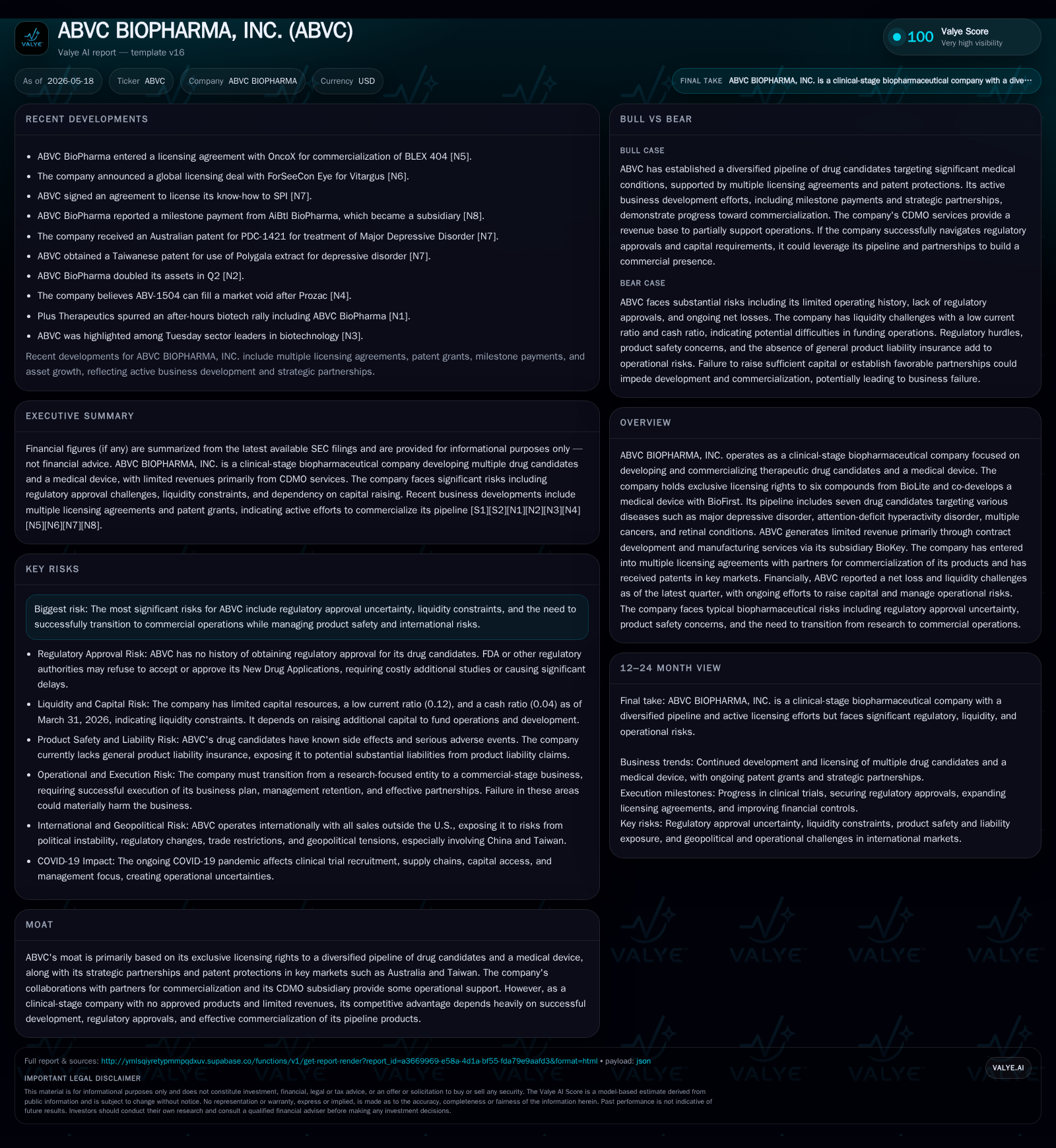
ABVC BioPharma remains a clinical-stage biopharmaceutical entity primarily advancing seven drug candidates and one medical device licensed from BioLite, focusing on CNS, oncology, and retinal conditions. The latest quarter reflects continuing revenue limitations mainly from contract manufacturing services through its BioKey subsidiary. Despite strategic partnerships in Asia and patent protections, the company confronts liquidity pressure highlighted by a severely impaired current ratio and net losses. Regulatory approval uncertainties and the need to secure additional capital underscore significant risks as ABVC strives for successful pipeline commercialization and broader market entry.
Recent Operating Update
In its latest quarterly filing dated May 18, 2026 (Form 10-Q) [S2], ABVC BioPharma disclosed continued revenue limitations alongside significant liquidity challenges. The company maintains a cash balance of approximately $140K and current assets of $649K against current liabilities surpassing $5.39 million, resulting in a precarious current ratio of just 0.12 [F1]. Operating losses persist with no substantive revenue inflection from the clinical portfolio yet. This acute cash constraint underscores the urgency around securing additional financing to maintain operations and advance clinical programs.
No new product approvals or commercial launches were reported this quarter; revenues were primarily derived through contract development and manufacturing services rendered by its wholly owned CDMO subsidiary BioKey. The filing notes ongoing efforts to raise capital amid volatile market conditions impacted by macroeconomic factors including COVID-19 pandemic disruptions [S2][S23].
Business Model
ABVC operates as a clinical-stage biopharmaceutical firm that has acquired exclusive licensing rights to six drug candidates from BioLite, complemented by co-development rights on a medical device with BioFirst. These pipeline products target varied therapeutic areas: central nervous system disorders such as major depressive disorder (MDD) and attention-deficit hyperactivity disorder (ADHD), several oncology indications including triple negative breast cancer (TNBC), non-small cell lung cancer (NSCLC), pancreatic cancer, myelodysplastic syndromes (MDS), depression in cancer settings, as well as retinal diseases like retinal detachment and vitreous hemorrhage [S1][S11].
Revenue generation at present is largely symbolic: limited license fee payments intertwined with contractual restrictions have contributed minimally to top-line inflows. Most licensing revenue recognized previously was reversed upon reassessment per ASC 606 revenue recognition rules due to related-party transaction complexities involving BioFirst and investee companies [S9]. Thus, commercial revenues are negligible while research & development expenditure dominates cash outflows.
The company’s subsidiary BioKey provides contract development and manufacturing organization (CDMO) services within cGMP-certified facilities primarily aimed at supporting internal pipeline advances alongside third-party client projects. However, these operations remain small-scale relative to industry-leading peers.
Strategic partnerships play a pivotal role: collaborations with Asian entities such as BioHopeKing facilitate joint development/commercialization in select markets (e.g., Asia excluding Japan). Yet none of ABVC’s drug candidates has been fully licensed out globally; efforts continue to identify co-developers in the U.S. and other territories [S11][S23]. This phased licensing approach aligns with ABVC’s limited capacity for direct commercialization.
Industry Structure and Competitive Position
ABVC occupies the clinical-stage niche within biotechnology focused on neuropsychiatric disorders, oncology subtypes, hematology, autoimmune segments, plus ophthalmologic interventions via its medical device. This segment is distinctly competitive comprising biotech startups launching innovative molecular entities alongside established pharmaceutical companies wielding broad portfolios and market reach.
Without any FDA-approved drugs or medical devices to date, ABVC’s competitive moat hinges largely on:
- Exclusive licenses to novel drug candidates;
- Patent protections obtained in key jurisdictions like Australia and Taiwan;
- Early strategic partnerships providing partial access into Asian markets;
- Proprietary manufacturing capabilities through BioKey enhancing operational control over product supply chain aspects.
However, these strengths are counterbalanced by several industry realities:
- Extensive R&D timelines coupled with regulatory uncertainty leave product commercialization horizons distant;
- Substantial competition from better-funded entities able to accelerate development or out-license effectively;
- Challenges securing favorable partnership terms given the unproven nature of pipeline assets;
- Risks of patent infringement litigation or inadequate protection outside designated territories [S14][S27]
Growth Drivers
Growth prospects for ABVC remain tethered fundamentally to progression along the clinical development continuum towards regulatory approvals followed by successful commercialization:
- Clinical Trial Milestones: Completion of Phase II/III trials for lead compounds such as ABV-1504 (MDD) or ABV-1505 (ADHD) could materially enhance licensing opportunities or direct sales potential.
- Partnership Expansion: Securing collaborators in major markets — particularly the U.S., Mainland China, Japan — is critical to amplify resource access for continued trials and marketing infrastructure.
- Regulatory Approvals: Obtaining NDA clearance for key drug candidates or FDA clearance for the Vitargus medical device would unlock significant value streams via licensing milestones and royalty revenues.
- Manufacturing Scale-up: Expanding CDMO activities not only supports internal supply but can generate incremental revenue outside core R&D spending.
- Patent Filings: Strengthening intellectual property breadth globally will mitigate competitor encroachment risks.
These drivers depend heavily on successfully navigating stringent regulatory pathways under current good manufacturing practices (cGMP), stringent clinical data requirements amid pandemic-related patient recruitment constraints, and evolving commercial landscapes for CNS disorders and oncology therapeutics.
Risks / Watchpoints / Growth Constraints
Several material risks temper ABVC’s growth narrative:
- Liquidity Shortfalls: With cash reserves running thin ($140K) against imminent liabilities exceeding $5 million, the company faces an existential threat unless it secures capital imminently [F1].[S2].[S10]
- Regulatory Uncertainty: No prior FDA approval experience heightens risk that planned NDAs may be rejected or require costly supplemental studies delaying market entry [S10].[S27].
- Clinical Program Interruptions: COVID-19 related disruptions continue affecting trial site access, patient enrollment rates, and supply chains which could delay milestones [S1].[S23].
- Partner Dependence: Lack of full commercial licenses increases reliance on attracting collaborators; negotiation complexities may result in suboptimal deals or partnership failures requiring additional internal investment [S11].[S29].
- Competitive Intensity: Larger biopharma firms with superior resources pose threats via faster go-to-market strategies or product innovation outpacing ABVC’s offerings.
- Intellectual Property Limitations: Patent coverage gaps abroad can reduce exclusivity benefits exposing pipeline assets to generic entrants sooner than intended [S14].
A pronounced valuation risk emerges from these uncertainties combined with public-market volatility noted for thinly traded stocks similar to ABVC.[S28]
What To Watch Next
Key near-term execution points include:
- Progress updates on Phase II/III clinical trials expected later this year that can validate efficacy/safety data;
- Announcements regarding new strategic collaboration agreements especially in U.S. or Japanese territories;
- Capital raising initiatives delineating sources, amounts raised, use of proceeds;
- Patent grant developments extending protection scope outside Asia;
- Regulatory filings submitted or accepted by FDA/foreign agencies;
- Quarterly financial reports confirming burn rate trajectories relative to cash runway.
These milestones will serve as tangible indicators of operational momentum or systemic constraints impeding advancement.
Financial Profile Summary
As of March 31, 2026, ABVC's financial condition reveals substantial strain: cash & equivalents stand at approximately $140K against current liabilities exceeding $5.39 million leading to an acute working capital deficit evidenced by a current ratio near 0.12 [F1]. Total debt figures previously reported (~$450K) do not materially ease liquidity constraints given the mismatch between payables due timelines vs available funds [F1]. Operating losses recorded at over $7 million for FY2025 underscore persistent negative cash flow requiring capital inflows for sustainability [F1].
Despite these challenges, the company's modest revenues (~$510K reported end 2024) come almost exclusively from contract services rather than drug sales reflecting pipeline immaturity at present stages [F1]. Continued dependency upon external financing heightens going concern considerations until significant regulatory or commercial breakthroughs occur.[F1][S2][S10]
This analysis is grounded solely in publicly filed documents without forward-looking judgments beyond reported evidence. It aims to provide an informed industry perspective on ABVC BioPharma's business positioning amidst evolving operational dynamics.
Disclaimer: This is research-only, informational analysis and not investment advice. It may include AI-generated interpretation and general industry context. Always verify important details using primary sources.

Comments