
ABVC BIOPHARMA: Licensing-Driven Development Meets Capital and Approval Hurdles
The company’s ability to convert intellectual property into commercial products hinges on capital raising and clinical execution.
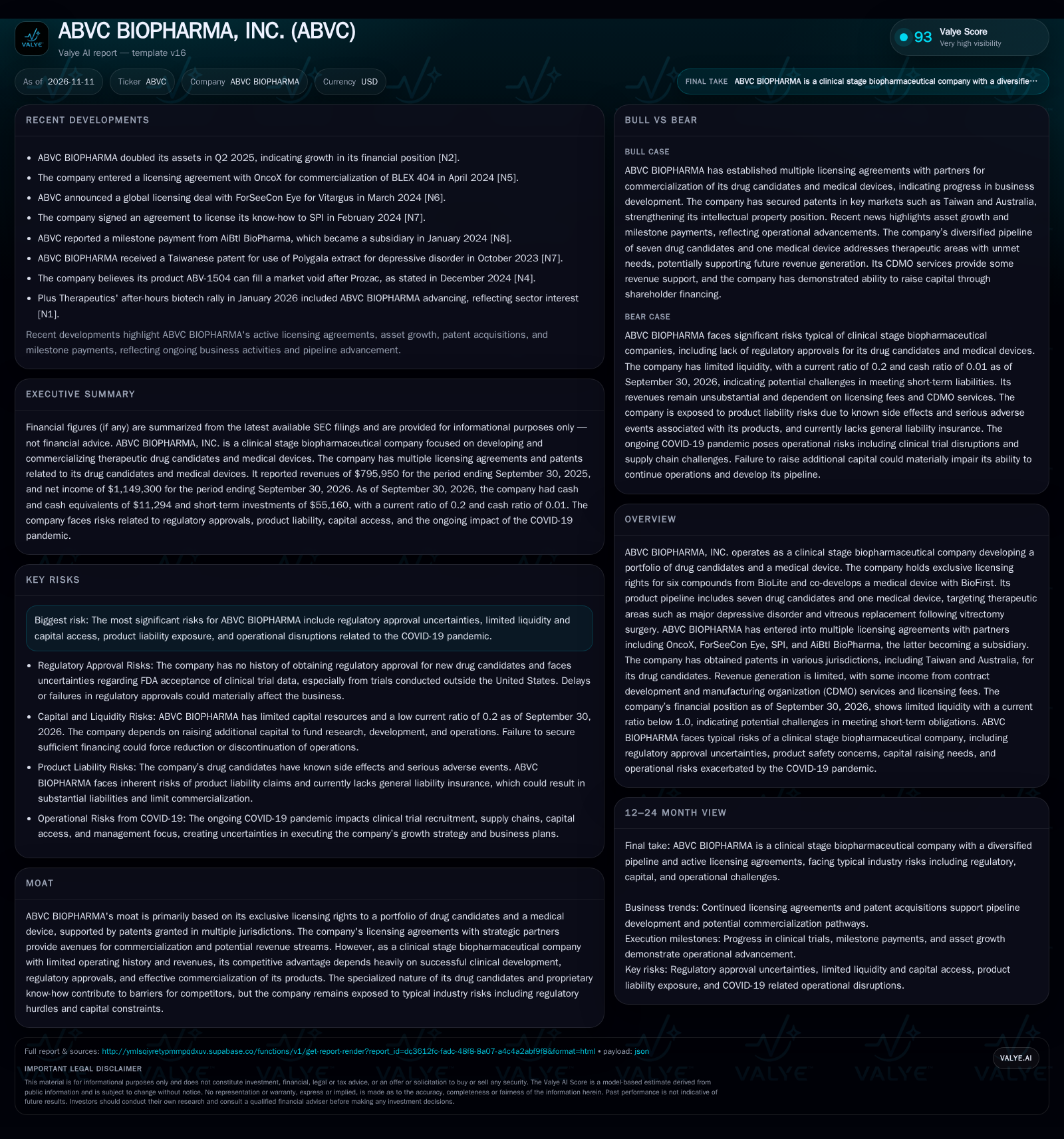
ABVC BIOPHARMA combines early-stage drug development with a licensing-driven model, supported by patents and recent asset growth. However, persistent liquidity pressures, limited revenues, and lack of product approvals put its future on a knife’s edge. Success depends on bridging the gap between pipeline milestones and the substantial costs and risks of clinical and regulatory progress.[S2]
ABVC BIOPHARMA, INC. is a clinical-stage biopharmaceutical company leveraging a licensing-heavy strategy to advance a pipeline of seven drug candidates and a medical device. The challenge for ABVC is to realize value from its intellectual property before funding gaps or regulatory setbacks stall its development ambitions.
Recent Licensing Deals and Liquidity Pressures Define ABVC’s Outlook
Several recent licensing agreements—including partnerships with OncoX for BLEX 404, ForSeeCon Eye for Vitargus, and SPI for proprietary know-how—have resulted in milestone payments and asset growth for ABVC BIOPHARMA.[N5] [N6] [N7] [N8] The acquisition of AiBtl BioPharma as a subsidiary further expands its pipeline reach. Despite these developments, as of September 30, 2026, the company reported cash and cash equivalents of $11,294, short-term investments of $55,160, current assets of $1.4 million, and current liabilities exceeding $7.1 million, yielding a current ratio of 0.2 and a cash ratio of 0.01. The company reported cash and liquidity metrics for the period; these figures do not by themselves establish operating runway, investment capacity, financial flexibility, or financing capacity. [S2] The absence of regulatory approvals for any pipeline drug or device compounds the uncertainty, as future milestone revenues remain contingent on further development and commercialization success.[S2]
Revenue Model Relies on Licensing, Milestones, and Unproven Commercialization
ABVC BIOPHARMA’s business model is structured around the development and licensing of proprietary drug candidates and medical devices. The company’s revenue to date is modest, with $795,950 reported for the period ending September 30, 2025, driven primarily by licensing fees and limited CDMO service income.[S2] This structure means the company’s financial health is highly sensitive to the timing and scale of external deals and milestone payments.
Unlike established biopharma firms that benefit from recurring product sales, ABVC is not yet generating substantial operating cash flow from commercialized products. Instead, it incurs high fixed R&D and regulatory costs, while variable costs remain relatively low until later-stage trials or commercialization. The capital intensity of drug development means operating leverage could be significant if products advance successfully, but conversely, fixed costs can quickly overwhelm the company if financing gaps persist.
The reliance on external capital—historically sourced from shareholders or loans—introduces ongoing dilution risk and potential for operational disruption if markets tighten. Without near-term approvals or substantial new licensing deals, the company faces a structural funding gap.
Intellectual Property and Licensing Bolster Pipeline, but Execution and Funding Remain Core Challenges
ABVC’s competitive approach is to acquire exclusive rights and patents for a diverse set of drug candidates and a medical device, seeking to monetize these assets through licensing agreements with commercial partners. This model can accelerate path-to-market by leveraging partner resources, regulatory know-how, and distribution reach, especially for a company with limited commercial infrastructure.
However, the clinical-stage biopharma space is intensely competitive and capital-intensive. ABVC faces competition from larger, better-funded pharmaceutical companies and other early-stage innovators, many of whom are targeting similar therapeutic areas. The company’s moat is primarily its intellectual property portfolio and exclusive access to certain compounds, but these advantages are only durable if clinical data are favorable and regulatory hurdles are cleared.
Switching costs for partners may be low, as licensing deals are often contingent on clinical milestones, and there is no established recurring revenue base. Moreover, the absence of general liability insurance and the presence of known side effects for several candidates could deter potential partners or acquirers.
Rapid Clinical Progress and Additional Licensing Catalyze Value Creation
If ABVC achieves positive clinical trial results for one or more pipeline assets—particularly in high-impact areas such as major depressive disorder or ophthalmology—this could trigger additional milestone payments from existing partners or attract new licensing deals. Regulatory progress (e.g., successful FDA or ex-US approvals) would unlock commercialization pathways and could enable upfront payments, royalties, or even co-development partnerships with larger pharmaceutical firms.
A favorable scenario would see the company leveraging its intellectual property portfolio to generate non-dilutive capital, reducing reliance on equity or debt financing. Confirmation would come from announced clinical trial results, regulatory submissions or approvals, and disclosure of new or expanded licensing agreements with substantial upfront or milestone economics.
Falsification would be evident if clinical data are inconclusive, regulatory feedback is negative, or if no new licensing deals are announced in the face of continued capital outflows.
Prolonged Development and Ongoing Capital Dependence Dominate Near-Term Trajectory
The most plausible outcome is that ABVC continues to advance its pipeline at a measured pace, with sporadic milestone revenues partially offsetting high operating costs. The company will likely remain dependent on new equity or debt financing to fund ongoing trials and overhead, given the absence of near-term commercial launches.
In this scenario, licensing deals and milestone payments provide some operational lifeline, but are insufficient to eliminate the persistent liquidity gap. The risk of dilution for existing shareholders remains high, and the company’s ability to retain talent and clinical partners may be tested if cash constraints intensify.
Confirmation would be continued announcements of licensing activity or small revenue infusions, paired with regular capital raises. Falsification would be a sudden halt in pipeline progress, missed payroll or vendor payments, or public disclosure of going concern warnings.
Liquidity Shortfall or Clinical Setbacks Force Restructuring or Wind-Down
In an adverse scenario, ABVC’s acute liquidity constraints result in missed obligations, loss of key personnel, or inability to continue clinical programs. Clinical trial failures or regulatory rejections would compound these pressures, making it difficult to attract further capital or partners.
Product liability claims—given known side effects and lack of general insurance—could lead to unanticipated cash drains or legal exposure. Persistent operational disruptions from external factors such as COVID-19 could further delay trials and exacerbate supply chain or management challenges.
Downside confirmation would be public disclosure of severe financial distress, asset sales, workforce reductions, or bankruptcy filings. Falsification of this scenario would require evidence of successful capital raises, new high-value licensing deals, or unexpected regulatory wins that materially improve the company’s liquidity outlook.
Milestones and External Conditions That Will Determine ABVC’s Trajectory
Announcement of positive clinical trial results for any of the seven drug candidates—especially ABV-1504 or ABV-1519—would be a leading indicator of value inflection.
Disclosure of new or expanded licensing agreements with substantial upfront or milestone economics would help test the company’s ability to monetize its pipeline.
Revealing the timeline and status of regulatory submissions or feedback, particularly from the FDA or major ex-US agencies, would clarify commercialization prospects.
Any public filing or statement regarding a material capital raise, bridge financing, or shareholder loan would indicate how the company intends to address its liquidity gap.
If disclosed, cash burn rate and runway estimates would allow assessment of operational sustainability between financing events.
Updates on product liability claims, insurance coverage expansion, or legal settlements would shed light on downside risk management.
Progress reports or delays in clinical enrollment, supply chain stability, or COVID-19-related disruptions would provide insight into operational execution.
Disclaimer: This is research-only, informational analysis and not investment advice. It may include AI-generated interpretation and general industry context. Always verify important details using primary sources.

Comments