
Autolus Therapeutics: Commercializing Next-Gen CAR T Amid Expansion, EU Delay, and Clinical Risk
Autolus Therapeutics has transitioned into commercial-stage operations with AUCATZYL, a differentiated CAR T therapy now available in the US and UK for relapsed/refractory B-ALL. While initial sales momentum is evident, the company’s near-term trajectory is shaped by a paused EU rollout, a pipeline targeting autoimmune expansion, persistent net losses, and the challenges of capital-intensive cell therapy manufacturing.
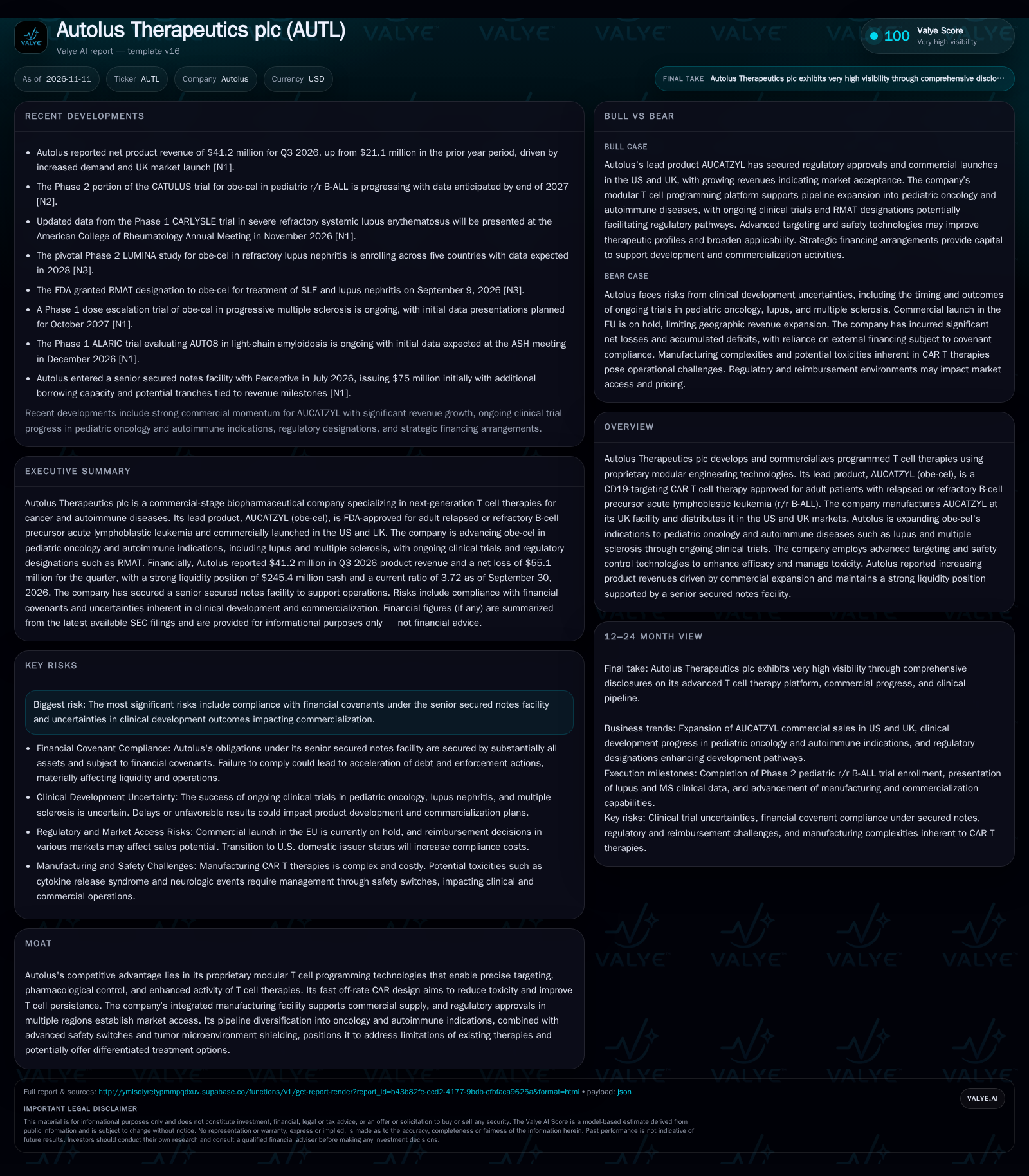
Autolus Therapeutics is selling its lead CAR T cell therapy, AUCATZYL, in the US and UK, with the EU launch on hold. Revenues are growing but the company remains unprofitable, with a $55.1 million Q3 2026 net loss and $245.4 million in cash. Pipeline and geographic expansion could drive upside, but clinical, regulatory, and capital risks remain elevated.[S2]
Autolus Therapeutics has reached a pivotal stage, transitioning from pure development to early commercial operations with its CAR T therapy AUCATZYL now available for adult r/r B-ALL patients in the US and UK. The company’s modular T cell programming promises differentiated efficacy and safety, but the business is still loss-making and faces substantial hurdles: a paused EU launch, dependence on ongoing clinical trials for pipeline expansion, and the operational demands of scaling personalized cell therapies. The next phase will test Autolus’s ability to grow revenue, control costs, and navigate regulatory and manufacturing complexity as it seeks to realize the promise of its platform.
Commercial Launches, EU Delay, and Persistent Losses Shape the Present
Autolus’s lead product, AUCATZYL (obe-cel), has secured FDA approval and launched commercially in the US in January 2025, followed by a UK launch in January 2026 after conditional authorization.[S2] However, despite European Commission marketing approval in July 2025, the EU commercial rollout is on hold, with no sales expected in 2026.[S2] This restricts near-term revenue growth to the US and UK markets, stalling anticipated geographic expansion.
Financially, Autolus reported a net loss of $55.1 million for Q3 2026 and an accumulated deficit exceeding $1.5 billion as of September 30, 2026. The company reported a current ratio of 3.72 for the period. [S2]
Commercial manufacturing for AUCATZYL is centralized at the 'Nucleus' facility in Stevenage, UK, supporting both US and UK supply. Distribution in the US leverages Cardinal Health as an agent, with revenue recognized upon patient dosing at authorized treatment centers.[S2]
Unit Economics and Scaling Challenges in Personalized Cell Therapy
Autolus’s revenue model is built around high-value, low-volume sales typical of autologous CAR T therapies. Each AUCATZYL treatment is a bespoke product, manufactured for individual patients, which drives high per-patient pricing but also significant variable costs due to complex logistics, quality controls, and regulatory requirements.
The company’s modular engineering—such as fast off-rate CARs and safety switches—may support premium pricing if efficacy and safety advantages are clinically validated. However, manufacturing costs remain elevated in the absence of large-scale automation, and fixed costs (facility, R&D, compliance) are substantial.
Operating leverage could improve if Autolus succeeds in expanding AUCATZYL to larger indications (e.g., pediatric B-ALL, autoimmune diseases) or increases manufacturing throughput. Nonetheless, the capital required to scale and the need for continued investment in pipeline development and regulatory submissions suggest that break-even is not imminent.
Autolus’s dependence on a senior secured notes facility for liquidity introduces additional fixed obligations and financial covenants, making cash management and debt compliance critical for future operations.[S2]
Modular CAR T Platform and Safety Controls as Differentiators—But Competition Remains Fierce
Autolus’s proprietary technology—modular T cell programming, fast off-rate CARs, dual-targeting, and advanced safety switches—could set its platform apart by reducing toxicity and enhancing persistence. These features are especially relevant in competitive indications like B-ALL, where existing CD19 CAR Ts (from larger biopharma players) are already established.
The company’s integrated manufacturing facility and regulatory approvals in two major markets provide a foundation for commercial credibility. However, the CAR T landscape is crowded, with competitors ranging from global pharmaceutical companies to newer entrants developing allogeneic (off-the-shelf) or next-generation autologous approaches.
Substitution risk is heightened by ongoing innovation in cell therapy, including allogeneic platforms that could eventually offer lower costs and faster turnaround. Reimbursement pressures and payer scrutiny on new entrants also create hurdles to both initial uptake and sustained pricing power.
Autolus’s ability to move into autoimmune indications could offer a less crowded playing field and larger patient populations, but clinical proof of concept and regulatory clarity remain to be established.
Broadened Indications and EU Entry Unlock Revenue Acceleration
The most favorable scenario for Autolus is one where AUCATZYL sales ramp up in the US and UK, EU commercial rollout resumes, and ongoing clinical trials in pediatric B-ALL and autoimmune diseases demonstrate positive outcomes. This would expand the addressable patient population and enable Autolus to leverage its manufacturing base more efficiently.
Evidence supporting this scenario would include: a resolution of EU commercial delays, continued double-digit sequential growth in AUCATZYL sales, positive pivotal trial data in new oncology and autoimmune indications, and regulatory approvals for additional uses.
A material improvement in gross margin—driven by higher volumes and manufacturing scale—would further support operating leverage. If disclosed, strong patient demand, expanded treatment center adoption, and favorable reimbursement decisions in new geographies would be confirming signals.
Falsification would come from persistent EU regulatory barriers, weak uptake in new indications, or safety/efficacy setbacks in pivotal trials.
Incremental Growth in Core Markets Amid Pipeline and Regulatory Uncertainty
The most plausible medium-term outcome is a gradual ramp in US and UK AUCATZYL sales, with the EU launch remaining delayed through most or all of 2026. Revenue growth tracks adoption at additional treatment centers and incremental market penetration in adult r/r B-ALL.
Pipeline progress is mixed: some clinical trials advance (possibly with early signals in pediatric or autoimmune studies), but timelines for approval and launch in new indications remain extended, reflecting inherent clinical risk.
Compliance with debt covenants remains a focus, and any tightening in external funding markets could constrain flexibility.[S2]
This scenario is confirmed by stable or moderately rising quarterly sales, ongoing net losses, continued R&D spend, and updates indicating slow but steady progress on pipeline milestones. Falsification would occur if AUCATZYL demand plateaus or declines, or if regulatory or reimbursement setbacks further restrict market access.
Clinical, Regulatory, or Operational Setbacks Erode Momentum and Liquidity
A negative chain of events could unfold if AUCATZYL encounters safety issues or competitive pressures that limit adoption, or if pivotal trials in expansion indications fail to demonstrate sufficient efficacy or safety, stalling pipeline progress.
Persistently delayed or unsuccessful EU commercialization would further limit revenue growth and strain the company’s ability to approach operating scale. If manufacturing or supply chain disruptions occur—given the complexity of autologous cell therapy—Autolus could face both reputational and financial setbacks.
On the financial side, continued high net losses and potential noncompliance with debt covenants could trigger adverse actions from creditors, severely restricting liquidity and forcing cutbacks in R&D or commercial operations.[S2]
This scenario is confirmed by flat or declining product revenues, negative trial readouts, regulatory setbacks, and warnings or actions related to debt compliance. Falsification would require robust sales momentum, successful clinical milestones, and evidence of sustained potential financial flexibility.
Milestones That Will Test Autolus’s Commercial and Clinical Trajectory
Quarterly AUCATZYL sales volumes and revenue growth in the US and UK, including trends in new treatment center adoption, will clarify commercial trajectory.
Any formal announcement or update on the timing and terms of the EU commercial launch; a useful metric would be the number of EU centers poised for onboarding if disclosed.
Readouts from pivotal clinical trials in pediatric B-ALL and autoimmune indications (lupus, MS), as well as regulatory feedback, will be decisive for pipeline value.
Gross margin trends and cost-per-patient metrics, if provided, would test progress toward improved manufacturing efficiency and operating leverage.
Safety and toxicity data from both commercial and clinical settings, especially incidence of cytokine release syndrome and neurologic events.
Progress in expanding the company’s manufacturing capacity or efficiency at the Nucleus facility, including automation or process improvements, if disclosed.
Payer coverage decisions and reimbursement rates in new and existing markets, which will affect both pricing power and access.
Disclaimer: This is research-only, informational analysis and not investment advice. It may include AI-generated interpretation and general industry context. Always verify important details using primary sources.

Comments